

Fossil fuel subsidies after 2025: missed deadlines and new coalitions

The G7 failed to honour its pledge made 10 years ago to end fossil fuel subsidies by 2025. Energy crises have pushed governments back towards price caps and subsidies, but the Coalition of Phasing out Fossil Fuel Incentives including Subsidies (COFFIS) offers a way forward. Giorgia Monsignori explores the facts behind this missed deadline and how reform can support energy security.
Russia’s invasion of Ukraine in 2022 triggered a global energy crisis and fossil fuel subsidies climbed in reaction. Four years later, as the Iran war disrupts oil flows through the Strait of Hormuz, governments are reaching for the same tools: price caps and subsidies. But this reflex has been brought into action just as the G7 was meant to be phasing out inefficient fossil fuel subsidies to honour its 2016 pledge, following an earlier, 2009, pledge from the G20. So, if joint statements are largely ignored, what mechanisms can hold governments to account? New international developments may build momentum and structure.
Subsidies distort price signals, keep emissions high and undermine security
Fossil fuel subsidies come in two forms. ‘Explicit’ subsidies keep fuel prices below the supply costs through caps or transfers. ‘Implicit’ subsidies arise when market prices omit externalities such as air pollution and climate damage and shrink when governments price emissions through carbon pricing. Explicit subsidies totalled US$725 billion globally in 2024 and implicit subsidies US$6.7 trillion.
Both types distort price signals and encourage continued fossil fuel use. They also contradict the Paris Agreement’s commitment to align financial flows with climate goals (Article 2.1.c) because they misallocate public money, entrench carbon-intensive energy use and support assets that could become stranded. Removing them is a core part of the low-carbon transition and works alongside other climate policies.
Fossil fuel subsidies can also undermine energy security mandates. Although they may ease the cost of energy in the near term, they contribute little to the stable energy systems that long-term security depends on. In fact, subsidies weaken energy security in several distinct ways. For example, they may slow diversification, which can improve energy availability, and weaken the incentive to cut reliance on imported fuels. Redirecting public funds towards renewables, grids and targeted support for vulnerable households has the potential to do far more to improve a country’s energy security.
The IMF estimates that removing explicit subsidies could cut global emissions by 6% by 2035 and raise GDP by 0.6%. Reform is difficult because subsidies shield vulnerable groups and sectors, which raises the priority of ensuring a just transition through targeted compensation. Fossil fuel subsidies are costly, and the money could instead fund health, education, clean energy or debt servicing.
Slow progress against a backdrop of missed deadlines and backtracking
Although subsidies declined somewhat from 2015 to 2020, almost a decade after the G7 leaders’ commitment in 2016, little progress has been made (see Figure 1). Across most of the world, spending on subsidies almost doubled in 2021 as governments strove to soften the impact of rising energy prices when economies rebounded. It peaked in 2022 during the energy crisis, then fell as prices eased. That decline points to the unwinding of emergency measures rather than structural reform of fossil fuel subsidies. Subsidy levels in 2024 remained similar to those in 2015, erasing any of the progress made before 2020.

Fossil fuel subsidy reform is losing political ground as energy and national security take priority. Most developing country governments are raising subsidies to cushion their populations from energy price shocks. Post 2024 the G7 Communiqué dropped its long-repeated fossil fuel phaseout pledge in favour of energy and geopolitical risk. The G20 has also failed to restate its pledge.
Our research at the TPI Centre has identified the same retreat. Among other areas of climate policy, our Assessing Sovereign Climate-related Opportunities and Risks (ASCOR) tool tracks whether countries have set fossil fuel phaseout deadlines and published associated subsidy inventories. In our latest report, we find that only five of the 71 countries assessed have an active phaseout deadline: Austria, Lithuania, Latvia, Portugal and Slovenia. Meanwhile, Canada, Germany and Italy, which had set 2025 deadlines linked to the G7 pledge, no longer qualify as the deadline passed without a replacement and subsidies continue.
Beyond joint statements: new mechanisms and the lead taken by COFFIS
Inconsistent standards and weak accountability make progress on national phase-out commitments hard to track. The G20 pledge lacked transparency mechanisms, deadlines and roadmaps, which may partly explain its limited success.
Recent developments offer an opportunity for more structured progress. The Coalition on Phasing Out Fossil Fuel Incentives Including Subsidies (COFFIS), launched at COP28 with 12 countries, now has 17 members. Members commit to publishing a subsidy inventory within a year of joining and a phaseout plan within two, and are making progress on both (see Figure 2). The UK, for example, has now published an inventory. COFFIS also tracks reforms such as the Netherlands six, detailing each subsidy’s type, timelines and size.
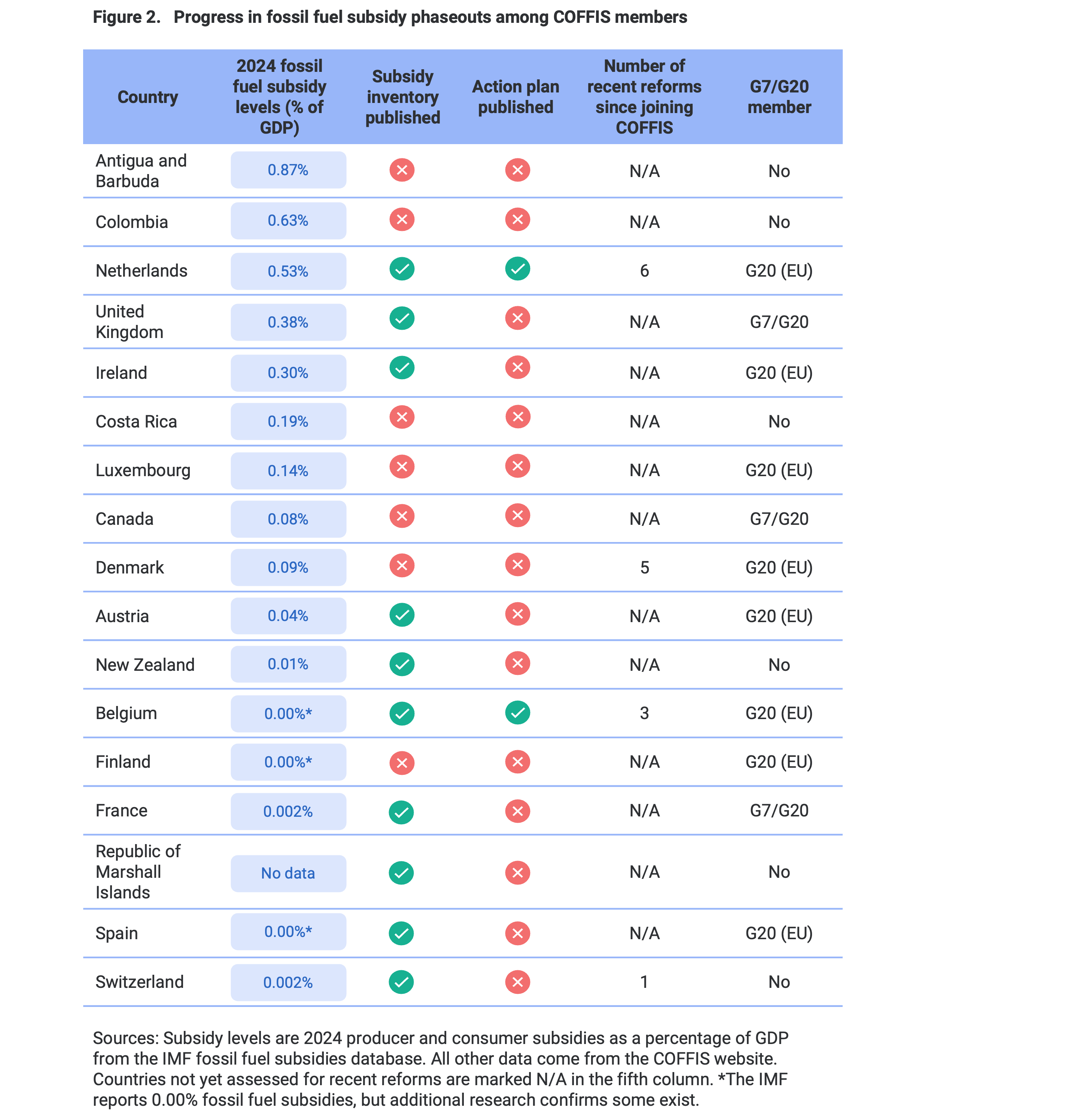
Compared with previous joint international pledges on fossil fuel subsidies, COFFIS’s structure shows promise in driving meaningful progress:
- Milestones create early accountability. Unlike the G7’s single target, COFFIS members face checkpoints one and two years after joining.
- Standardised inventories prevent redefinition. Common standards make data comparable across countries.
- Public tracking enables peer pressure and civil society scrutiny. Inventories are published on the COFFIS website.
- ‘Coalitions of the willing’ can raise ambition. Voluntary members are more likely to deliver and can share lessons learned with non-member countries.
Accelerating fossil fuel subsidy phaseouts
International developments suggest new momentum. In July 2025, the International Court of Justice advised that failing to act on climate change, including through fossil fuel subsidies, may be an internationally wrongful act. In April 2026, 57 countries at the Summit on Transitioning Away from Fossil Fuels agreed to develop national phaseout roadmaps and new tools to tackle harmful subsidies.
The 2026 energy crisis showed how quickly governments turn to emergency support when prices spike. Transparency is a precondition for accountability, but inventories alone do not redirect money still supporting fossil fuels. The G7 and G20 pledges show what happens to commitments without dedicated accountability mechanisms. COFFIS is the first serious attempt to build one and its test will be whether members phase out their subsidies.
Subsidy reform could be part of building long-term energy security. Shifting public finance to renewables, grids and targeted support would strengthen domestic infrastructure and energy diversity. The next price shock would then make domestic renewables more attractive than costly imported fuels, rather than prompting renewed subsidies.
The author would like to thank Simon Dietz and Antonina Scheer for their helpful reviews of this commentary.
This commentary draws on research conducted by the Grantham Research Institute’s sister centre, the TPI Centre as part of the ASCOR project. The TPI Centre developed the ASCOR framework and methodology and conducts annual assessments of countries. National commitments to phase out fossil fuel subsidies are one aspect of countries’ climate action tracked by ASCOR. The assessment data for 85 countries are publicly available on the online ASCOR tool.