

Master of Public Administration

The Master of Public Administration (MPA) is an in-depth two-year degree programme designed to equip early-stage professionals with the core analytical skills, practical tools and professional experience to confidently address real-world policy challenges.
The programme combines methodological discipline and practical application, giving students the opportunity to develop foundation skills in empirical methods, political science and economic analysis throughout their first year of study. Students will then apply their skills to real-world scenarios in their second year through completion of a six-month Capstone Project with an external client.
Graduates will be equipped with the analytical and professional skills to effectively understand and address the challenges of contemporary governance and make an immediate impact for employers in public, private and non-profit organisations around the world.
Key features:
- Academic core skills (Year 1)- rigorous empirical training, particularly in micro- and macro-economics, political science and quantitative methods of analysis.
- MPA Capstone (Year 2)- an opportunity to work on a real-world policy challenge as part of a six-month consultancy style project hosted by an external client.
- A broad curriculum- allows you to identify your key interests and strengths from core-courses and a range of option courses (electives).
- A global outlook- be a part of LSE’s international community as well as a network of prestigious policy schools around the world as part of the Global Public Policy Network (GPPN).
MPA overview
| Applications open | October 2026 |
| Application deadline | We encourage applicants to apply by our early deadline on 25 January 2027, however we accept applications on a rolling basis and will close to applications once spaces are filled. We encourage you to apply as early as possible. |
| Duration | 21 months, full time only |
| Expected intake | 70-90 |
| Minimum entry requirement | 2:1 degree or equivalent in any discipline. There is no formal requirement for previous professional work experience, but students starting the MPA normally have one year of professional experience and many have two or more years of experience. GRE/GMAT: not required English language requirements: Higher (see 'your application' section) |
| Location | LSE, London |
MPA programme
Preparation before your arrival
Prior to your arrival at LSE you will receive details about optional readings and online learning materials which are designed to help you to prepare for the programme.
MPA Welcome & Introductory Teaching (on campus)
From mid-September you will need to attend MPA Welcome events and introductory teaching sessions. These will take place before the start of LSE Autumn Term. These sessions include campus enrolment, a programme introduction, information sessions, networking opportunities, academic skills training, and compulsory introductory teaching in mathematics and statistics.
If you have not studied mathematics and statistics for some time, the MPA introductory teaching provides a challenging but accessible introduction to some of the key skills and techniques required for the degree. For other students, it serves as a refresher course.
In the first year, you will take three compulsory courses. These provide a rigorous foundation to support you in your second year.
You will also select option courses (electives) to the value of one unit from a range of options.
PP440: Micro and Macro Economics for Public Policy
You will learn macro- and micro- economic concepts, models and methods suitable for appraising policy, applicable in a wide variety of contexts. This includes the study of demand and supply, the labour market, public goods, market failure, inflation and monetary policy, fiscal policy and debt, and exchange rates.
PP478: Political Science for Public Policy
You will learn concepts and models for understanding the behaviour of political actors and why they lead to particular outcomes. This includes the study of voting, political parties, interest groups, legislative politics, corruption, democratisation and ethnic conflict. These tools are essential for designing policy interventions to achieve desired future outcomes.
PP455: Quantitative Approaches and Policy Analysis
You will learn skills for the quantitative evaluation of public policies, such as causal relationships; randomised control trials; difference-in-difference estimation; instrumental variables; regression discontinuity designs and cost-benefit analysis.
Option courses (electives) - Year one
In addition to your required core courses, you will take full unit or half-unit option courses (electives). The SPP offers a wide range of courses as options.
You can review the current 2026/27 option list here.
The key features of the second year are:
Core Course
PP425: Strategic Policymaking: Economic Analysis, Narrative Development, Political Feasibility, and Implementation which will consolidate your learning from Year One and enable you to continue to apply this throughout Year Two.
You will additionally select option courses (electives) from the School of Public Policy (or elsewhere in LSE, subject to permission and availability).
The MPA Capstone
The MPA Capstone is a compulsory one unit course. You will carry out analysis and research, as part of a team, in order to address a practical policy issue relevant to a real-life client organisation. It allows you to extend your capabilities by applying what you have learned in the MPA core courses in a professional context.
Option courses (electives)
Your remaining second year course units will be made up of option courses (electives) from a wide range available in the School of Public Policy or (with permission and subject to availability) from elsewhere in LSE.
Specialisms
In Year two, you’ll also choose one specialism from the list below. Specialisms are designed to provide a focus for your Year two curriculum, equipping you with the skills and knowledge to deliver impactful policy work.
There are six specialisms to choose from:
- Inequality, Poverty and Social Impact: covering inequality, poverty, social protection policies, and social responsibility
- Climate, Cities and the Environment: covering climate change, urban development, and the environmental impact of policies
- Global Economic Policy and Development: covering economic development, international finance, and global macro policy
- Public Finance and Economic Policy: covering public economics, macro policy and impact evaluation
- Political Economy and Public Management: covering political economy, public policy analysis, and strategic public sector management
- Technology and Data Policy: examining the governance, political dynamics, and analytical use of emerging digital technologies and data in public policy
Each specialism includes a choice of foundation and optional courses. For your chosen specialism to be added to your degree title, you must pass two units of courses attached to that specialism.
You can only choose one specialism, but you can take courses from other specialisms as option courses (electives).
Option courses (electives)
Any remaining Year two course units will be made up of option courses (electives) from a wide range of courses available in the School of Public Policy or, with permission and subject to availability, elsewhere at LSE.
For the latest list of courses, please go to the relevant School Calendar page.
A few important points you’ll need to know:
We may need to change, suspend or withdraw a course or programme of study, or change the fees due to unforeseen circumstances. We’ll always notify you as early as possible and recommend alternatives where we can.
The School isn't liable for changes to published information or for changing, suspending or withdrawing a course or programme of study, due to developments in teaching practice, regulatory requirements that require us to comply, lack of demand, financial unviability of a course, or due to circumstances beyond our control, such as the loss of a key member of staff or where a location or building becomes unavailable for use.
Places are limited on some courses and/or subject to specific entry requirements so we cannot therefore guarantee you a place.
Changes to programmes and courses may be made after you’ve accepted your offer of a place – normally due to developments in the discipline or as a consequence of student feedback. We may also make changes to course content, teaching formats or assessment methods but these are made to improve the learning experience.
For full details about the availability or content of courses and programmes, please take a look at the School’s Calendar, or contact the relevant academic department.
Some major changes to programmes/courses are posted on our updated graduate course and programme information page.
For further information on how we comply with UK consumer protection law, see your consumer rights as a student.
First year MPA students have the option to apply to complete a dual degree with one of three partner schools from the Global Public Policy Network of top policy schools:
The SPP's dual degree international partner schools and their corresponding programmes are:
- The MPP at the Hertie School, Berlin's University of Governance
- The MPP at the Lee Kuan Yew School of Public Policy (LKY), National University of Singapore
- The MPP at the Graduate School of Public Policy (GraSPP) at the University of Tokyo
The application process takes place during Year 1 and further information will be provided during the first term.
Successful applicants will spend their second year of study at one of the above partner institutions and will receive two degrees: one from LSE, and one from the partner institution at which they studied.
Find out more about the GPPN dual degree
LSE SPP also offers three double degree programmes with University of Toronto, Sciences Po and Columbia SIPA. Applicants for the double degree programmes will need to apply via the standard school admissions process. You can find out more about the double degree programmes and the application process here.
MPA students
The MPA attracts a highly diverse range of students from all over the globe. Our 2026 year one cohort represented 23 nationalities.
There is no formal work experience requirement to study the MPA, however our students have a wide range of prior experience ranging from recent graduates to 15+ years of prior professional experience. Our MPA students have an average of three and a half years' professional experience.
We welcome students from wide-ranging areas of expertise including economics, law, social sciences, political science, business and international relations.
Their combined experience encourages a mature and reflective approach to study that draws on professional skills and experience gained prior to the MPA.
This diversity is a major strength, providing many different national, economic and societal perspectives to problems and solutions of public policy.
Association of Public Policy Students (APPS)
The Association of Public Policy Students (APPS) is an elected body of SPP students that serve as a resource for the student community. Throughout the academic year, the APPS’s numerous committees and initiatives provide opportunities for students to engage with other classmates in professional and social activities.
Womxn’s Network
The School of Public Policy’s (SPP) Womxn’s Network is a student-run organisation focused on the advancement and empowerment of students within the SPP and broader LSE community who are marginalised by the intersectionalities of gender and/or sexuality. The Network aims to further encourage the inclusion of marginalised voices within policymaking through various events and forums designed to promote learning and open discussion.
Public Sphere Journal (PSJ)
The Public Sphere Journal (PSJ) is a journal of international policy studies produced by SPP students which features evidence-based research in economic policy, public management, international affairs, development studies and social policy. The PSJ offers students an opportunity to combine their unique professional and personal experiences to create a journal of international policy studies, from the initial call for papers through to the print and launch.
External networks
Turner MBA Investment Impact Network and Training (MIINT)
The Turner MBA Investment Impact Network and Training (MIINT) Competition gives students the opportunity to gain hands-on experience in impact investing by sourcing and conducting due diligence on real-world, early-stage impact investment opportunities. The MIINT is supported by LSE's Marshall Institute. Hear from our 2025 MIINT participants.
Global Public Policy Network (GPPN)
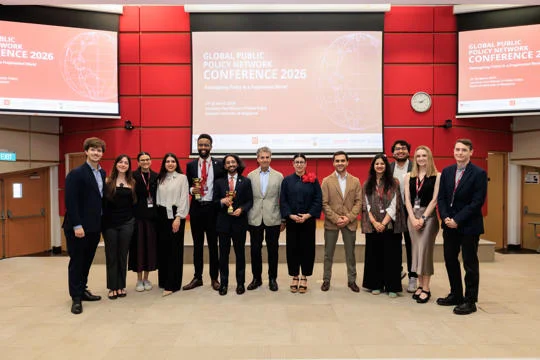
The Global Public Policy Network (GPPN) is a partnership between 7 prestigious universities in public policy. GPPN is a platform for institutional partnership, research collaboration, and student exchange. Members of the GPPN have organised an annual international conference for the students and deans from member schools to meet and discuss pressing issues of global public policy. Hear from our 2026 GPPN conference participants.
LSE student societies and activities
Your time at LSE is not just about studying, there are plenty of ways to get involved in extracurricular activities. From joining one of over 200 societies, or starting your own society, to volunteering for a local charity, or attending a public lecture by a world-leading figure, there is a lot to choose from.
Life in London
As a student at LSE you’ll be based at our central London campus. Find out what our campus and London have to offer you on academic, social and career perspective.
LSE is based on one campus in the centre of London. Despite the busy feel of the surrounding area, many of the streets around campus are pedestrianised, meaning the campus feels like a real community.
London is an exciting, vibrant and colourful city. It's also an academic city, with more than 400,000 university students. Whatever your interests or appetite you will find something to suit your palate and pocket in this truly international capital. Make the most of career opportunities and social activities, theatre, museums, music and more.
Want to find out more? Read why we think London is a fantastic student city, find out about key sights, places and experiences for new Londoners. Don't fear, London doesn't have to be super expensive: hear about London on a budget.

"I've been challenged and encouraged to think outside of my comfort zone - which is exactly what I was hoping to take away from my studies! I went into this programme wanting to know more than just the "what" of policymaking. Our studies have pushed us to consider critically assessing and evaluating data, thinking about now just what we've been given, but what is missing, and to be innovative in our thinking."
Hannah Salazar, MPA Class of 2027

"The programme is intellectually demanding but immensely rewarding. While the quantitative components can seem challenging at first, the strong academic support from faculty and collaboration with colleagues make the process easy. Beyond the coursework, it is equally important to invest time in building connections; some of the most valuable learnings come from conversations and experiences outside the classroom."
Ann Mary Philip, MPA Class of 2027
Professional development and student life at SPP
Professional development, alumni and careers
SPP Professional Skills Accelerator
Alongside your degree the School of Public Policy requires that you complete the Professional Skills Accelerator, a programme of applied sessions designed to help you to develop and refine the skills required of highly capable public policy professionals.
The sessions are delivered by outstanding trainers and educators and take place across the year, on subjects including leadership, interview skills, data visualisation, negotiation, and persuasive communication.
Students must complete 4 sessions across the first year of their programme.
As well as attendance at these sessions, you will be required to submit two short pieces of writing, which reflect on their professional experience and ability and identify areas where they would like to improve.
Details of the 2027/28 Professional Skills Accelerator are to be confirmed.
The sessions in 2026/7 are taking place during the Autumn and Winter terms at weekends, and those in the Spring Term are scheduled on weekdays in and around the exam period. The Professional Skills Accelerator will be formally launched to new students during the Welcome period.
Alumni mentorship and Q&As
Our alumni connect regularly with our students throughout their studies and share their expertise through our alumni/student mentoring scheme and our career Q&A series.
Policy in Practice (PiP) seminars
We run regular seminars through the year to connect you with policy practitioners in a range of fields, either to learn more about the work of particular organisations and sectors or to develop new skills. These seminars provide students with an opportunity to connect classroom learning to real world scenarios.
Career support
At the heart of the SPP is an emphasis on helping our students shape and enhance their future careers in policy-related fields. SPP students come to LSE from very diverse professional backgrounds, and it is our priority to support each of you as you move to the next stage of your career.
LSE Careers offers students a programme of support throughout their studies and after graduation.
In particular, students at LSE SPP have access to:
- one-to-one coaching in all aspects of career planning and professional development with the School of Public Policy's Careers Consultant
- Q&A events with SPP alumni who are working in particular sectors of interest such as international organisations and consultancy
- a weekly SPP Careers newsletter includes relevant short-term and long-term job opportunities and events
- Networking events with employers (specific for SPP students)
- Careers Impact Sessions which encourage students to consider their professional values, strengths and career goals as they navigate and manage evolving career journeys. SPP alumni contribute by sharing their experiences and insights, bringing the learning to life and creating opportunities to connect and network with alumni from across a range of related careers.
In addition SPP students benefit from LSE Careers activities and support including:
- Professionals at LSE programme designed for students and alumni with 5+ years professional experience. The programme includes events focused on employer and sector perspectives, career strategy and leadership workshops and skills focused events and panel discussions.
- access to LSE MyCareer, listing hundreds of opportunities, from short-term volunteering and internships to full-time positions for experienced professionals
- LSE Careers events throughout the year including career fairs, employer presentations, recruitment and networking events, skills seminars with employers
- specialist careers seminars run by LSE Careers, including sessions on CVs and cover letters, career management, networking, interviews and advice specific to particular employment sectors
Many leading organisations give careers presentations at the School during the year. LSE Careers has a wide range of resources available to assist students in their job search. Find out more about the support available.
Additional resources at LSE:
- LSE LIFE
- LSE Generate
Our Alumni
The SPP has an active global community of over 3,000 alumni. Our international network of alumni not only transform the world around them by designing policy to tackle some of the world’s leading problems in the top levels of government, international organisations, and NGOs – but also makes our community a vibrant and supportive one long after graduation.
As well as belonging to LSE School of Public Policy’s alumni network, SPP students will also belong to LSE’s prestigious alumni network of over 220,000 alumni across the world.
SPP alumni connect regularly with our students throughout their studies and share their expertise through our alumni/student mentoring scheme and our career Q&A series.
Alumni benefits
As part of LSE SPP’s alumni engagement programme our alumni stay connected via our regular newsletters and in-person and virtual professional development and social events throughout the year. Our annual "Alumni Symposium" offers a space for alumni to reconnect and benefit from the lifelong SPP network. Hear our alumni discuss the benefits of being able to reconnect at LSE to hear from expert panels and share their experiences at the 2025 Alumni Symposium, which focused on themes of "The New Geoeconomics: Policy making in a Fragmented World".
Alumni in action
As well as belonging to LSE School of Public Policy’s alumni network, SPP students will also belong to LSE’s prestigious alumni network of over 220,000 alumni across the world.
Hear from our MPA alumni:
Something that I picked up from the School of Public Policy which I continue using is really understanding the dynamics of international political economy. Whenever you're dealing with multiple stakeholders and with challenges which are very multi-dimensional and complex, it's important to understand the political economy and decipher the very many forces behind a decision or a situation, only then can you solve it.
Siddharth Sinha, MPA Class of 2018
Associate Vice President at Greenko Group and co-author of 'Smarter than the Storm: Championing the AI-Climate Nexus for a Truly Sustainable Future'
Rigorous coursework in econometrics, social impact, and quantitative analysis gave me the tools to begin answering the questions I had long held, and spurred my interest in leveraging impact evaluation tools in policy research.
Vyana McIntyre, MPA Class of 2018
Senior Policy Advisor at the Canadian Ministry of Economic Development, Job Creation and Trade
My mind was quite set on being a public servant at the start of the MPA, but throughout the programme, and as I met students with very different backgrounds, I came to realise the number of fascinating public policy roles that existed in the private sector.
Alexandra Belias, MPA Class of 2011
Head of Product Policy & Partnerships at Google DeepMind.
I gained the confidence to branch out into new areas, and loved doing the research for my dissertation which helped me to discover new interests and possible life paths.
Oluwagbemileke Joy Jegede, MPA Class of 2020
Ecosystems Research Lead for the Government of Sierra Leone in the Directorate of Science, Technology and Innovation
Read Oluwagbemileke Jegede profile
I am now equipped with the necessary theoretical and empirical skills to engage in rigorous analysis of public policies.
Akash Mehta, MPA Class of 2020
Environmental Analyst for the World Bank
Learn more about our alumni and how they are making an impact around the world.
Our graduates go on to pursue careers in a wide range of sectors with popular destinations including;
· Government and Politics
· Consultancy,
· Financial Services,
· NGOs & Charities,
· Data, Research & Think Tanks
· International Development and Aid
· International Finance and Trade
Our SPP graduates have gone on to roles supporting Governments around the world including, but not limited to, roles in UK, India, Australia, Canada, Indonesia, Chile, Philippines.
Other notable employers have included United Nations, European Bank for Reconstruction and Development (EBRD), Deloitte, World Bank Group, Ofgem, Civil Service, Google, Department for Education, Department for Environment, Food and Rural Affairs (UK), European Commission, Moody’s, Air Pollution Action Group, KPMG, Institute for Energy Economics and Financial Analysis (IEEFA) and Tony Blair Institute for Global Change.
Find out more about our alumni and their career journeys after graduation.
Your application
Minimum entry requirement
Upper second class honours (2:1) degree or equivalent in any discipline.
English language requirement: 'Higher' - see English language requirements
There is no requirement for prior professional experience, but students starting the MPA normally have one year of professional experience and many have two or more years of experience. We welcome students with a range of professional experiences and backgrounds.
Who we are looking for
We aim to bring together a cohort of passionate policy professionals who represent a wide range of nationalities, experiences and backgrounds, thus enriching the peer-to-peer learning experience.
We welcome applications from individuals from a range of academic disciplines and professional backgrounds who can demonstrate a passion for public policy and making a positive impact. Our students have a range of prior professional experience ranging from new graduates to those with many years of experience.
Excellent candidates will possess a strong academic record and be able to demonstrate a commitment to public service as well as a clear understanding of the MPA and how they'll benefit from the programme.
Whilst the MPA programme is designed to provide rigorous training in areas of econometrics and quantitative methods, there will be opportunities for individuals with less experience in these areas to develop or refresh their skills via online learning materials prior to the programme starting.
You can find further information in our Frequently Asked Questions
Information for international students
If you are applying to LSE from outside of the UK then take a note of the UK qualifications we require for your programme of interest and refer to our Information for International students page where you can view entry requirement by country.
Competition for places at the School is high. This means that even if you meet the minimum entry requirement, this does not guarantee you an offer of admission.
When to apply
We consider applications for admission on a rolling basis and applications close once spaces are full. We encourage all applicants to apply as early as possible by our early deadline of 25 January 2027. If you receive an offer of a place on the programme, we encourage you to aim to make your final decision and make your deposit payment by May 2027 in order to secure your place on the programme.
All applicants who want to be considered for a School of Public Policy scholarships will need to submit an application for admission by our early deadline of 25 January 2027 in order to be eligible for consideration. Please note the application deadline dates for other LSE scholarships listed under the "Scholarships, bursaries and loans" accordion below.
How your application will be assessed
We welcome applications from all suitably qualified prospective students and want to recruit students with the very best academic merit, potential and motivation, irrespective of their background.
We carefully consider each application on an individual basis, taking into account all the information presented on your application form, including your:
- academic achievement (including predicted and achieved grades)
- relevant professional experience
- statement of academic purpose
- two references (see guidance on professional and academic references)
- CV
See further information on supporting documents
You may need to provide evidence of your English language proficiency. See our English language requirements.
How to apply
LSE's 'How to apply' webpages guide you through the application process and link to the application form.
Tuition fee deposit
If you’re made an offer, we’ll ask you to pay a tuition fee deposit, normally 10 per cent of the first-year tuition fee. Paying the deposit by the specified deadline will secure your place on the programme, subject to meeting the other conditions of your offer.
Your payment deadline will usually be the earlier of six weeks after the date of your offer or 20 days before the formal start date of the programme.
Tuition fee deposits are generally non-refundable, although refunds may be available in the circumstances set out in LSE’s Tuition Fee Policy for your year of entry. Your offer letter and other correspondence from the School will also provide information about how to pay and the circumstances in which a payment deadline extension or exemption from the deposit requirement may be considered.
Fees and Funding
The table of fees shows the latest tuition fees for all programmes.
You're charged a fee for your programme. Your tuition fee covers registration and examination fees payable to the School, lectures, classes and individual supervision, lectures given at other colleges under intercollegiate arrangements and, under current arrangements, membership of the Students' Union. It doesn't cover living costs or travel or fieldwork.
Tuition fees 2027/28 for the Master of Public Administration (MPA)
Home and overseas students:
Year 1 (2027/28): £35,900
Year 2 (2028/29): £35,900
Fee status
At LSE, your tuition fees, and eligibility for any financial support, will depend on whether you’re classified as a home or overseas student (known as your fee status). We assess your fee status using The Higher education (Fee Limit Condition) (England) Regulations 2017.
Further information about fee status classification.
Fee reductions
At LSE, your tuition fees, and eligibility for any financial support, will depend on whether you’re classified as a home or overseas student (known as your fee status). We assess your fee status using The Higher education (Fee Limit Condition) (England) Regulations 2017.
Scholarships and other funding
The School recognises that the cost of living in London may be higher than in your home town or country, and we provide generous scholarships each year to home and overseas students.
LSE School of Public Policy scholarships
The School of Public Policy (SPP) offers programme and country specific scholarship awards. If you are eligible for these awards you will need to submit a complete application for admission (including references) by 25 January 2027 as well as a complete LSE Graduate Financial Support Application (GFSA) by 8 February 2027.
Find out more about SPP specific awards and how to apply.
LSE Scholarships
This programme is eligible for needs-based awards from LSE, including the Graduate Support Scheme, Master's Awards, and Anniversary Scholarships.
Selection for any funding opportunity is based on receipt of an offer for a place and submitting a Graduate Financial Support application, before the funding deadline.
Funding deadline for LSE needs-based awards from LSE: 22 April 2027.
Government tuition fee loans and external funding
The UK Government offers a postgraduate loan for eligible students studying for a first master’s programme. This is designed to help with fees and living costs. Some other governments and organisations also offer tuition fee loan schemes.
Find out more about tuition fee loans.
Further information
Next steps
SPP Programme Information Sessions
From November, we will be hosting online SPP programme information sessions for prospective students. These sessions provide an opportunity for prospective students to interact with our faculty and students to find out more about a specific SPP programme and student life at LSE SPP.
LSE information events and videos
LSE also have a number of webinars, videos, student blogs and student video diaries which will help you gain an insight into what it's like to study more broadly at LSE. Experience LSE from home.
LSE representatives also travel around the world to meet with prospective students at information fairs and events Find details on LSE's upcoming visits.
Visit LSE
Come on a guided campus tour, attend an undergraduate open day, drop into our office or go on a self-guided tour. Find out about opportunities to visit LSE.
LSE and SPP Speaker Series
LSE's SPP is a hub of global debate which attracts expert guest speakers from around the world. Discover more about our events and podcast series where experts come together to debate some of the world's most pressing policy challenges.
Discover more about SPP's guest speaker series and catch up on past events.
Admissions queries:
If your query is not answered on our FAQs page please contact Spp.admissions@lse.ac.uk
Fees and Funding queries: Visit LSE Financial Support Office webpages
Visa queries: Visit LSE Student Advice and Engagement webpages
You can find out more about SPP activities, faculty news, upcoming events and student life by connecting with us on social media:
LSE SPP Linkedin LSE School of Public Policy
LSE SPP Instagram @lsepublicpolicy
LSE SPP Youtube @lseschoolofpublicpolicy
LSE SPP X/Twitter @lsepublicpolicy
Register your interest to hear more
Start and submit your application
Start your application