


Teaching about colonialism in the classroom
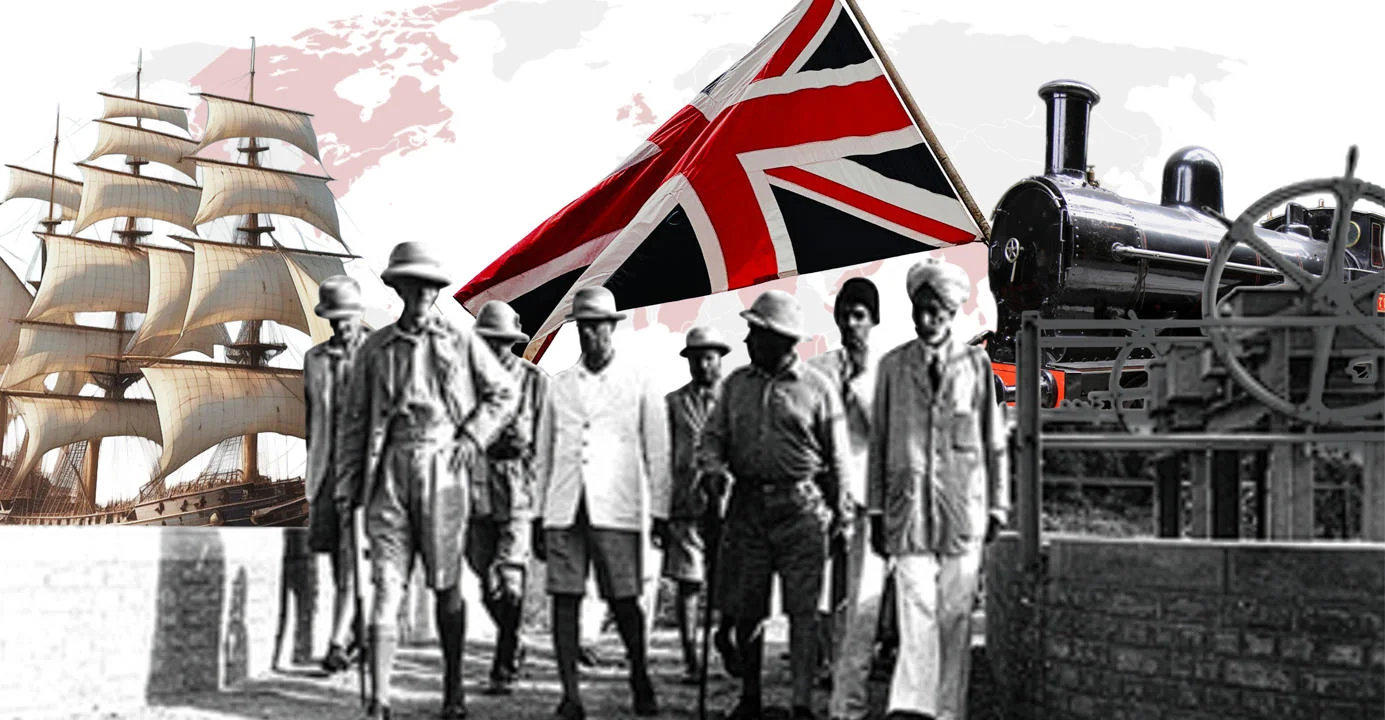
In recent years, there has been intensified discussion of the need for the UK national curriculum to better address colonial histories, particularly given the enduring legacies of the British Empire. But how can academic research inform how colonialism is taught in the classroom?
Supported by LSE internal engagement and impact funding, a team of researchers in the Department of Economic History at LSE undertook a year-long project in collaboration with the Historical Association with precisely this question in mind. Professor Leigh Gardner, Professor Tirthankar Roy and Professor Mohamed Saleh developed tools to support an economic history approach to teaching colonialism in UK schools.
Speaking at an LSE Research Showcase talk, Professor Roy and Professor Saleh explain that their project sought to adopt a different approach to how colonialism is currently taught, which is often through the lens of ideological debates. Instead, their initiative aims to introduce an evidence-based perspective to "provide teachers with more structured tools to guide pupils in studying economic history – the structure of incentives, institutions and long-run outcomes".
Economic history and the study of empire
Professor Saleh begins by defining the aim of economic history: "economic history is about linking novel archival sources, making use of quantitative data as well as qualitative sources of information, and doing comparative analysis across regions."
However, Professor Roy and Professor Saleh stress that economic history hasn’t always pursued the evidence-based approach at the core of their project with teachers. Professor Roy explains how his research has played a key role in pushing forward fundamental transformations in the field over the past 20-25 years, particularly the economic history of empire.
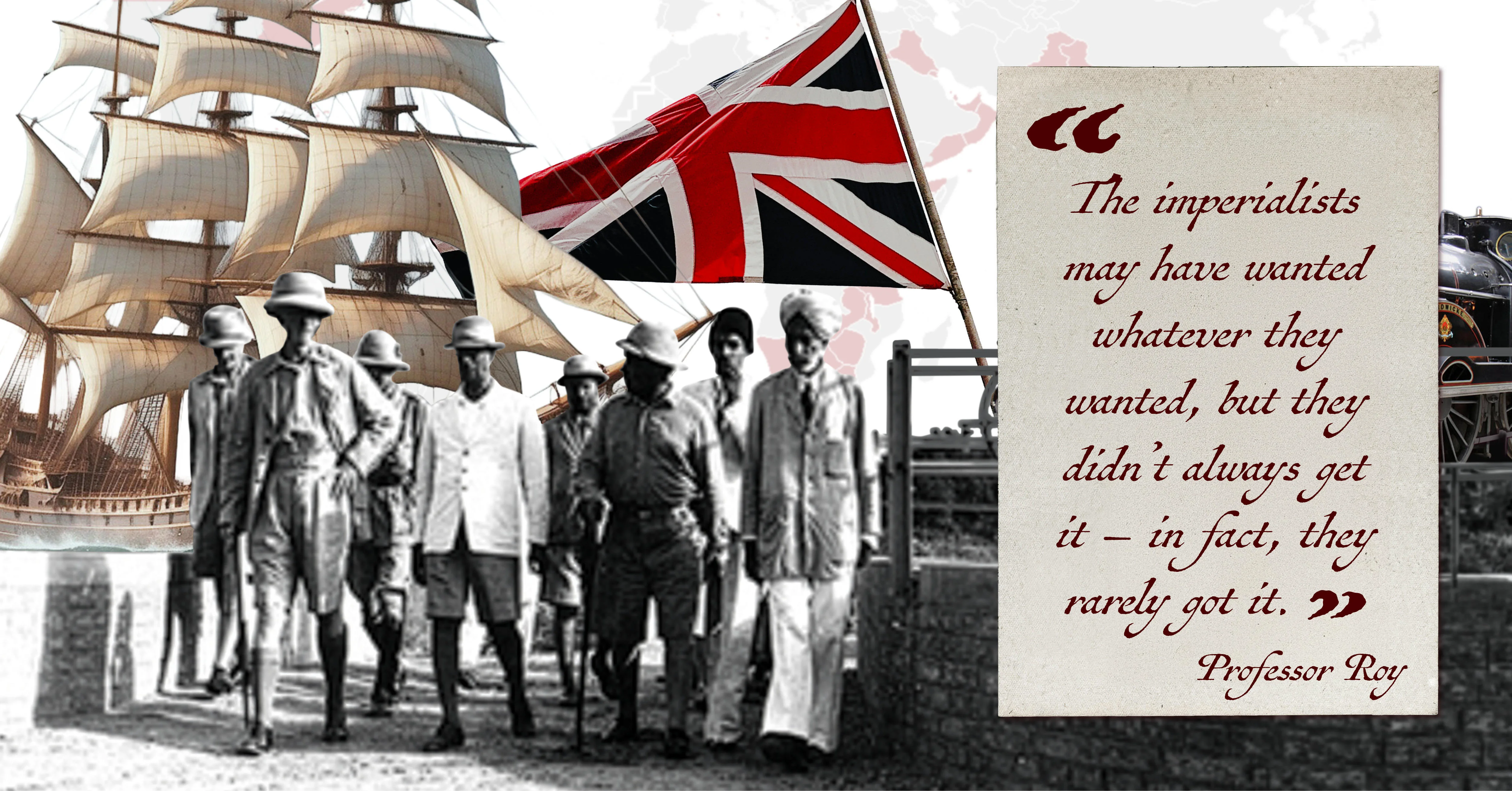
Professor Roy summarises past approaches: "If you had asked this question about how the British Empire shaped the economies of Asia and Africa, the answer would start from some explanation of what the imperialists wanted from Asia and Africa – whether that’s resource extraction or geopolitical stability or dominance. That has changed."
This past focus on the perspective of the imperialists often constrained the field to what the colonial state valued and collected data on – primarily revenue systems.
Yet colonial states were not typical states: "if you take away military power, they were extremely constrained in a variety of ways.’" For instance, their rule was divided – in the case of India, between Delhi and London – and they relied heavily on local power structures.
The British Empire was certainly able to use military and related powers to "manage a global system of connected markets, through commodity trade and little barriers to the movements of people". Despite this, Professor Roy makes clear that "the imperialists may have wanted whatever they wanted, but they didn’t always get it – in fact, they rarely got it."
![Inequality...[has] geographical and environmental dimensions. We have to be innovative in capturing these dimensions. you need different methods.](/all-images/26-0125-rftw-mohamed-saleh-tirthankar-roy-article-1200-x-628-2.x829fea1c.jpg?w=5000&h=2617&q=85&f=webp)
From colonial archives to local archives
In focusing only on colonial archives that reflect what the imperial powers prioritised, this neglects crucial materials that can give a deeper understanding of the economic history of colonialism. To illustrate this, Professor Roy shares an example of how the sources used can greatly impact how we understand the historical roots of regional inequality in India.
Professor Roy shows three maps side-by-side – one depicts the political borders between princely states and British India around 1900; a second shows India’s climatic zones, which vary dramatically from very arid to very wet; and the third is a geological map including features such as uplands, mountains and rivers.
Comparing the differences between the maps brings home what can be overlooked depending on the sources we use: "the political borders don’t coincide with climatic and geographical borders ... if we get all our data on economic changes from political units like districts, states and provinces, then there is a problem of understanding inequality. Inequality, we know, should have geographical and environmental dimensions. We have to be innovative in capturing these dimensions. You need different methods."
This search for innovative methods in economic history has led scholars to develop "a different way of doing research on the colonies – mainly [including] the perspective of the colonies themselves, using their archives".
An example shared by Professor Saleh concerns Egypt’s 1879 national manifesto, which captures "a less-known episode in the history of democratisation in the Middle East and North Africa". After Egypt defaulted on its debt in 1876, a domestic democratic movement emerged that sought to introduce executive constraints. The new constitution was designed to limit the monarch’s power and ensure that any debt and new loans were approved by the parliament.
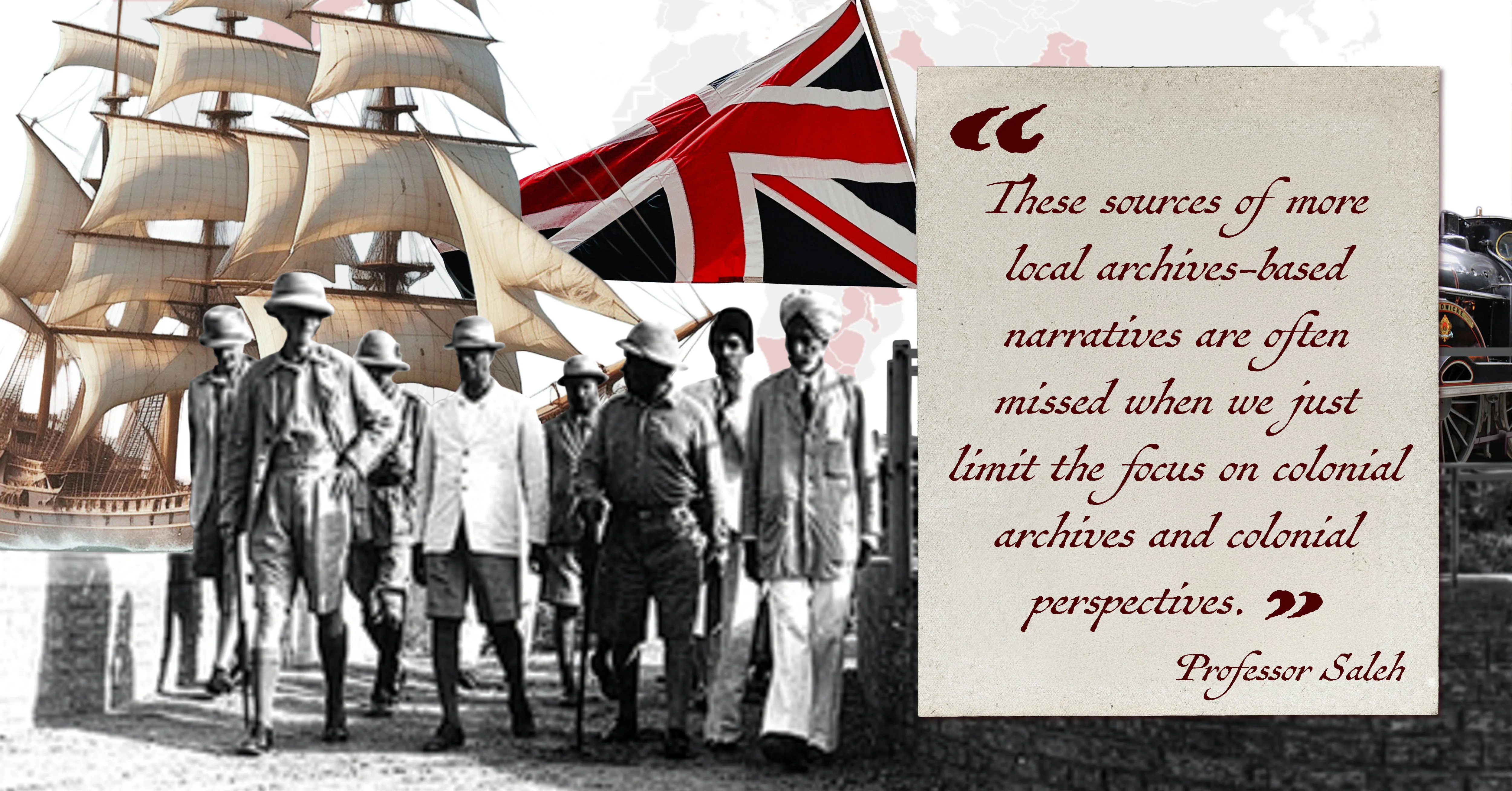
Professor Saleh explains how the manifesto reveals much about this domestic democratic movement, including showing the wide range of domestic elites who were signatories of the document. As Professor Saleh argues: "these sources of more local archives-based narratives are often missed when we just limit the focus on colonial archives and colonial perspectives."
Teaching colonialism in schools
The research team brought this emphasis on innovative methods and local archives to their Teaching Fellowship programme on teaching the economic history of colonialism in Africa and Asia, delivered in collaboration with the Historical Association.
The teaching fellows selected, who primarily taught at GCSE and A Level, attended a three-day residential course at LSE followed by an extended programme of online sessions. The course presented unique materials to cover a range of topics relevant to the economic history of colonialism – these included globalisation and colonial trade; capital and business; and labour regimes, including slavery, indentured labour and wage labour. Alongside this, the course explored resource management and extraction, as well as nationalism, independence, and resistance to colonial authorities.
The course drew on the regional expertise of the researchers involved, with Professor Gardner discussing sub-Saharan Africa, Professor Roy focusing on South Asia, and Professor Saleh on the Middle East and North Africa (MENA).
Each session took the form of a lecture led by one of the LSE research team. Professor Saleh gives an example from one of his lectures exploring colonial labour, trade and migration in the MENA region. He displays two maps, the first showing the routes of the trans-Saharan slave trade, which began around the seventh century, long predating the colonial period. While this trade certainly shifted under colonialism, notably through the impact of movements to abolish slavery, we can still see its legacies today in a second map showing contemporary migration routes from sub-Saharan Africa.
This longer-term perspective is therefore valuable for making visible the persistence of deeply rooted but less well-known patterns of trade and local labour, particularly domestic forms of labour coercion and enslavement, that both predated and shaped the colonial period.
The lectures were followed by interactive workshops where teachers would discuss how to formulate enquiries to produce teaching resources to take into their own classrooms.
One enquiry developed by a teaching fellow looks at the history of the poppy and what it reveals about the British Empire, positioning opium as a "keystone species" that was crucial to the Empire’s development. It seeks to inform students about how the opium trade between India and China influenced land use, labour and economic growth, bringing to the fore a range of actors including Indian peasants and the East India Company.
Examples of other enquiries include teaching resources focused on the "economic bonds of Empire" between Britain and its colonies between 1857 and 1914, while another looks at the impact of colonialism on the lives and livelihoods of Indians. The latter explores structures of colonial exploitation and Indian responses through case studies on land, railways, business, capital and famine, labour, and economic nationalism. A further enquiry looks at the importance of lascar labour for British merchant ships during the interwar years, with resources specifically crafted to suit the needs of SEND students.
While the focus of the enquiries differs, they are united by an evidence-based approach that seeks to draw on a diverse range of primary sources and include a variety of different actors and perspectives in order to inspire students to read "against the grain".
An evidence-based approach to the economic history of colonialism
Professor Saleh and Professor Roy conclude by highlighting that the enquiries developed by the teaching fellows are now being piloted in schools. The resources are also being disseminated through the Historical Association, with more to be published throughout 2026.
When it comes to teaching the economic history of colonialism in the classroom, what their project shows is that "we can essentially approach the same problems, the same debates, that are currently being taught from a more ideological perspective through evidence-based approaches."
This Research Showcase talk was written up by Rosemary Deller, Research Engagement Manager at LSE.
Read an interview with Tirthankar Roy at the LSE Impact Blog.
Subscribe to LSE Research for the World

LSE Research Showcase is a series of 20-minute talks from LSE researchers to enjoy on your coffee break. Catch up on YouTube.
The London School of Economics and Political Science (LSE) is a world-leading university, specialising in social sciences and ranked top in the UK by The Times and Sunday Times Good University Guide 2026. Based in the heart of London, we are a global community of people and ideas that transform the world.



Related content
Changing the narratives on Sub-Saharan Africa’s failure to develop

Rise of Egyptian cotton market tripled rural slave population between 1848-68
Shameful pasts: why is South Africa's youth disengaged from apartheid?