

MPhil/PhD programme

in the Department of International Relations
All applications for MPhil/PhD must be submitted by 3 December 2026. This includes applications for School scholarships and externally funded applications. However, early applications are strongly encouraged.
About our MPhil/PhD programme
MPhil/PhD International Relations
The Department of International Relations provides supervision across the discipline for research leading to a PhD degree. Applicants are required to have a master's degree in a subject relevant to their proposed research with a high merit (65% or above) including a high merit in the dissertation (65% or above). Applications which do not meet these criteria (or do not expect to do so on completion of any pending qualifications) are not considered eligible.
We encourage research projects which will expand and diversify the research profile of the Department. Please check our People page to see whether the Department has supervision capacity and expertise to take on your research project.
Programme structure
In the first year, MPhil/PhD students are required to attend the Methods in International Relations Research Training Seminar (IR501) which explores the theoretical and practical problems associated with a piece of major research. Study concentrates on epistemological and theoretical issues, with special reference to the context and literature of international relations, and time is also devoted to problems arising from source materials, methodology and normative dilemmas. The aim is to train well-rounded academic professionals, who are able to comprehend, critically interrogate, and engage with scholarship employing diverse methodological toolkits.
Students are also required to take assessed courses to the combined value of one unit from the range of quantitative and qualitative research methods topics listed under Programme Content on the Graduate Prospectus page.
All MPhil/PhD students at LSE are initially registered with MPhil status. Continued re-registration and upgrade are dependent on satisfactory progress being made.
Progress will be reviewed in the first and second year by a Research Panel made up of members of academic staff, other than the supervisor. Students are normally upgraded to PhD status by the end of the first year, and no later than 18 months after initial registration. Students in their third year are required to submit an annual progress report with a timeline to completion.
Research community and research students
The Department is able to offer supervision in a variety of specialist areas, and, with its research centres and over 30 current research students, provides a vibrant and rich research community.
During the course of the programme, research students will be affiliated with and required to attend/contribute to at least one of the Department’s four research clusters: International Institutions, Law and Ethics; Theory/Area/History; International Political Economy; Security and Statecraft.
Students will also find it beneficial to get involved and contribute to the operation of Millennium: Journal of International Studies, the highly-ranked postgraduate student-run journal. Millennium is always open to new members, each editorial board meeting offers students the very rare opportunity to read a submitted manuscript and to hear what peer-reviewers have said about the piece. Millennium also runs a prestigious annual conference in mid/late October.
Teaching
Undergraduate teaching is an integral part of the PhD training programme. IR PhD students are expected to undertake some paid teaching for one academic year during the four years of their PhD, typically in the second or third year. This includes leading undergraduate classes—usually two classes on a 1st- or 2nd-year course—grading assessments and holding office hours. The timing of this teaching should be discussed with your supervisor(s) during your first year to ensure it aligns with your academic progress. Teaching is a key component of the PhD training and provides valuable professional experience and skills that will support career development both within and beyond academia.
There are a number of opportunities to support the development of your teaching, both through Department and Eden Centre led induction sessions, and ongoing support and training courses delivered by the Eden Centre and the GTA Portal.
How to apply to join our PhD programme
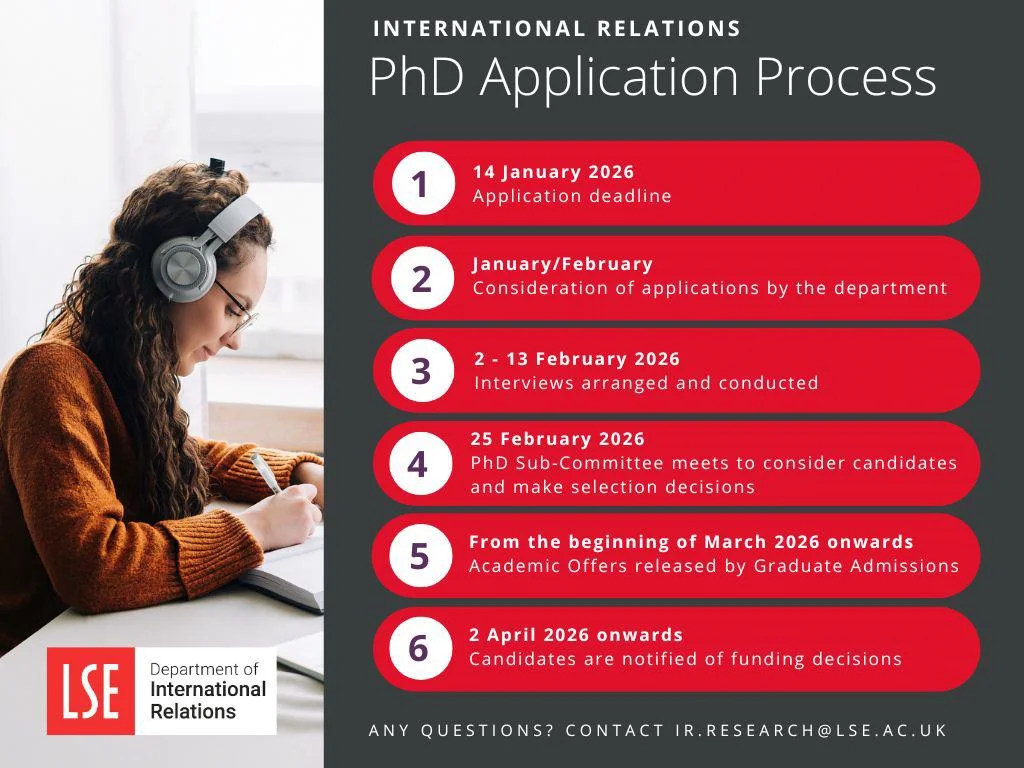
- DownloadDownload or print timeline abovepdf(245KB)
Download or print timeline above
- The application deadline is 14 January 2026, followed by departmental consideration of applications from January to February.
- Interviews for candidates will be arranged and conducted between 2 and 13 February 2026.
- The PhD Sub-Committee will meet on 25 February 2026 to consider candidates and make selection decisions.
- Academic offers will be released by Graduate Admissions from early March 2026 onwards.
- Candidates will be notified of funding decisions from 2 April 2026 onwards.
Further information
Full information on how to apply
Please read the information below before you begin the online application so that you have all the necessary documents ready for consideration.
Completing your application
Your application must include:
- a CV
- a personal statement
- details of academic achievement (including existing and pending qualifications with transcripts)
- 2 academic references
- sample of written work
- a research proposal of maximum 4,000 words
Your research proposal should give:
- details of the particular topic to be addressed
- relevant literature and previous research in the field
- the theoretical/conceptual framework to be adopted
- the proposed research question(s)
- the planned research methods to answer the research question(s)
This will enable the Department to make an informed decision about the proposal and, equally important, to establish if there is appropriate supervision within the Department. One lead supervisor is normally identified at this stage and a second supervisor will be confirmed by the end of the Autumn Term.
See the LSE guide with further information on supporting documents
Application checklist
Use the correct application code
M1ZR MPhil/PhD in International Relations
OR
M1ER for Visiting Research Students (VRS) programme
Do you meet the minimum requirements?
The minimum entry requirements for this programme are a 2:1 bachelor’s degree, plus Master’s degree marks equivalent to an LSE high merit grade (+ 65%), preferably in International Relations or in a subject relevant to your proposed research, with an overall average of 65% (or equivalent) and 65 % in the dissertation (or equivalent). Applications which do not meet these criteria (or do not expect to do so on completion of any pending qualifications) are not considered eligible.
See information on international entry requirements - scroll down for country-specific information
Do you meet the English language requirements?
Applicants whose first language is not English, or who have not been taught entirely in English at degree level, are required to provide evidence of their English language ability. The most common qualifications are the IELTS or TOEFL tests.
Applicants do not need to have the required marks when they apply, but successful award of the qualification would form a condition of any offer issued and would have to be achieved before registration. For research level, candidates are expected to meet the research programmes requirement. See our English language requirements.
Identifying supervisors
The Department welcomes applications for research programmes that complement the academic interests of members of staff in the Department. We recommend that you investigate staff research interests and their availability before applying.
Please note:
- Prospective candidates for the MPhil/PhD in International Relations are not expected to contact potential supervisors in advance of their application. Due to the high volume of enquiries, potential supervisors are unlikely to be able to provide feedback on enquiries and outline proposals.
- Individual academic members of staff are not able to make commitments to supervise prospective students outside of the formal application process. Selection goes through an internal PhD Sub-Committee review before any offer of place can be agreed.
- You should name academics who have research interests which fit with yours in your personal statement so that they can be asked to consider your research proposal.
Part-time study
LSE allows part-time PhD study under limited circumstances. If you wish to study part-time, you should mention this (and the reasons for it) in your statement of academic purpose, and discuss it at interview if you're shortlisted.
Application and funding deadlines
Application will open in early October 2025 and close on 3 December 2026.
There are no separate applications for funding/scholarships. There is only one funding deadline for the MPhil/PhD in International Relations: 3 December 2026. Selection for funding is based on receipt of a complete application (including all supporting documents: transcripts and references) by the deadline.
We are not able to accept any materials that arrive after the deadline; only complete applications supplied with all the required supporting information by 3 December 2026 will be considered. Given the volume of applications received every year, we strongly encourage our applicants to apply early: early applications have a greater chance of being successful and of meeting financial support/scholarship and visa deadlines.
Funding is allocated by nomination and you will automatically be considered for the award you are eligible for alongside all applications received by the deadline.
When will I hear the outcome of the application?
We aim to process all complete applications in a timely manner, however the application process for research programmes can take up to three months. This is to enable the Department to make an informed decision about your proposal and, equally important, to establish if there is appropriate supervision available for your research. All applications are reviewed by our PhD Sub-Committee which normally meets to review applications at the end of February once interviews have been carried out.
Interviews
The Department interviews all shortlisted applicants before any offer of a place is made. Interviews normally take place online across two weeks in February.
Programme start
Please note that students may only start their studies in the Department at the beginning of the Autumn Term (September). This is so that they can attend the compulsory research training courses and follow the programme cycle in their first year.
1. Where can I check the equivalence of my non-UK qualifications?
The Student Recruitment Office provides information aimed at prospective applicants coming from outside the UK. It includes information on international entry requirements, just scroll down and click on the country of your choice.
2. Should I contact potential supervisors before I apply?
Before applying you should ensure that your research area can be supervised in the Department. Our People webpage and individual staff profiles clearly outline the research interests of faculty, and whether they are able to take on PhD students.
You are welcome to contact prospective supervisors, but because of the high volume of enquiries, we cannot guarantee an answer.
If you feel that one of the academics in the Department has interests that fit with yours, you should name them in your application and they would normally be asked to consider your research proposal. You should indicate if you have discussed your proposed research with any member of faculty and give the name of that person so they are automatically consulted.
3. Do you offer distance learning?
Our programme requires regular attendance at the LSE during the course of your programme, to attend courses, supervisory meetings and research cluster seminars, so we cannot offer distance learning. In exceptional circumstances, students may be granted permission to reside outside the UK while continuing their research programme but this is usually not granted before the final year.
Please see Regulations for Research Degrees on the linked page for information on study time away from the School.
4. Can I apply for an MPhil programme rather than a PhD?
There is no separate MPhil programme. The MPhil/PhD International Relations is intended for students wishing to complete a PhD. All students are initially registered as MPhil students and are upgraded to PhD status upon meeting the upgrade requirements at the end of the first year.
Students who do not wish to complete their PhDs or whose work is not of PhD standard, may elect to submit an MPhil thesis instead.
Further details of alternative master's programmes
5. Can I still be considered for funding if I listed the PhD in IR as my 2nd choice?
It will depend when we receive your application. Programme choices are considered in order, so if you are successful for your first choice, you will not be considered for your second choice. Consequently, we can only guarantee your application will be considered for funding if you submit it by the funding deadline and list our programme as your first-choice.
6. Do I need to apply for funding separately?
No. All successful applicants are automatically considered for a range of funding opportunities, including LSE PhD Studentships, ESRC Studentships, and several other funding schemes. A separate funding application is therefore not required.
The only exception is if you wish to apply for external funding opportunities that are administered outside of LSE, in which case you should follow the application process specified by the relevant funding body.
7. Do you accept self-funded students?
Yes. All applicants are considered on academic merit, regardless of their funding status. Self-funded applicants who meet the programme's entry requirements are eligible for admission in the same way as funded applicants.
8. Can I study part time?
The first year of the MPhil/PhD programme must be completed on a full-time basis.
After successfully completing the first year, students may apply to transfer to part-time registration if they meet one of the following criteria:
• They are employed or self-employed for more than 20 hours per week; and/or
• They have a protected characteristic recognised under the Equality Act 2010 that means they are unable to undertake full-time study.
Please note that students sponsored under the Student Visa route are not permitted to transfer to part-time study.
9. Can I join the programme in January?
No. Students are only admitted to the MPhil/PhD programme at the start of the academic year in September.
We do not offer January or mid-year entry points, unless you are joining as a visiting research student.
10. I am currently studying for a PhD elsewhere. Can I transfer to LSE?
In most cases, students cannot formally transfer PhD registration, candidature, or credits from another institution into the LSE MPhil/PhD programme at an advanced stage.
Applicants currently enrolled on a PhD elsewhere are normally required to apply through the standard admissions process and will be assessed alongside all other applicants. If admitted, they would typically join the programme as a new student and may be required to complete all stages of the LSE PhD programme.
Applicants who are in the early stages of a PhD elsewhere may still be considered for admission, but prior doctoral study does not guarantee advanced standing within the programme.
11. Can I change my research topic after starting the programme?
Research projects often evolve during doctoral study. While significant changes may require approval, students are generally able to refine or develop their research topic in consultation with their supervisory team.
The MPhil/PhD International Relations is part of the group of accredited programmes for ESRC funding and the Department can normally nominate one candidate for an ESRC 3.5 award each year (see eligibility and prior training requirements here). Please note that ESRC awards are normally targeted at HUK students and only very few are awarded to OS/HEU students, for which specific requirements will apply.
The programme is also eligible for .
LSE's Financial Support Office administers a variety of studentships and award schemes for which different deadlines apply. There are also other funding opportunities available through organisations or governments and we recommend you investigate the options listed on our External Funding Sources document [PDF]. The LSE Financial Support Office also provides a list of external funding providers and additional scholarships.
Visiting Research Student (VRS) scheme allows research students registered at an overseas university to spend up to 3 terms in the Department of International Relations to undertake some aspect of their research in the UK.
Because of its emphasis on independent research, the VRS scheme is better suited to students who are at an advanced stage in their doctoral training and research.
How to apply to the VRS programme
The procedure and requirements are the same as for the MPhil/PhD. Please refer to the 'How to Apply' section above. Please ensure you use the correct code: M1ER- Visiting Research International Relations.
What does a career in Research in International Relations look like?
Hear from PhD Alumni about the diverse range of careers that research studies in the field of International Relations (IR) can lead to:
Dr Victor Bojbov is Head of Cooperation in the Delegation of the European Union in Azerbaijan:
Dr Kiran Phull is Assistant Professor in IR, Department of War studies at King’s College, London:
Dr Giovanni Angioni is Head of Government Social Research Strategy at the HM Treasury:
Dr Marnie Howlett is Lecturer in Politics, Oxford:
Contact us
All enquiries should be addressed to the PhD Team at ir.research@lse.ac.uk