


About
Sumi Madhok is Professor of Political Theory and Gender Studies and Head of Department.
Quite unusually, she is a feminist political theorist with an ethnographic sensibility. Her teaching and scholarship bring together two distinct fields of study, which often stay apart: that of political theory and philosophy, especially of autonomy, agency, human rights and global justice, and of coloniality, imperialism, developmentalism and transnational activisms for liberation and justice. Her scholarship goes beyond producing critiques of Eurocentrism and develops new concepts, theoretical frameworks and methodologies, which contribute to setting a new direction for the social sciences focused on epistemic interventions from most of the world.
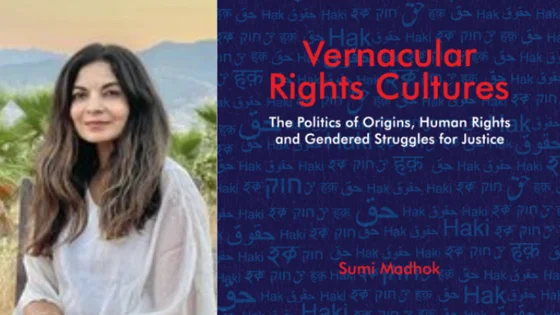
Her recent book is Vernacular Rights Cultures: The Politics of Origins, Human Rights and Gendered Struggles for Justice (Cambridge University Press 2021). You can watch the video of the book launch here. Vernacular Rights Cultures is the winner of the 2022 Susan Strange Best Book Prize, awarded by the British International Studies Association for ‘an outstanding book published in any field of International Studies’. It has also received The Sussex International Theory Prize, 2022 awarded annually for the ‘best piece of innovative theoretical research in International Relations’. In 2023, Vernacular Rights Cultures received an ‘Honorable Mention’ by the International Studies Association’s Lee Ann Fujii Prize. Here is a review of the book in the LSE Review of Books, a recently published review forum on the book in International Affairs and a Q&A on Vernacular Rights Cultures.
Sumi Madhok is also the author of Rethinking Agency: Developmentalism, Gender and Rights (2013); the co-editor of Gender, Agency and Coercion (2013); and of the Sage Handbook of Feminist Theory (2014).
Professor Madhok is the recipient of numerous grants, prizes and honours, including from the AHRC, the ESRC, the Andrew W. Mellon Foundation, The British Academy, and the Ford Foundation. During 2015-16 she also held the Leverhulme Research Fellowship.
Sumi Madhok is a dedicated teacher. In 2013, she was the winner of the ‘Major Review Teaching Prize for Outstanding Teaching’, and in 2017, she received the LSE Student's Union’s ‘Teaching Excellence Award for Inspirational Teaching'. In 2019 and 2020, she was awarded the ‘Excellence in Education’ Prizes for exceptional contribution to education at the LSE. She welcomes prospective PhD students to apply to work with her at the LSE on her areas of expertise. Currently, she co-supervises the PhDs of Kristyna Brozova and Nadia Ma (Department of Government).
Professor Madhok is a member of the editorial board of the journals, Social Politics and Geohumanities. She is an editor of the Cambridge University Press--London School of Economics International Studies Book Series. She is also a Faculty Associate at the LSE International Inequalities Institute.
Expertise
Feminist Political Theory; Agency, Autonomy, Global Justice, and Human Rights; Imperialism and Coloniality; Vernacular Rights Cultures; Rights Politics in Most of the World; Transnational Social Movements for Justice.
Research
Anti-Imperial Epistemic Justice
My current work is on what I call Anti-Imperial Epistemic Justice. By Anti-imperial epistemic justice, I mean the imperative to take seriously epistemic interventions from most of the world in a manner that matters epistemically. So, not to treat knowledge production from most of the world as ‘case studies’, or as the local variant of ‘the global’, or quickly culturalised away as ‘custom’ or ‘vernacularised’. But rather as knowledges that are speaking to, with, alongside and also ‘speaking back’ to hegemonic forms of knowledge production.
Towards this end, I am working on three related research projects. The first on conceptual diversity and knowledge production from most of the world took form in June 2021 as a two-day online and multi-lingual global workshop that Mary Evans and I co-organised on The Epistemic Urgency of Conceptual Diversity. The workshop CfP was distributed in 13 languages, and it brought together 500 participants from across the globe. More than 100 abstracts in different languages, including Quechua, were submitted, and the workshop presentations were simultaneously translated in English and Spanish. You can watch the recordings of all the workshop panels here. The first set of academic papers from the workshop have now appeared as a special issue of the European Journal of Women’s Studies on ‘Conceptual Diversity and Anti-Imperial Epistemic Justice’. The second project takes my thinking in a slightly different direction and asks a two-fold question: how to take anti-imperial critique seriously? And, what does it mean to do critical human rights thinking and scholarship in the aftermath of this anti-imperial critique? A recent article ‘Anti-imperial epistemic justice and remaking rights and justice ‘after rights’ examines some elements of this thinking. And, finally, I am also currently working on book project titled ‘Anti-Imperial Time’, which examines anticolonial thinking on epistemic justice.
Vernacular Rights Cultures and Rights Politics in ‘Most of the World’
My research on anti-imperial epistemic justice builds on my recent book Vernacular Rights Cultures: The politics of origins, human rights and gendered struggles for justice (CUP 2021). In the book, I argue for the critical importance of an epistemic accounting of the struggles for rights and human rights in ‘most of the world’.
Importantly, the book tells a different story of rights and human rights. It tells a story of rights and human rights that is articulated and fought for by subaltern groups in India and Pakistan. These are stories of the critical conceptual vocabularies, subaltern mobilisations, and of conflictual gendered politics of rights; they are stories of the struggles for economic redistributive justice but also for representational justice; and, they are stories of conceptual diversity, of oppositional politics of protest against authoritarianism, and, of the political imaginaries that animate subaltern rights politics but also open up different futures and possibilities for rights and human rights around the globe. You can watch a video of the book launch here. And, also watch a recording of a book talk given at the Centre for Advanced International Theory, Sussex here.
Theorising Agency and Coercion in the Social Sciences
I started out in the academy with a very deep interdisciplinary interest in the philosophical formulations of autonomy and agency, and also in the empirical and normative life trajectories of developmentalism. Two books emerged from bringing together both these interests. My first book Rethinking Agency develops a new conception of agency, which I subsequently broaden and develop into a wide-ranging intervention into theorising the thorny relationship between Gender, Agency and Coercion. The book essentially asks: How to theorise agency in oppressive contexts? Through asking this innovative question, the book reconceptualises agency and thereby changes the conversation on individual agency and autonomy. This new conception of agency neither relies upon the ability to perform ‘free acts’ as a proof of critical consciousness, nor insists upon ‘open’ resistance to the oppressor as a sign of agency and autonomy. Instead, it shifts the theoretical gaze away from overt actions to an analysis of reflexive processes, motivations and desires that lie behind actions or inaction and as expressed in speech practices. To theorise this new conception of agency, the book shifts the spatial geographies and ‘standard’ philosophical background contexts of ‘negative freedom’, ‘abstract personhood’ and action bias that dominate theoretical and philosophical work on autonomy and agency, and radically transports theory building on agency and coercion to a concrete empirical context of severe oppression in rural India where very marginalised women ‘development workers’ carry out the development work of the Indian state. Drawing on year-long ethnographic research, the book empirically engages with the new theoretical agency framework but also draws attention to the normative impulses that drives international development in the Global South.
Alongside my colleagues, Professor Anne Phillips (LSE) and Dr Kalpana Wilson (Birkbeck), I organised a day long research workshop on ‘gender, agency and coercion’ that resulted in a co-edited book, Gender, Agency and Coercion (2013).
Select Honours, Awards and Prizes
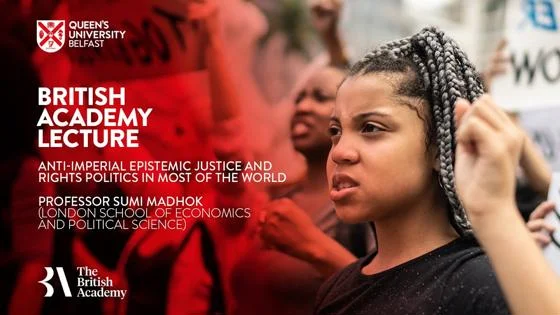
- 2024. The British Academy Lecture.
- 2024. Dr B.R. Ambedkar Memorial Lecture.
- 2023. ‘Honorable Mention’, Lee Ann Fujii Book Prize, International Studies Association.
- 2022. The Susan Strange Best Book Prize; The Sussex International Theory Prize, 2022.
- AHRC Network Grant AH/W01047X/1 (Co-Investigator with Prof. Clare Hemmings).
- 2020-23. Mercator Professorial Fellow, University of Kassel.
- 2021. LSE Excellence in Education Award.
- 2020. LSE Excellence in Education Award.
- 2017. LSE Student's Union Teaching Excellence Award for 'Inspirational Teaching'.
- 2016. Winner, LSE ‘Education Vision Fund’.
- 2015-2016. The Leverhulme Research Fellowship.
- 2014: The Eranda Rothschild Foundation Grant.
- 2013. Major Review Teaching Prize.
- 2008. 'Standard ESRC Grant' [RES-062-23-1609
- 2005-2007. Andrew W. Mellon Postdoctoral Fellowship.
Teaching
Teaching
Sumi is the Head of Department at LSE Gender
- GI411 Gender, Post/coloniality and Development: Critical Perspectives and New Directions
- GI426 Gender and Human Rights
PhD supervision
She welcomes MPhil/PhD applications from students to study at LSE Gender with her on her areas of research expertise, which include feminist politics and theories; transnational rights/human rights politics and movements; agency, autonomy and social justice; and postcolonial gendered politics, citizenship and developmentalism. Currently, she is co-supervisor to Kristyna Brozova and Nadia Ma (Department of Government).
Please see our PhD page for how to apply and what we are looking for in a research proposal.
Recent highlights
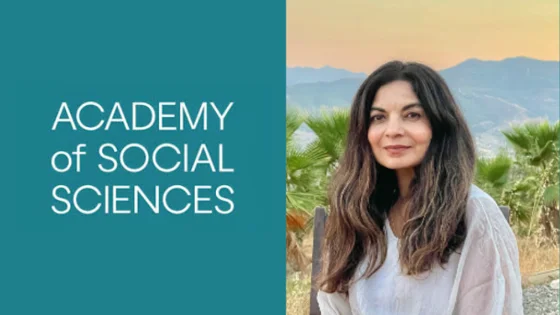
Prof Sumi Madhok elected Fellow of the Academy of Social Sciences
Mapping anti-gender movements and resistance