

Journal issues

Latest issue:
Economica: Volume 92, Issue 366, April 2025
Quantifying the Federal Reserve's objectives using a structural vector autoregressive model, by Shengliang Ou, Donghai Zhang
Monetary union effects on high inflation episodes, by Vigninou Gammadigbe
Core strength: international evidence on the impact of energy prices on core inflation, by Gertjan Vlieghe
This paper is part of the Economica 100 Series. Economica, the LSE "house journal" is now 100 years old. To commemorate this achievement, we are publishing 100 papers by former students, as well as current and former faculty. Gertjan Vlieghe obtained his MSc and PhD from the LSE and has been a Visiting Fellow at the LSE.
Supply shortages and inflation in Europe, by Jakub Mućk, Łukasz Postek
Longer-run equilibrium interest rates: evidence from the United Kingdom, by Omar Kaykhusraw
Revealing inequality aversion from tax policy and the role of non-discrimination, by Kristoffer Berg
This paper is part of the Economica 100 Series. Economica, the LSE "house journal" is now 100 years old. To commemorate this achievement, we are publishing 100 papers by former students, as well as current and former faculty. Kristoffer Berg obtained his MSc from the LSE.
Zombie firms, state subsidies and aggregate productivity, by Xijie Gao
This paper is part of the Economica 100 Series. Economica, the LSE "house journal" is now 100 years old. To commemorate this achievement, we are publishing 100 papers by former students, as well as current and former faculty. Xijie Gao obtained his PhD from the LSE.
Establishment size and the task content of jobs: evidence from 46 countries, by Micole De Vera, Javier Garcia-Brazales
Cui prodest? A firm-level analysis of hiring credits, by Edoardo Santoni, Fabrizio Patriarca, Margherita Scarlato
The effects of a disability employment quota when compliance is cheaper than defiance, by Judit Krekó, Álmos Telegdy
How digitalization can shape markets: the case of sports betting, by Jonas Vandenbruaene, Jan Annaert, Marc De Ceuster
Economica's issues from 2016 onwards:
2025
Employer cooperation, productivity and wages: new evidence from inter-firm formal network agreements, by Francesco Devicienti, Elena Grinza, Alessandro Manello, Davide Vannoni
Staff engagement, co-workers' complementarity and employee retention: evidence from English NHS hospitals, by Giuseppe Moscelli, Melisa Sayli, Marco Mello, Alberto Vesperoni
The impact of a minimum wage increase on hours worked: heterogeneous effects by gender and sector, by Paul Redmond, Seamus McGuinness
Firms' margins of adjustment to wage growth: the case of Italian collective bargaining, by Francesco Devicienti, Bernardo Fanfani
Why gender norms matter, by Ryo Sakamoto, Miki Kohara
Monetary policy communication shocks and the macroeconomy, by Robert Goodhead, Benedikt Kolb
Export policy cooperation in a pandemic: the good, the bad and the hopeful, by Gerda Dewit, Dermot Leahy
Trust and accountability in times of crisis, by Monica Martinez-Bravo, Carlos Sanz
Deterrent effects of targeted sanctions by mainland China on Taiwan: evidence from 2021–2 sanction events, by Fengze Han, Runliang Li, Sen Ma, Tzu-Chang Forrest Cheng
The right to counsel: criminal prosecution in 19th century London, by Bryan C. McCannon, Zachary Porreca
Combating trade-related fraud: do the Financial Action Task Force recommendations bite? By Sami Bensassi, Arisyi F. Raz
CORRECTION
Correction to ‘Recent trends in firm-level total factor productivity in the UK: new measures, new puzzles’
Correction to ‘What if? The macroeconomic and distributional effects for Germany of a stop of energy imports’
2024
What if? The macroeconomic and distributional effects for Germany of a stop of energy imports from Russia, by Rüdiger Bachmann, David Baqaee, Christian Bayer, Moritz Kuhn, Andreas Löschel, Benjamin Moll, Andreas Peichl, Karen Pittel, Moritz Schularick
This paper is part of the Economica 100 Series. Economica, the LSE "house journal" is now 100 years old. To commemorate this achievement, we are publishing 100 papers by former students, as well as current and former faculty. Benjamin Moll is the Sir John Hicks Professor of Economics at the LSE. David Baqaee was an Asst. Prof. of Economics at the LSE. Moritz Schularick obtained his MSc from the LSE.
More dads at home, more girls in maths-intensive studies? Evidence from a parental leave reform, by Sara Mikkelsen, Noemi Peter
Hours of work and the long-run effects of in-work transfers, by David Goll, Robert Joyce, Tom Waters
Goods market desirability of minimum wages, by Rui Pan, Dao-Zhi Zeng
Wage–price spirals: what is the historical evidence? By Jorge Alvarez, John Christopher Bluedorn, Niels-Jakob Hansen, Youyou Huang, Evgenia Pugacheva, Alexandre Sollaci
Recent trends in firm-level total factor productivity in the UK: new measures, new puzzles, by Diane Coyle, John McHale, Ioannis Bournakis, Jen-Chung Mei
Did COVID-19 induce a reallocation wave? By Agostino Consolo, Filippos Petroulakis
This paper is part of the Economica 100 Series. Economica, the LSE "house journal" is now 100 years old. To commemorate this achievement, we are publishing 100 papers by former students, as well as current and former faculty. Filippos Petroulakis obtained his MSc from the LSE.
Corporate culture as a theory of the firm, by Gary B. Gorton, Alexander K. Zentefis
The regional economics of mineral resource wealth in Africa, by Zareh Asatryan, Thushyanthan Baskaran, Carlo Birkholz, Patrick Hufschmidt
Export competition with China and firms' coping strategies, by Katariina Nilsson Hakkala, Yao Pan
Economic and financial integration, capital controls, and risk sharing, by Michael Donadelli, Ivan Gufler
The determinants of trust: findings from large, representative samples in six OECD countries, by Roxanne Kovacs, Maurice Dunaiski, Matteo M. Galizzi, Gianluca Grimalda, Rafael Hortala-Vallve, Fabrice Murtin, Louis Putterman
This paper is part of the Economica 100 Series. Economica, the LSE "house journal" is now 100 years old. To commemorate this achievement, we are publishing 100 papers by former students, as well as current and former faculty. Rafael Hortala-Vallve is a Professor in the Department of Government at the LSE. Matteo M. Galizzi is an Associate Professor at the LSE.
Endogenous monitoring through voluntary reporting in an infinitely repeated prisoner's dilemma game: experimental evidence, by Kenju Kamei, Artem Nesterov
Extending the formal state: the case of Pakistan's Frontier Crimes Regulation, by Michael Callen, Saad Gulzar, Arman Rezaee, Jacob N. Shapiro
This paper is part of the Economica 100 Series. Economica, the LSE "house journal" is now 100 years old. To commemorate this achievement, we are publishing 100 papers by former students, as well as current and former faculty. Michael Callen is an Associate Professor at the LSE.
Measuring maternal autonomy and its effect on child nutrition in rural India, by Wiji Arulampalam, Anjor Bhaskar, Nisha Srivastava
This paper is part of the Economica 100 Series. Economica, the LSE "house journal" is now 100 years old. To commemorate this achievement, we are publishing 100 papers by former students, as well as current and former faculty. Wiji Arulampalam obtained her PhD from the LSE.
Do management practices matter in further education?By Sandra McNally, Luis Schmidt, Anna Valero
This paper is part of the Economica 100 Series. Economica, the LSE "house journal" is now 100 years old. To commemorate this achievement, we are publishing 100 papers by former students, as well as current and former faculty. Anna Valero is a distinguished Policy fellow at CEP and Deputy Director of POID and associate at GRI. Sandra McNally is Director of the Education and Skills Programme at the CEP. Luis Schmidt-Rivera is a Researcher at STICERD.
Beyond cultural norms: how does historical rice farming affect modern firms' family control? By Chenchen Fan, Mingming Jiang, Bo Zhang
How the wellbeing function varies with age: the importance of income, health and social relations over the lifecycle, byJürgen Bitzer, Erkan Gören, Heinz Welsch
Follow the leader? The long-run interaction between public and private sector wage growth in the UK, by Peter Dolton, Arno Hantzsche
This paper is part of the Economica 100 Series. Economica, the LSE "house journal" is now 100 years old. To commemorate this achievement, we are publishing 100 papers by former students, as well as current and former faculty. Peter Dolton is a senior Fellow at the CEP, LSE.
Unequal ground: oil booms and income inequality in the USA, by Loujaina Abdelwahed, Cole Campbell
Debt, deficits and interest rates, by Christopher D. Cotton
This paper is part of the Economica 100 Series. Economica, the LSE "house journal" is now 100 years old. To commemorate this achievement, we are publishing 100 papers by former students, as well as current and former faculty. Christopher David Cotton obtained his BSc from the LSE.
Neighbourhood labour structure, lockdown policies, and the uneven spread of COVID-19: within-city evidence from England, by Carlo Corradini, Jesse Matheson, Enrico Vanino
This paper is part of the Economica 100 Series. Economica, the LSE "house journal" is now 100 years old. To commemorate this achievement, we are publishing 100 papers by former students, as well as current and former faculty. Enrico Vanino is affiliated to the Department of Geography and Environment of the LSE.
The effect of school grants on test scores: experimental evidence from Mexico, by Mauricio Romero, Juan Bedoya, Monica Yanez-Pagans, Marcela Silveyra, Rafael de Hoyos
From unobserved to observed preference heterogeneity: a revealed preference methodology, by Laurens Cherchye, Dieter Saelens, Reha Tuncer
Ex ante transparency and corruption by networks, by Mehmet Bac
Forecasting the UK top 1% income share in a shifting world, by Jennifer L. Castle, Jurgen A. Doornik, David F. Hendry
This paper is part of the Economica 100 Series. Economica, the LSE "house journal" is now 100 years old. To commemorate this achievement, we are publishing 100 papers by former students, as well as current and former faculty. David Forbes Hendry received his MSc and PhD from the LSE.
Austerity and elections, by Alberto Alesina, Gabriele Ciminelli, Davide Furceri, Giorgio Saponaro
Fading choice: transport costs and variety in consumer goods, by Jan Willem Gunning, Pramila Krishnan, Andualem T. Mengistu
This paper is part of the Economica 100 Series. Economica, the LSE "house journal" is now 100 years old. To commemorate this achievement, we are publishing 100 papers by former students, as well as current and former faculty. Andualem Mengistu is a researcher at the IGC, LSE.
Pandemic distress and anti-immigration sentiments, by Gianmarco Daniele, Andrea F. M. Martinangeli, Francesco Passarelli, Willem Sas, Lisa Windsteiger
Social organizations and political institutions: why China and Europe diverged, by Joel Mokyr, Guido Tabellini
Endogenous property rights and the nature of the firm, by Carmine Guerriero, Giuseppe Pignataro
This paper is part of the Economica 100 Series. Economica, the LSE "house journal" is now 100 years old. To commemorate this achievement, we are publishing 100 papers by former students, as well as current and former faculty. Carmine Guerriero completed his MSc at the LSE.
Hyperbolic discounting and state-dependent commitment, by Takayuki Ogawa, Hiroaki Ohno
On the inefficiency of non-competes in low-wage labour markets, by Tristan Potter, Bart Hobijn, André Kurmann
Do wages underestimate the inequality in workers' rewards? The joint distribution of job quality and wages across occupations, by Andrew E. Clark, Maria Cotofan, Richard Layard
This paper is part of the Economica 100 Series. Economica, the LSE "house journal" is now 100 years old. To commemorate this achievement, we are publishing 100 papers by former students, as well as current and former faculty. Maria Cotofan is a research Associate at the CEP. Andrew E. Clark obtained his mSc and PhD from the LSE and is a research Associate at the CEP. Richard layard is the Founder-Director at the CEP and is the co-Director of the Centre's programme on Community Wellbeing.
The welfare effects of time reallocation: evidence from Daylight Saving Time, by Joan Costa-Font, Sarah Fleche, Ricardo Pagan
This paper is part of the Economica 100 Series. Economica, the LSE "house journal" is now 100 years old. To commemorate this achievement, we are publishing 100 papers by former students, as well as current and former faculty. Joan Costa-Font obtained his MSc from the LSE and is a Professor of Economics at the LSE. Sarah Flèche is an Associate at the CEP, LSE. Ricardo Pagan was a visiting Professor at the LSE from 2014–2019.
The role of firm-to-firm relationships in exporter dynamics, by Davide Rigo
This paper is part of the Economica 100 Series. Economica, the LSE "house journal" is now 100 years old. To commemorate this achievement, we are publishing 100 papers by former students, as well as current and former faculty. Davide Rigo is a Leverhulme Early Career Fellow at the LSE.
Economic insecurity and the demand for populism in Europe, by L. Guiso, H. Herrera, M. Morelli, T. Sonno
This paper is part of the Economica 100 Series. Economica, the LSE "house journal" is now 100 years old. To commemorate this achievement, we are publishing 100 papers by former students, as well as current and former faculty. Tommaso Sonno obtained his PhD from the LSE and is a CEP Associate. luigi Guiso obtained his MSc from the LSE and is a fellow at the CEP.
Exchange rates and political uncertainty: the Brexit case, by Paolo Manasse, Graziano Moramarco, Giulio Trigilia
This paper is part of the Economica 100 Series. Economica, the LSE "house journal" is now 100 years old. To commemorate this achievement, we are publishing 100 papers by former students, as well as current and former faculty. Paolo Manasse obtained his MSc and PhD from the LSE.
The wage curve after the Great Recession, by David Blanchflower, Alex Bryson, Jackson Spurling
This paper is part of the Economica 100 Series. Economica, the LSE "house journal" is now 100 years old. To commemorate this achievement, we are publishing 100 papers by former students, as well as current and former faculty. Alex Bryson obtained his MSc from the LSE.
Market power and monetary policy transmission, by Romain Duval, Davide Furceri, Raphaël Lee, Marina M. Tavares
Consumption and time use responses to unemployment: Implications for the lifecycle model, by Jim Been, Eduard Suari-Andreu, Marike Knoef and Rob Alessie
Export-platform foreign direct investment and trade policy uncertainty: Evidence from brexit, by Nicolò Tamberi
Driver's licences for undocumented immigrants and post-mortem organ donation, by Tianyuan Luo and Cesar L. Escalante
Healthy climate, healthy bodies: Optimal fuel taxation and physical activity, by Inge van den Bijgaart, David Klenert, Linus Mattauch and Simona Sulikova
Stigma and take-up of labour market assistance: Evidence from two field experiments, by Adam Osman, Jamin D. Speer
Evaluating compliance gains of expanding tax enforcement Knut Løyland, Oddbjørn Raaum, Gaute Torsvik and Arnstein Øvrum
Effects of the COVID-19 pandemic on domestic violence in Los Angeles, by Amalia R. Miller, Carmit Segal and Melissa K. Spencer
Risk aversion and favourite–longshot bias in a competitive fixed-odds betting market, by Karl Whelan
What drives the substitutability between native and foreign workers? Evidence about the role of language, by Elena Gentili and Fabrizio Mazzonna
Bank ownership and firm performance, by Pavel Chakraborty
The real side of stock market exuberance: bubbles, output and productivity at the industry level, by Francisco Queirós
Market concentration and the relative demand for college-educated labour, by Anders Akerman
When populists deliver on their promises: the electoral effects of a large cash transfer programme in Poland, by Jan Gromadzki, Katarzyna Sałach and Michał Brzeziński
2023
Accounting for the role of investment frictions in recessions, by Fernando del Ríoand Francisco-Xavier Lores
Investor beliefs about transformative innovations under uncertainty, by Johannes Binswanger, Anja Garbely and Manuel Oechslin
Productivity dispersion, wage dispersion and superstar firms, by Yannick Bormans and Angelos Theodorakopoulos
Retail pricing format and rigidity of regular prices, by Sourav Ray, Avichai Snirand Daniel Levy
Migrants and imports: Evidence from Dutch firms, by Aksel Erbaharand Ömer Tarık Gençosmanoğlu
Intra-EU migration, public transfers and assimilation, by Eduard Suari-Andreuand Olaf van Vliet
Are political and economic integration intertwined? By Bernt Bratsberg, Giovanni Facchini, Tommaso Frattini, and Anna Cecilia Rosso
Consequences of inconvenient information: Evidence from sentencing disparities, by Michal Šoltés
Buddha's grace illuminates all: Temple destruction, school construction and modernization in 20th century China, by Shaoda Wang and Boxiao Zhang
The taxman cometh: Pathways out of a low-capacity trap in the Democratic Republic of the Congo, by Jonathan L. Weigel and Elie Kabue Ngindu
Heterogeneous predictive association of CO2 with global warming, by Liang Chen, Juan J. Dolado, Jesús Gonzalo and Andrey Ramos
Intellectual property and the organization of the global value chain, by Stefano Bolatto, Alireza Naghavi, Gianmarco Ottavianoand Katja Zajc Kejžar
The importance of political selection for bureaucratic effectiveness, by James Habyarimana, Stuti Khemani and Thiago Scot
Accounting for the slowdown in UK innovation and productivity, by Peter Goodridgeand Jonathan Haskel
Diagnosing the UK productivity slowdown: which sectors matter and why? By Diane Coyleand Jen-Chung Mei
‘Good jobs’, training and skilled immigration, by Andrew Mountford and Jonathan Wadsworth
The effect of child allowances on female labour supply: evidence from Israel, by Yuval Mazarand Yaniv Reingewertz
Firm-specific pay premiums and the gender wage gap in Europe, by Jan-Luca Hennigand Balazs Stadler
The UK gender pay gap: Does firm size matter? By Melanie Jonesand Ezgi Kaya
Children's social care and early intervention policy: Evidence from sure start, by Dan Anderberg and Christina Olympiou
Beyond windfall gains: The redistribution of apprenticeship costs and vocational education of care workers, by Eric Schuss
Global banking, financial spillovers and macroprudential policy coordination, by Pierre-Richard Agénor, Timothy P. Jacksonand Luiz A. Pereira da Silva
Seeking shelter in times of crisis? unemployment, perceived job insecurity and trade union membership, by Adrian Chadiand Laszlo Goerke
Taxes, subsidies and gender gaps in hours
and wages by Robert Duval-Hernández, Lei Fang and L. Rachel NgaiNetwork-based appointments and board
diversity, by Marie LalanneFemale labour, status and decision power, by Catherine Bros, Véronique Gille and François Maniquet
Presenteeism when employers are under
pressure: evidence from a high-stakes
environment, by Mario Lackner and Hendrik SonnabendThe impact of place-based policies on
interpersonal income inequality, by Giuseppe Albanese, Guglielmo Barone and Guido de BlasioA micro perspective on r > g, by Roberto Iacono and Elisa Palagi
An imperfect wealth tax and employment in
closely held firms, by Marie Bjørneby, Simen Markussen and Knut RøedThe long-run investment effect of taxation
in OECD countries, by Jakob B. Madsen, Antonio Minniti and Francesco VenturiniSupport for small businesses amid COVID-19, by Charles A.E. Goodhart, Dimitrios P. Tsomocos and Xuan Wang
Exponential growth bias in the prediction of
COVID-19 spread and economic expectation, by Ritwik Banerjee and Priyama Majumdar
Artificial intelligence adoption in a
competitive market, Joshua S. Gans
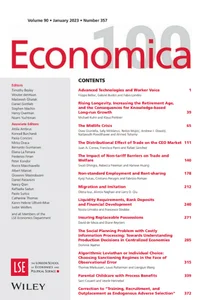
Advanced Technologies and Worker Voice, by Filippo Belloc, Gabriel Burdin and Fabio Landini
Rising Longevity, Increasing the Retirement Age, and the Consequences for Knowledge-based Long-run Growth, by Michael Kuhn and Klaus Prettner
The Midlife Crisis, by Osea Giuntella, Sally McManus, Redzo Mujcic, Andrew J. Oswald, Nattavudh Powdthavee and Ahmed Tohamy
The Distributional Effect of Trade on the CEO Market, by Juan A. Correa, Francisco Parro and Rafael Sánchez
The Impact of Non-tariff Barriers on Trade and Welfare, by Swati Dhingra, Rebecca Freeman and Hanwei Huang
Non-standard Employment and Rent-sharing, by Kyoji Fukao, Cristiano Perugini and Fabrizio Pompei
Migration and Imitation, by Olena Ivus, Alireza Naghavi and Larry D. Qiu
Liquidity Requirements, Bank Deposits and Financial Development, by Nicola Limodio and Francesco Strobbe
Insuring Replaceable Possessions, by David de Meza and Diane Reyniers
The Social Planning Problem with Costly Information Processing: Towards Understanding Production Decisions in Centralized Economies, by Dominik Naeher
Algorithmic Leviathan or Individual Choice: Choosing Sanctioning Regimes in the Face of Observational Error, by Thomas Markussen, Louis Putterman and Liangjun Wang
Parental Childcare with Process Benefits, by Sam Cosaert and Veerle Hennebel
Correction to "Training, Recruitment, and Outplacement as Endogenous Adverse Selection", by Heski Bar-Isaacand Clare Leaver
2022
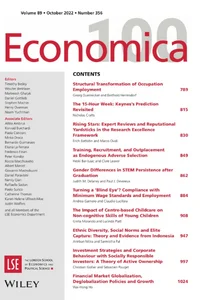
Structural Transformation of Occupation Employment, by Georg Duernecker and Berthold Herrendorf
The 15-Hour Week: Keynes’s Prediction Revisited, by Nicholas Crafts
This paper is part of the Economica 100 Series. Economica, the LSE "house journal" is now 100 years old. To commemorate this achievement, we are publishing 100 papers by former students, as well as current and former faculty. Nicholas Crafts is Emeritus Professor at the University of Warwick. He was a Professor of Economic History at the LSE from 1995–2005.
Rising Stars: Expert Reviews and Reputational Yardsticks in the Research Excellence Framework, by Erich Battistin and Marco Ovidi
Training, Recruitment, and Outplacement as Endogenous Adverse Selection, by Heski Bar-Isaac and Clare Leaver
This paper is part of the Economica 100 Series. Economica, the LSE "house journal" is now 100 years old. To commemorate this achievement, we are publishing 100 papers by former students, as well as current and former faculty. Heski Bar-Isaac is the Distinguished Professor of Economics and Finance, and Area Coordinator Economic Analysis and Policy Area, Rotman School of Management, University of Toronto. He obtained his MSc and PhD from the LSE.
Gender Differences in STEM Persistence after Graduation, by Judith M. Delaney and Paul J. Devereux
Turning a ‘Blind Eye’? Compliance with Minimum Wage Standards and Employment, by Andrea Garnero and Claudio Lucifora
The Impact of Centre-based Childcare on Non-cognitive Skills of Young Children, by Greta Morando and Lucinda Platt
This paper is part of the Economica 100 Series. Economica, the LSE "house journal" is now 100 years old. To commemorate this achievement, we are publishing 100 papers by former students, as well as current and former faculty. Lucinda Platt has been a Professor of Social Policy and Sociology, Department of Social Policy at the LSE since 2013.
Ethnic- Diversity, Social Norms and Elite Capture: Theory and Evidence from Indonesia, by Anirban Mitra and Sarmistha Pal
This paper is part of the Economica 100 Series. Economica, the LSE "house journal" is now 100 years old. To commemorate this achievement, we are publishing 100 papers by former students, as well as current and former faculty.
Sarmistha Pal is a Professor of Financial Economics at the University of Surrey. She graduated with a PhD in economics from the LSE in 1995.Investment Strategies and Corporate Behaviour with Socially Responsible Investors: A Theory of Active Ownership, by Christian Gollier and Sébastien Pouget
Financial Market Globalization, Deglobalization Policies and Growth, by Wai-Hong Ho
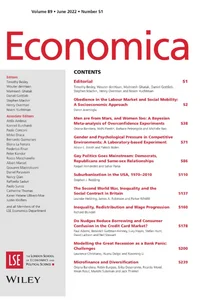
Volume 89/ Issue 355/ July 2022
Job Creation in Colombia Versus the USA: ‘Up-or-out Dynamics’ Meet ‘The Life Cycle of Plants’, by Marcela Eslava, John Haltiwanger and Álvaro Pinzón
Military Conscription, Sexist Attitudes and Intimate Partner Violence, by M. Amelia Gibbons and Martín A. Rossi
Negative Trade Shocks and Gender Inequality: Evidence from the USA, by Ishan Ghosh, Mario Larch, Irina Murtazashvili and Yoto V. Yotov
Jobs, Crime and Votes: A Short-run Evaluation of the Refugee Crisis in Germany, by Markus Gehrsitz and Martin Ungerer
Information Provision and Postgraduate Studies, by Jan Berkes, Frauke Peter, C. Katharina Spiess and Felix Weinhardt
Assortative Learning, by Jan Eeckhout and Xi Weng
Jan Eeckhoutis ICREA research professor of Economics at UPF Barcelona.Jangraduated from the LSE in 1998 with a PhD in Economics. Jan also lectured at the LSE from 1996 – 1997.
Do Sticky Wages Matter? New Evidence from Matched Firm Survey and Register Data, by Anne Kathrin Funk and Daniel Kaufmann
An Index Measuring State Capacity, 1789 –2018, by Colin O’Reilly and Ryan H. Murphy
Pricing Behaviour and Menu Costs in Multi-product Firms, by Wilko Letterie and Øivind A. Nilsen
On the Gains from Tradable Benefi ts-in-kind: Evidence for Workfare in India, by Martin Ravallion
This paper is part of the Economica 100 Series. Economica, the LSE "house journal" is now 100 years old. To commemorate this achievement, we are publishing 100 papers by former students, as well as current and former faculty.
Martin Ravallionholds the inaugural Edmond D. Villani Chair of Economics at Georgetown University. Martin graduated from the LSE with an MSc in 1978 and a PhD in Economics in 1981. Martin also lectured at the LSE from 1978–1981.
Volume 89/ Issue S1/ June 2022
Editorial, by Timothy Besley, Wouter Denhaan, Maitreesh Ghatak, Daniel Gottlieb, Stephen Machin, Henry Overman and Noam Yuchtman
Obedience in the Labour Market and Social Mobility: A Socioeconomic Approach, by Daron Acemoglu
Men are from Mars, and Women Too: A Bayesian Meta-analysis of Overconfi dence Experiments, by Oriana Bandiera, Nidhi Parekh, Barbara Petrongolo and Michelle Rao
Gender and Psychological Pressure in Competitive Environments: A Laboratory-based Experiment, by Alison L. Booth and Patrick Nolen
Gay Politics Goes Mainstream: Democrats, Republicans and Same-sex Relationships, by Raquel Fernández and Sahar Parsa
Suburbanization in the USA, 1970--2010, by Stephen J. Redding
The Second World War, Inequality and the Social Contract in Britain, by Leander Heldring, James A. Robinson and Parker Whitfill
Inequality, Redistribution and Wage Progression, by Richard Blundell
Do Nudges Reduce Borrowing and Consumer Confusion in the Credit Card Market? By Paul Adams, Benedict Guttman-Kenney, Lucy Hayes, Stefan Hunt, David Laibson and Neil Stewart
Modelling the Great Recession as a Bank Panic: Challenges, by Lawrence Christiano, Husnu Dalgic and Xiaoming Li
Microfinance and Diversification, by Oriana Bandiera, Robin Burgess, Erika Deserranno, Ricardo Morel, Imran Rasul, Munshi Sulaiman and Jack Thiemel
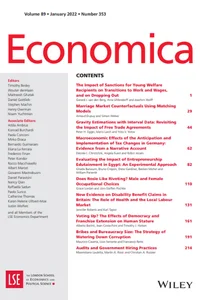
Volume 84/ Issue 354/ April 2022
Rainfall, Agricultural Output and Persistent Democratization, by Antonio Ciccone, Adilzhan Ismailov
Gentrification and the Rising Returns to Skill, by Lena Edlund, Cecilia Machado, Maria Sviatschi
The Weak State Trap, by Leopoldo Fergusson, Carlos A. Molina, James A. Robinson
Trust and Law in Credit Markets, by Koji Asano
Measuring Judicial Sentiment: Methods and Application to US Circuit Courts, by Elliott Ash, Daniel L. Chen, Sergio Galletta
Incorporated in Westminster: Channels and Returns to Political Connection in the United Kingdom, by Colin P. Green, Swarnodeep Homroy
Gender Identity and Quality of Employment, by Estefanía Galván
Missing Men: Second World War Casualties and Structural Change, by Christoph Eder
The Effects of Firing Costs on Labour Market Dynamics, by Armando Näf, Yannic Stucki, Jacqueline Thomet
Incentives to Eat Healthily: Evidence from a Grocery Store Field Experiment, by John A. List, Anya Samek, Terri Zhu
Volume 89/ January 2022/ Issue 353
The Impact of Sanctions for Young Welfare Recipients on Transitions to Work and Wages, and on Dropping Out, by Gerard J. van den Berg, Arne Uhlendorff, Joachim Wolff
Marriage Market Counterfactuals Using Matching Models, by Arnaud Dupuy, Simon Weber
Gravity Estimations with Interval Data: Revisiting the Impact of Free Trade Agreements, by Peter H. Egger, Mario Larch, Yoto V. Yotov
Macroeconomic Effects of the Anticipation and Implementation of Tax Changes in Germany: Evidence from a Narrative Account, by Désirée I. Christofzik, Angela Fuest, Robin Jessen
Evaluating the Impact of Entrepreneurship Edutainment in Egypt: An Experimental Approach, by Ghada Barsoum, Bruno Crépon, Drew Gardiner, Bastien Michel, William Parienté
Does Rosie Like Riveting? Male and Female Occupational Choices, by Grace Lordan, Jörn-Steffen Pischke
New Evidence on Disability Benefit Claims in Britain: The Role of Health and the Local Labour Market, by Jennifer Roberts, Karl Taylor
Voting Up? The Effects of Democracy and Franchise Extension on Human Stature, by Alberto Batinti, Joan Costa-Font, Timothy J. Hatton
Bribes and Bureaucracy Size: The Strategy of Watering Down Corruption, by Maurizio Caserta, Livio Ferrante, Francesco Reito
Audits and Government Hiring Practices, by Maximiliano Lauletta, Martín A. Rossi, Christian A. Ruzzier
2021
Volume 88/ October 2021/ Issue 352
Potential Consequences of Post-Brexit Trade Barriers for Earnings Inequality in the UK, by Rachel Griffith, Peter Levell, Agnes Norris Keiller
Populism and Civil Society, by Tito Boeri, Prachi Mishra, Chris Papageorgiou, Antonio Spilimbergo
The Wounds That Do Not Heal: The Lifetime Scar of Youth Unemployment, by Gianni De Fraja, Sara Lemos, James Rockey
Maternal Undernutrition in Adolescence and Child Human Capital Development Over the Life Course: Evidence from an International Cohort Study, by Andreas Georgiadis, Liza Benny, Paul Dornan, Jere Behrman
EURQ: A New Web Search-based Uncertainty Index, by Maria Elena Bontempi, Michele Frigeri, Roberto Golinelli, Matteo Squadrani
Technological Growth and Hours in the Long Run: Theory and Evidence, by Magnus Reif, Mewael F. Tesfaselassie, Maik H. Wolters
Product Quality and International Price Dynamics over the Business Cycle, by Marta Arespa, Diego Gruber
From Safe Motherhood to Cognitive Ability: Exploring Intrahousehold and Intergenerational Spillovers, by Somdeep Chatterjee, Prashant Poddar
Have you Read This? An Empirical Comparison of the British REF Peer Review and the Italian VQR Bibliometric Algorithm, by Daniele Checchi, Alberto Ciolfi, Gianni De Fraja, Irene Mazzotta, Stefano Verzillo
Will Brexit Age Well? Cohorts, Seasoning and the Age–Leave Gradient: On the Evolution of UK Support for the European Union, by Barry Eichengreen, Rebecca Maria Mari, Gregory Thwaites
Volume 88/ July 2021/ Issue 351
Hours, Employment and Earnings of American Manufacturing Workers from the 19th Century to the 21st Century, by John H. Pencavel
Does Ignorance of Economic Returns and Costs Explain the Educational Aspiration Gap? Representative Evidence from Adults and Adolescents, by Philipp Lergetporer, Katharina Werner, Ludger Woessmann
Hierarchy and the Employer Size Effect on Wages: Evidence from Britain, by Colin P. Green, John S. Heywood, Nikolaos Theodoropoulos
Liquidity Formation and Preopening Periods in Financial Markets, by Jieying Hong, Sébastien Pouget
Violence against Rich Ethnic Minorities: A Theory of Instrumental Scapegoating, by Yann Bramoullé, Pauline Morault
Water, Health and Wealth: The Impact of Piped Water Outages on Disease Prevalence and Financial Transactions in Zambia, by Nava Ashraf, Edward Glaeser, Abraham Holland, Bryce Millett Steinberg
Self-reporting and Market Structure, by Matthew D. Rablen, Andrew Samuel
Election Outcomes and Individual Subjective Wellbeing in Great Britain, by Daniel Gray, Harry Pickard, Luke Munford
Volume 88/ April 2021/ Issue 350
Gender Gaps in the Labour Market and Economic Growth, by Pierre-Richard Agénor, Kamer K. Ozdemir, Emmanuel Pinto Moreira
Capital Heterogeneity and the Decline of the Labour Share, by Mary O’Mahony, Michela Vecchi, Francesco Venturini
Measuring the Market Size for Cannabis: A New Approach Using Forensic Economics, by Matthias Parey, Imran Rasul
Longevity Adjustment of Retirement Age and Intragenerational Inequality, by Svend E. Hougaard Jensen, Thorsteinn Sigurdur Sveinsson, Gylfi Zoega
Electives Shopping, Grading Policies and Grading Competition, by Martin Gregor
Heterogeneity across Families in the Impact of Compulsory Schooling Laws, by Ciprian Domnisoru
Household Bargaining and Spending on Children: Experimental Evidence from Tanzania, by Charlotte Ringdal, Ingrid Hoem Sjursen
Comparing Apples to Apples: Estimating Consistent Partial Effects of Preferential Economic Integration Agreements, by Peter H. Egger, Filip Tarlea
Losing My Connection: The Dark Side of Bank–Firm Interlocking Directorates, by Guglielmo Barone, Litterio Mirenda, Sauro Mocetti
Identity and Redistribution: Theory and Evidence, by Sanjit Dhami, Emma Manifold, Ali al-Nowaihi
Perceptions of Inherited Wealth and the Support for Inheritance Taxation, by Spencer Bastani, Daniel Waldenström
Collateral Damage? Labour Market Effects of Competing with China—at Home and Abroad, by Sónia Cabral, Pedro S. Martins, João Pereira dos Santos, Mariana Tavares

Volume 88/ January 2021/ Issue 349
Regionalism Meets Samuelson: Local Production of a National Public Good, by Jan K. Brueckner, Steven G. Craig, Kangoh Lee
Why are Fiscal Multipliers Asymmetric? The Role of Credit Constraints, by Richard McManus, F. Gulcin Ozkan, Dawid Trzeciakiewicz
Violence Against Women: A Cross-cultural Analysis for Africa, by Alberto Alesina, Benedetta Brioschi, Eliana La Ferrara
Gender Differences in Professional Career Dynamics: New Evidence from a Global Law Firm,by Ina Ganguli, Ricardo Hausmann, Martina Viarengo
Resource Discovery and the Political Fortunes of National Leaders, by Sambit Bhattacharyya, Michael Keller
Male-biased Demand Shocks and Women's Labour Force Participation: Evidence from Large Oil Field Discoveries, by Stephan E. Maurer, Andrei V. Potlogea
Presidential Elections, Divided Politics, and Happiness in the USA, by Sergio Pinto, Panka Bencsik, Tuugi Chuluun, Carol Graham
Breaking the Crystal Methamphetamine Economy: Illegal Drugs, Supply-side Interventions and Crime Responses, by Rocco d'Este
2020
Catching Cheating Students, by MingJen LinandSteven D. Levitt
The Role of Land in Temperate and Tropical Agriculture, by T. Ryan Johnsonand Dietrich Vollrath
The Impact of Trade Openness on Relative Equipment Prices: Lessons from Latin America, by Jessica Madariagaand Anton Bekkerman
Distributional Effects of Corruption When Enforcement is Biased: Theory and Evidence from Bribery in Schools in Bangladesh, by M. Shahe Emran, Asadul Islamand Forhad Shilpi
Trend Fundamentals and Exchange Rate Dynamics, by Florian Huberand Daniel Kaufmann
Gender Disparities in Sentencing, by Arnaud Philippe
‘Trophy Architects’ and Design as Rentseeking: Quantifying Deadweight Losses in a Tightly Regulated Office Market, by Paul C. Cheshireand Gerard H. Dericks
Does It Matter How and How Much Politicians are Paid?, by Duha T. Altindag, Elif S. Filiz and Erdal Tekin
Investment in Financial Information and Portfolio Performance, byLuigi Guiso andTullio Jappelli
A Democratic Measure of Household Income Growth: Theory and Application to the United Kingdom, by Andrew Aitken and Martin Weale
Is a Minimum Wage an Appropriate Instrument for Redistribution?, by Aart Gerritsenand Bas Jacobs
How Do NYPD Officers Respond to Terror Threats?, by Steven F. Lehrerand LouisPierre Lepage
Unemployment and Effort at Work, by Michael C. Burda, Katie R. Genadekand Daniel S. Hamermesh
Occupational Social Value and Returns to Long Hours, by Dora Gicheva
Input–Output Linkages and Sectoral Volatility, by Michael Olabisi
The Effect on Annuities Preference of Prompts to Consider Life Expectancy: Evidence from a UK Quota Sample, by Jenny Robinsonand David A. Comerford
Income Guarantees and Borrowing in Risky Environments: Evidence from India's Rural Employment Guarantee Scheme, by Clive Belland Abhiroop Mukhopadhyay
ValueAdded Tax, Input–Output Linkages and Informality, by Mohammad Hoseini
Fighting for Votes: Theory and Evidence on the Causes of Electoral Violence, by Olivier Sterck
Does Social Pressure Hinder Entrepreneurship in Africa? The Forced Mutual Help Hypothesis, by Philippe Alby, Emmanuelle Aurioland Pierre Nguimkeu
Highpowered Contracts, Selfselection and Welfare in Settings with Externalities, by Eberhard Feess, M. Vittoria Levati, Marcel Rieser and Ivan Soraperra
Endogenous Institutions and Economic Outcomes, by Carmine Guerriero
Euler Equations, Subjective Expectations and Income Shocks, by Orazio Attanasio, Agnes Kovacsand Krisztina Molnar
Credit Constraints and the InvertedU Relationship Between Competition and Innovation, by Roberto Bonfattiand Luigi Pisano
Paying Politicians: Not Too Little, Not Too Much, by Alessandro Fedeleand Pierpaolo Giannoccolo
What Drives Enrolment Gaps in Further Education? The Role of Beliefs in Sequential Schooling Decisions, by Chris Belfield, Teodora Boneva, Christopher Rauhand Jonathan Shaw
Financial Development, Endogenous Dependence on External Financing, and Trade, by ByeongHwa Choi
Intergenerational Earnings Mobility in PostSoviet Russia, by Gleb V. Borisovand Christopher A. Pissarides
School Grants and Education Quality: Experimental Evidence from Senegal, by Pedro Carneiro, Oswald Koussihouèdé, Nathalie Lahire, Costas Meghirand Corina Mommaerts
Exponentialgrowth Bias in Experimental Consumption Decisions, by Matthew R. Levyand Joshua Tasoff
Chameleons: The Misuse of Theoretical Models in Finance and Economics, by Paul Pfleiderer
Incomplete Preferences and Equilibrium in Contingent Markets, by Robert Chambersand Tigran Melkonyan
A Twosided Matching Model of Monitored Finance, by Arturo Antónand Kaniṣka Dam
The Evolution of Charter School Quality, by Patrick L. Baude, Marcus Casey, Eric A. Hanushek, Gregory R. Phelanand Steven G. Rivkin
Economic Crises and Unemployment Persistence: Analysis of Job Losses During the Finnish Recession of the 1990s, by Jouko Verho
Firmlevel Investment Spikes and Aggregate Investment over the Great Recession, by Richard Disney, Helen Millerand Thomas Pope
Saving and Bequest in China: An Analysis of Intergenerational Exchange, by Ingvild Almås, Eleonora Freddiand Øystein Thøgersen
How Important are Firms in Explaining Wage Changes During a Recession?, by Aedín Doris, Donal O'Neilland Olive Sweetman
2019
The Decline in Capital Efficiency and Labour Share, by Fernando del Ríoand Francisco-Xavier Lores
Employment Protection and Firm Relocation: Theory and Evidence, by Gerda Dewit, Holger Görgand Yama Temouri
Old and Young Politicians, byAlberto Alesina,Traviss CassidyandUgo Troiano
The Real Effects of Credible Disinflation in the Presence of Real Wage Rigidities, byMewael F. Tesfaselassie
Do-it-yourself Digital: the Production Boundary, the Productivity Puzzle and Economic Welfare, byDiane Coyle
When do Voters Weaken Checks and Balances to Facilitate Economic Reform?, byAlvaro FortezaandJuan S. Pereyra
Early Marriage, Social Networks and the Transmission of Norms, by M. Niaz Asadullahand Zaki Wahhaj
Efficiency under Uncertainty and Non-convexity: Evaluating the Role of Probabilities, by Jean-Paul Chavasand Walter Briec
Monetary Policy, Product Market Competition and Growth, by Philippe Aghion, Emmanuel Farhiand Enisse Kharroubi
Who Got the Brexit Blues? The Effect of Brexit on Subjective Wellbeing in the UK, by Nattavudh Powdthavee, Anke C. Plagnol, Paul Frijtersand Andrew E. Clark
The Rise and Fall of Consumption in the 2000s: A Tangled Tale, by Yuliya Demyanyk, Dmytro Hryshko, María José Luengo-Pradoand Bent E. Sørensen
Special Economic Zones and WTO Compliance: Evidence from the Dominican Republic, by Fabrice Defever, José-Daniel Reyes, Alejandro Riañoand Miguel Eduardo Sánchez-Martín
Local Environmental Quality and Interjurisdictional Spillovers, by John William Hatfieldand Katrina Kosec
The Effect of University Fees on Applications, Attendance and Course Choice: Evidence from a Natural Experiment in the UK, by Filipa Sá
Risky Sexual Behaviours: Biological Markers and Self-reported Data, by Lucia Cornoand Áureo De Paula
Inflation Targets and the Zero Lower Bound in a Behavioural Macroeconomic Model, by Paul De Grauweand Yuemei Ji
Airport Size and Urban Growth, by Nicholas Sheard
The Public and Private Marginal Product of Capital, by Matt Lowe, Chris Papageorgiouand Fidel Perez-Sebastian
Foreign Direct Investment, Source Country Heterogeneity and Management Practices, by Fredrik Heyman, Pehr-Johan Norbäckand Rickard Hammarberg
Note on Idea Diffusion Models with Cohort Structures, by Santiago Caicedo
Some Misconceptions About Public Investment Efficiency and Growth, by Andrew Berg, Edward F. Buffie, Catherine Pattillo, Rafael Portillo, Andrea F. Presbiteroand Luis-Felipe Zanna
Coase Lecture - The Inverted-U Relationship Between Credit Access and Productivity Growth, by Philippe Aghion, Antonin Bergeaud, Gilbert Cette, Rémy Lecat and Hélène Maghin
Public Goods and Ethnic Diversity: Evidence from Deforestation in Indonesia, by Alberto Alesina, Caterina Gennaioli and Stefania Lovo
Destination-based vs. Origin-based Commodity Taxation in Large Open Economies with Unemployment, by Fabio Antoniou, Panos Hatzipanayotou and Nikos Tsakiris
Real Effect of Bank Efficiency: Evidence from Disaggregated Manufacturing Sectors, by Ali Mirzaei and Tomoe Moore
Export Destination Characteristics and Markups: The Role of Country Size, by Umut Kilinç
A Non-unitary Discount Rate Model, by Takeo Hori and Koichi Futagami
Don’t Look Down: The Consequences of Job Loss in a Flexible Labour Market, by Richard Upward and Peter W. Wright
Immigration Policies and the Choice between Documented and Undocumented Migration, by Slobodan Djajic ́ and Alexandra Vinogradova
2018
How Much do Existing Borrowers Value Microfinance? Evidence from an Experiment on Bundling Microcredit and Insurance, by Abhijit Banerjee, Esther Duflo andRichard Hornbeck
Wage Regulation and the Quality of Police Applicants, by Rowena Crawford andRichard Disney
What Do We Know About the Effects of Macroprudential Policy?, by Gabriele Galati andRichhild Moessner
The Competitive Effects of Credit Constraints in the Global Economy, by Peter Egger,Sebastian Kunert and Tobias Seidel
A Head-count Measure of Rank Mobility and its Directional Decomposition, by Walter Bossert,Burak Can and Conchita D’Ambrosio
Intergenerational Earnings Persistence and Economic Inequality in the Long Run: Evidence from French Cohorts, 1931–75, by Arnaud Lefranc
Attitudes Towards Large Income Risk in Welfare States: An International Comparison, by Fred Schroyenand Karl Ove Aarbu
Leveraging Monopoly Power by Degrading Interoperability: Theory and Evidence from Computer Markets by, Christos Genakos, Kai-Uwe Kühnand John Van Reenen
Wage Flexibility and Employment Fluctuations: Evidence from the Housing Sector, by Jorn-Steffen Pischke
Should Congestion Tolls be Set by the Government or by the Private Sector? The Knight-Pigoy Debate Revisited, by Stephen Salantand Nathan Seegert
House Prices, Wealth Effects and Labour Supply, by Richard Disneyand John Gathergood
The Economic Consequences of Political Donation Limits, by John Maloneyand Andrew Pickering
Clientelism, Contagious Voting and Governance, by Abhirup Sarkar
Did the Swedish Tobacco Monopoly Set Monopoly Prices?, by Marcus Asplund
Did the Euro Common Currency Increase or Decrease Business Cycle Synchronization for its Member Countries?, by William Miles, Chu-Ping C Vijverberg
Accounting for the UK Productivity Puzzle: A Decomposition and Predictions, by Peter Goodridge, Jonathan Haskel, and Gavin Wallis
Trends in Life Expectancy by Income and the Role of Specific Causes of Death, by Karin Hederos, Markus Jantti, Lena Lindahl, and Jenny Torssander
Debt Relief for Poor Countries: Conditionality and Effectiveness, by Almuth Scholl
The Effects of Recommended Retail Prices on Consumer and Retailer Behaviour, by Lisa Bruttel
Coase Lecture– The Glass Ceiling, by Marianne Bertrand
Does Financial Deregulation Boost Top Incomes? Evidence from the Big Bang, by
Julia Tanndaland Daniel Waldenstrom
Mandated Political Representation and Redistribution, by Anirban Mitra
General Equilibrium Dynamics with Naïve and Sophisticated Hyperbolic Consumers in an Overlapping Generations Economy, by Takeshi Ojima
Risk Preferences and the Role of Emotions, by Anna Conte, M Vittoria Levatiand Chiara Nardi
International Technology Spillovers and Growth over the Past 142 Years: The Role of Genetic Proximity, by Jakob B Madsenand Minoo Farhadi
Towards an Understanding of the Origins of the Favourite–Longshot Bias: Evidence
from Online Poker Markets, a Real-money Natural Laboratory, by Leighton Vaughan Williams, Ming-Chien Sung, Peter A F Fraser-Mackenzie, John Peirsonand
Johnnie E V Johnson
Measuring Corruption in China: An Expenditure-based Approach Using Household Survey Data, by Hai Zhong
Phillips Lecture– Why Some Times Are Different: Macroeconomic Policy and the Aftermath of Financial Crises, by Christina D Romerand David H Romer
Friends with Benefits: How Political Connections Help to Sustain Private Enterprise Growth in China, by James Kai-sing Kungand Chicheng Ma
Public–Private Mixed Delivery and Information Effects, by Illoong Kwonand Sangin Park
The Impact of House Prices on Consumption in the UK: a New Perspective, by Vivien Burrows
Job Loss and Immigrant Labour Market Performance, by Bernt Bratsberg, Oddbjørn Raaumand Knut Røed
The Clash of Central Bankers with Labour Market Insiders, and the Persistence of Inflation and Unemployment, by George Alogoskoufis
Export and Innovation in Small and Medium Enterprises: The Role of Concentrated Bank Borrowing, by Maria Luisa Mancusi, Andrea Vezzulli, Serena Frazzoni, Zeno Rotondiand Maurizio Sobrero
2017
On a World Climate Assembly and the Social Cost of Carbon, by Martin L Weitzman
Non-additivity and the Salience of Marginal Productivities: Experimental Evidence on Distributive Fairness, by Urs Fischbacher, Nadja Kairies-Schwarzand Ulrike Stefani
Knowledge is Power: A Theory of Information, Income and Welfare Spending, by Jo Thori Lindand Dominic Rohner
Migration when Social Preferences are Ordinal: Steady-state Population Distribution and Social Welfare, by Oded Stark
Demographic Change and R&D-based Economic Growth, by Klaus Prettnerand Timo Trimborn
Do Banks Lend Less in Uncertain Times?, by Burkhard Raunig, Johann Scharlerand Friedrich Sindermann
Social Spillovers in the Classroom: Identification, Estimation and Policy Analysis, by Santiago Pereda-Fernández
The Intergenerational Transmission of Education: New Evidence from Adoptions in the USA, by Mary A Silles
Fiscal Policy and Inflation in a Monetary Union, by José-Miguel Cardoso-Costaand Vivien Lewis
Government Size and Macroeconomic Volatility, by Fabrice Collard, Harris Dellasand George Tavlas
The Discounted Euler Equation: A Note, by Alisdair McKay, Emi Nakamuraand Jón Steinsson
- Taxes, Targets and the Social Cost of Carbon, by Robert S Pindyck
Group Learning, Wage Dispersion and Non-stationary Offers, by Julio J Rotemberg
Death and the Media: Infectious Disease Reporting During the Health Transition, by Dora L Costa and Matthew E Kahn
Baumol's Cost Disease and the Sustainability of the Welfare State, by Torben M Andersen and Claus T Kreiner
Do the Right Thing: Incentives for Policy Selection in Presidential and Parliamentary Systems, by Michela Cella, Giovanna Iannantuoni and Elena Manzoni
The Good, the Bad and the Different: Can Gender Quotas Raise the Quality of Politicians?, by Paulo Júlio and José Tavares
Spacey Parents and Spacey Hosts in Foreign Direct Investment, by Harald Badinger and Peter Egger
Workplace Productivity and Bonus Preferences: Why Do Men With Low Productivity Prefer Individual Pay?, by Gaute Torsvik
Volume 84 / April 2017 / Issue 334 Special Issue on Inequality
The issue commemorates Frank Cowell's contribution to Economica as Editor from 1982 to 2015.
Pareto and the Upper Tail of the Income Distribution in the UK: 1799 to the Present, by A B Atkinson
Two Decades of Income Inequality in Britain: The Role of Wages, Household Earnings and Redistribution, by Chris Belfield, Richard Blundell, Jonathan Cribb, Andrew Hoodand Robert Joyce
Gender Inequality and Economic Development: Fertility, Education and Norms, by Henrik Klevenand Camille Landais
Wellbeing Inequality and Preference Heterogeneity, by Koen Decancq, Marc Fleurbaeyand Erik Schokkaert
On the Share of Inheritance in Aggregate Wealth: Europe and the USA, 1900–2010, by Facundo Alvaredo, Bertrand Garbintiand Thomas Piketty
Pareto Models, Top Incomes and Recent Trends in UK Income Inequality, by Stephen P Jenkins
Inequality with Ordinal Data, by Frank A Cowelland Emmanuel Flachaire
Dynamic Equality of Opportunity, by John E Roemerand Burak Ünveren
Phillips Lecture- The Anatomy of Stagnation in a Modern Economy, by Robert E Hall
Defaults, Decision Costs and Welfare in Behavioural Policy Design, by Nicholas Chesterley
The Importance of Product Reformulation Versus Consumer Choice in Improving Diet Quality, by Rachel Griffith, Martin O'Connelland Kate Smith
The Design of Vertical R&D Collaborations, by Patrick Herbstand Uwe Walz
Centralised Fiscal Spending by Supranational Unions, by Jenny Simonand Justin Mattias Valasek
Martial Sorting, Inequality and the Role of Female Labour Supply: Evidence from East and West Germany, by Nico Pestel
2016
Recovery from Work and the Productivity of Working Hours, by John Pencavel
Churn Versus Diversion in Antitrust: An Illustrative Model, by Yongmin Chenand Marius Schwartz
Resilient Leaders and Institutional Reform: Theory and Evidence, by Timothy Besley, Torsten Perssonand Marta Reynal-Querol
Aid, Catastrophes and the Samaritan's Dilemma, by Paul A Raschkyand Manijeh Schwindt
Sale of Visas: a Smuggler's Final Song?, by Emmanuelle Aurioland Alice Mesnard
Assessing Individual Income Growth, by Stephen P Jenkinsand Philippe Van Kerm
Role-dependent Social Preferences, by Friedel Bolleand Philipp E Otto
Incentive Provision when Contracting is Costly, by Ola Kvaløyand Trond E Olsen
Saints Marching In, 1590-2012, by Robert J Barroand Rachel M McCleary
Subjective Expectations and Income Processes in Rural India, by Orazio Attanasioand Britta Augsburg
Real Rigidities and Nominal Price Changes, by Peter J Klenowand Jonathan L Willis
Growth and Violence: Argument for a Per Capita Measure of Civil War, by Hannes Mueller
Does the Federal Reserve have Private Information about its Future Actions?, by Bedri Kamil Onur Taş
'For Richer, For Poorer': Assortative Mating and Savings Preferences, by Luc Arrondeland Nicolas Frémeaux
Coase Lecture- Human Capital, Inequality and Tax Reform: Recent Past and Future Prospects, by Richard Blundell
Why Can Modern Governmen Tax So Much? An Agency Model of Firms as Fiscal Intermediaries, by Henrik Jacobsen Kleven, Claus Thustrup Kreinerand Emmanuel Saez
Shopping Around: How Households Adjusted Food Spending Over the Great Recession, by Rachel Griffith, Martin O'Connelland Kate Smith
The Rising Postgraduate Wage Premium, by Joanne Lindleyand Stephen Machin
Predicateble Recoveries, by Xiaoming Cai, Wouter J Den Haanand Jonathan Pinder
Intra-industry trade: A Krugman-Ricardo Model and Data, by Kwok Tong Soo
The Impact of Government Debt, Expenditure and Taxes on Aggregate Investment and Productivity Growth, by Simone Salottiand Carmine Trecroci
Education as Liberation?, by Willa Friedman, Michael Kremer, Edward Migueland Rebecca Thornton
A General Equilibrium Analysis of Personal Bankruptcy Law, by Ulf Von Lilienfeld-Toaland Dilip Mookherjee
Information and Enforcement in Informal Credit Markets,by Parikshit Ghoshand Debraj Ray
The Slow Growth of New Plants: Learning about Demand?, by Lucia Foster, John Haltiwangerand Chad Syverson
Spatial Asset Pricing: A First Step,by François Ortalo-Magnéand Andrea Prat
Does Competition Solve the Hold-up Problem?, by Leonardo Felliand Kevin Roberts