

How Brexit remade Britain’s political identities
Ten years after the Brexit referendum the political and social consequences of this landmark vote are still unfolding. How did this single political moment reshape the way voters viewed themselves and each other? And how did this one vote transform the landscape of British politics into something almost unrecognisable to what had gone before?
These are some of the questions explored in Tribal Politics: how Brexit divided Britain, a new book by Professor Sara Hobolt, Head of the Department of Government at LSE, and Chair of the European Election Studies (EES), and Professor James Tilley, University of Oxford.
“The book’s starting point is the Brexit referendum,” Professor Hobolt explains. “But it doesn't look at the Brexit referendum as an event, rather how it reshaped British politics and society in the 10 years since.” What interests Professor Hobolt most is how a single political moment altered “people’s interior world”, with consequences that continue to shape British democracy today.
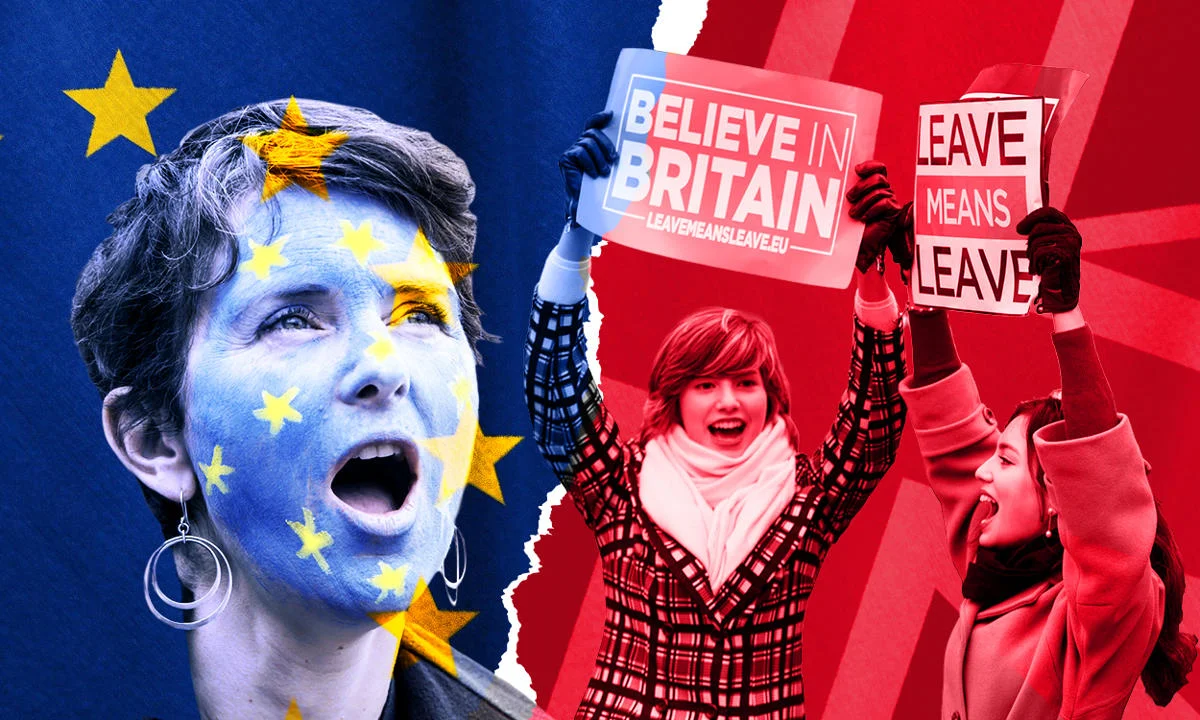
At the heart of the book is a simple but significant claim: Brexit created two new political tribes, Leavers and Remainers, that became central to how people saw themselves and others. “It became a way that people looked at themselves – similar to how we might have a partisan identity. It became a social group identity but based on the referendum rather than based on an affiliation and a closeness to a party.”
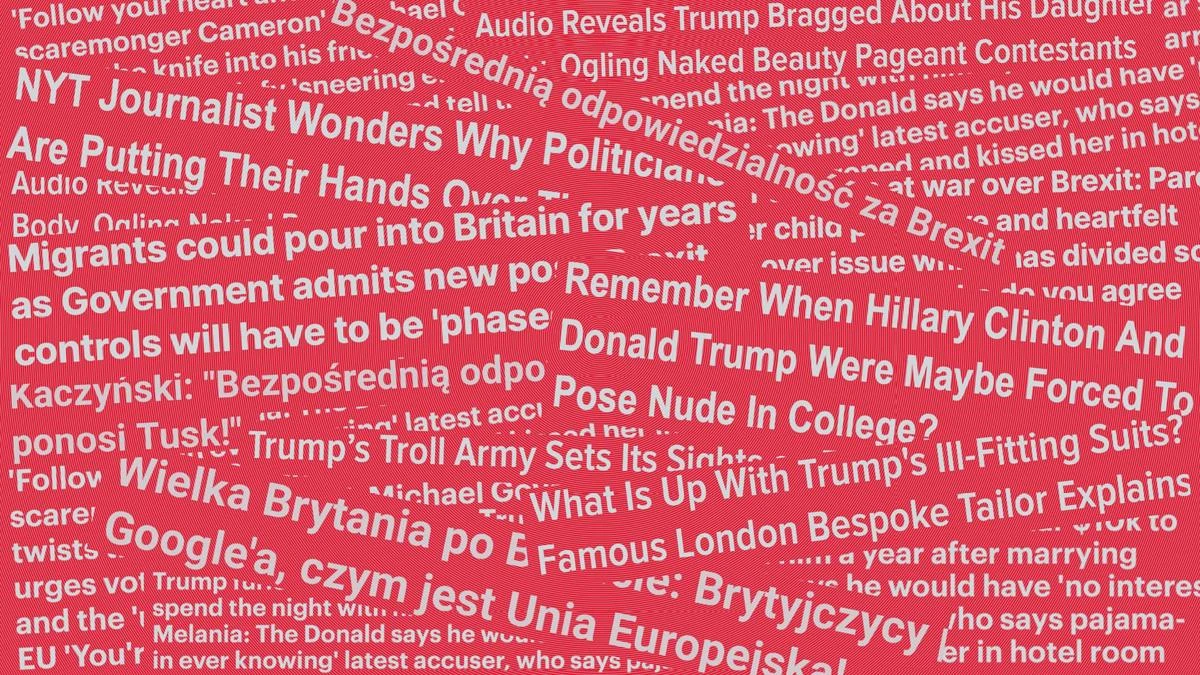
![[Brexit] became a social group identity.](/all-images/brexit-eu-britain-political-identities-1200-x-628.x4f6b8fc6.jpg?w=1200&h=628&q=85&f=webp)
Forming new political identities
Most political disagreements do not turn into identities. People hold views on multiple policy areas, for example income tax, without those views defining who they are. What makes Brexit different, Professor Hobolt argues, is that it crossed a threshold from opinion to identity.
“And that's not just about political views, as in ‘I want to stay in the EU’ and ‘I want to leave the EU’,” she says. “It became a social group identity. And so what we do is we offer a more general theory of what we call issue-based identities.”
Issue-based identities, as Professor Hobolt defines them, are political identities rooted in positions on specific issues rather than longstanding social categories such as class or religion. Tribal Politics explains that Brexit identities were not simply expressions of existing divisions.
“We show how those identities were formed and how they weren't just an expression of other kind of identities, like class or national identity. And we show the consequences of what it means when you have these tribal identities that meant people started looking at the world differently, looking at the other groups differently, even discriminating against people belonging to the other tribe.”
The Brexit referendum itself created new lines of political belonging, with powerful consequences.
The “Goldilocks” conditions for tribalism
For an issue to generate a political identity, Professor Hobolt argues, it must meet a rare combination of conditions. In Tribal Politics, this is described as a “Goldilocks mixture” of factors.
“We identify three factors,” she says. “These are: issue contestation, issue expression and issue alignment.”
Issue contestation refers to the combination of high salience and deep division. “You can imagine issues that are divisive, but not salient,” Professor Hobolt notes. For example, simple like/dislike scenarios such as liking a particular type of food. Equally, some issues are salient but not divisive, for example particularly harsh laws that wouldn’t be supported by the majority of the population. Brexit was unusual because it became both. “The public was almost equally split,” she explains, and the issue became “extremely salient”, especially after the referendum result.
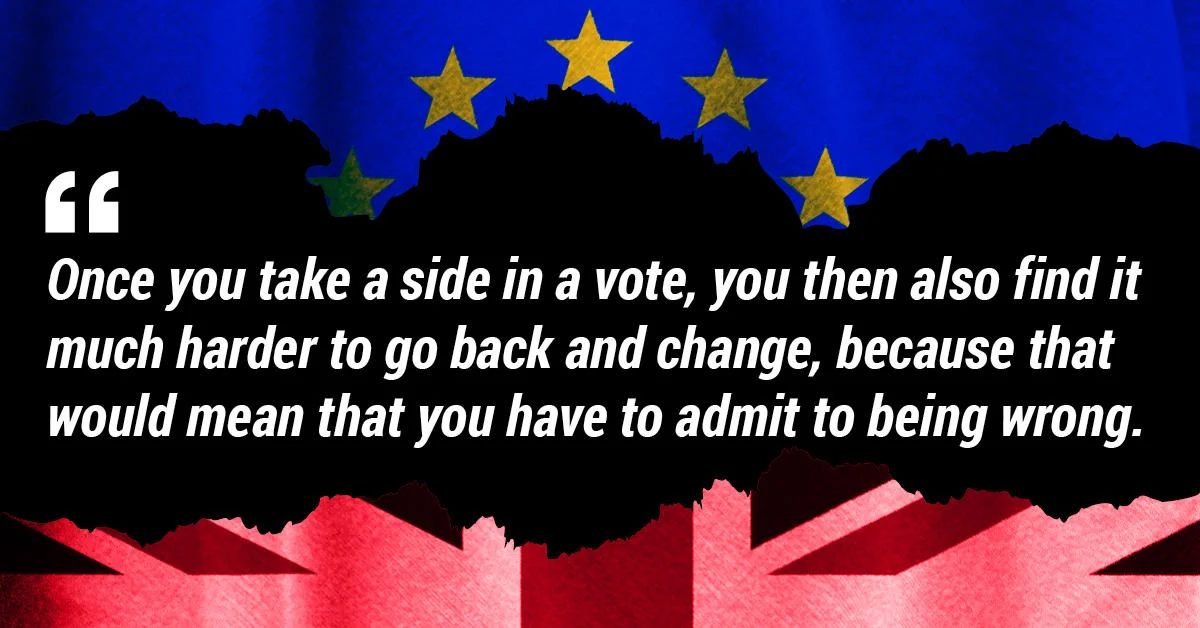
The second factor is issue expression. “What does a referendum do?” Professor Hobolt asks. “It forces you to take a stance and express that you're compelled to vote. Once you take a side in a vote, you then also find it much harder to go back and change, because that would mean that you have to admit to being wrong.”
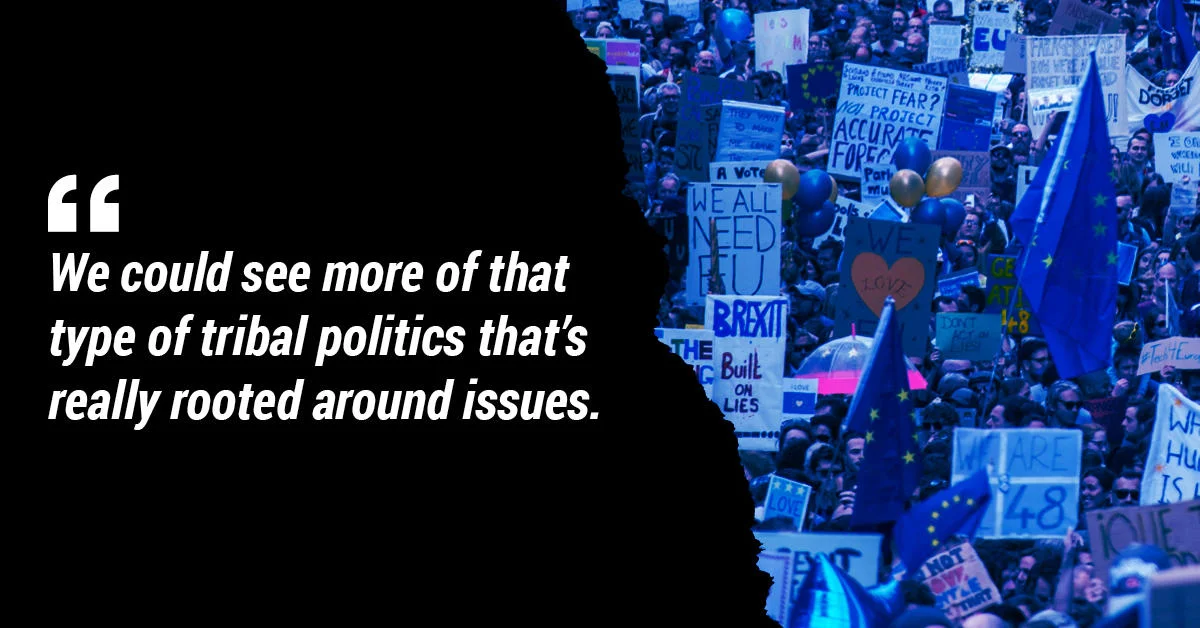
Crucially, that expression did not end with the vote: “we had some of the largest demonstrations we've ever seen, and six million people signed a petition against Brexit. People could continue to engage and express their views and their commitment to their tribe.”
The final factor, issue alignment, may have mattered most in the British context. “What normally happens when you have a very salient issue is that you have something that's at first really salient, but then it gets absorbed into existing divisions along partisan lines,” Professor Hobolt explains.
“What happened from the very outset with Brexit was that it was a Conservative government under David Cameron that proposed the vote and, in fact, campaigned to remain in the European Union. And the main proponent on the Leave side was Boris Johnson and, second to that, Michael Gove – two Conservative politicians. If you analyse the coverage, you're seeing from the outset there was an intra-party Conservative divide. And although the Labour Party was mainly on the Remain side, it wasn't exclusively. Jeremy Corbyn had a history of being a Eurosceptic, and he was reluctantly campaigning for Remain.”
This resulted in highly ambiguous, muddled party cues from the two major parties.
Brexit identities: why have they lasted so long?
Political identities typically endure because they are reinforced by institutions including parties, leaders and elections. Brexit identities lacked these organisational structures yet have proved incredibly long-lasting.
“The most salient political identity that we normally think of is partisanship,” Professor Hobolt explains. Parties provide “a very clear set of leaders” and “ongoing institutionalised competition around power”, neither of which were offered by Brexit identities.
And yet a decade later, “two thirds of people say: I feel like a Leaver, I feel like a Remainer.” More strikingly, “the emotional resonance of those identities is still higher than belonging to or feeling attached to the Conservative and Labour Party.”
Professor Hobolt admits this persistence surprised her. “I would have thought that after COVID, where Brexit really fell off the agenda, that people would have decided it didn’t matter,” she says. “But it has had more of a stickiness. I wouldn’t have expected it to be salient for people quite that long.”
When elites create mass division
One of the book’s most striking arguments is that Brexit became an identity issue despite widespread public indifference beforehand.
“British people mostly didn't care that much about the EU,” she says. “It wasn't seen as a top issue ahead of Cameron's decision to call the referendum.” When he announced the vote, “it was about two per cent of the British populace that said that the EU was in any way the top issue.”
The referendum, she argues, emerged from elite conflict rather than popular demand. “It had much more to do with intra-party politics,” she explains. Once unleashed, however, it produced consequences elites could not control.
“This means that referendums can often have elite-defining consequences. First of all, you don't necessarily get the outcome you want, but they can have these longstanding consequences in how people look at politics.”
How Brexit shaped our tribal perceptions
As Brexit identities solidified, they reshaped not just opinions but perceptions of reality itself.
“People are ultimately social beings, and we operate in the world with social identities,” says Professor Hobolt. These identities provide belonging and self esteem, but they also create out-groups. “To have that”, she explains, “you tend to need to feel that your group is superior”.
This dynamic fuels confirmation bias. “When our preferred party is in government, we like to think that the economy generally is doing a lot better than it actually is.” Brexit intensified this pattern. Remainers and Leavers interpreted economic shocks, energy crises and political failures through radically different lenses.
“If you feel that Brexit was a terrible decision and you identify as a Remainer,” she says, “you would process information in a way that's consistent with that identity.” On the other side, “you think it's nothing to do with Brexit.”
The result is reinforcing divergence. “You become more and more convinced that you are right, the others are wrong.”
In Tribal Politics, Professor Hobolt outlines four scenarios for Britain’s political trajectory: restoration; revival; realignment; and replacement.
Restoration, which is a return to traditional left-right politics, appears unlikely. “It’s certainly not where we are”.
Revival, where Brexit re-emerges as the central dividing line, would require political entrepreneurs willing to reopen the issue. “That's not on the cards right now”.
Realignment, however, is already visible. “It’s not Brexit that's at the top of the agenda,” Professor Hobolt explains, “but the issues that aligned with that divide, what one might call culture war issues - immigration, sovereignty and multiculturalism – continue to structure political conflict.”
The most dramatic scenario is replacement: “the collapse of party politics and party competition in Britain, as we know it”. With parties such as Reform UK and the Greens drawing support from clearly defined Brexit tribes, Professor Hobolt suggests the groundwork for fragmentation is already in place.
Democracy after tribalism
Another big change to emerge from Brexit was a movement of people taking part in the political process. “People voted who hadn't voted in many, many elections,” she says.
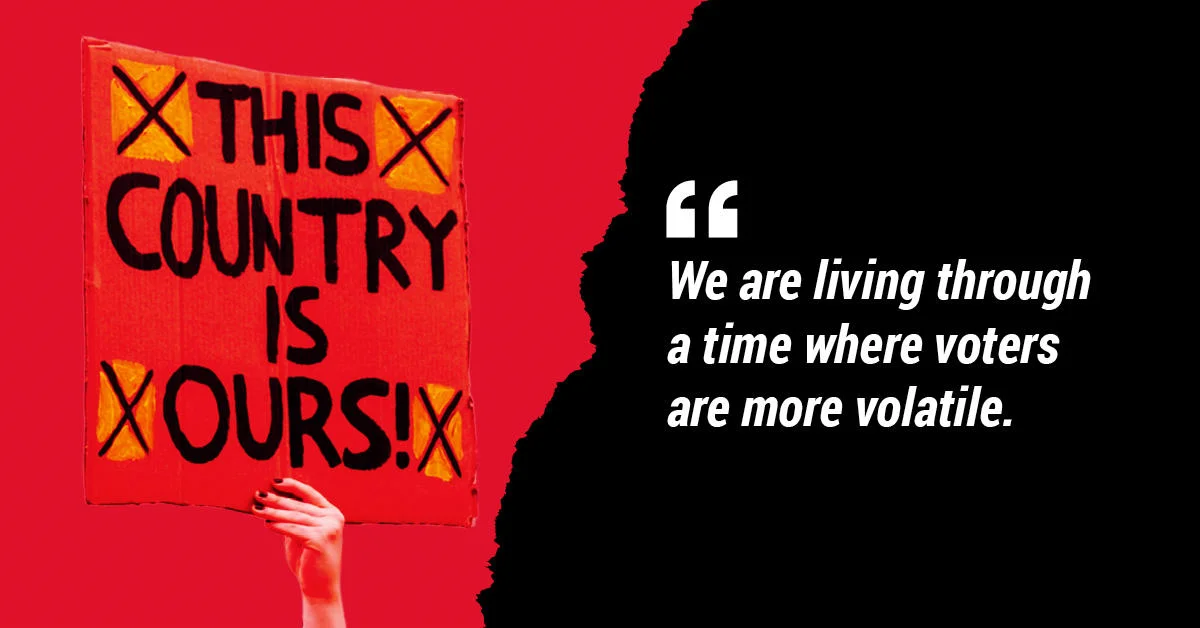
Whether future political moments generate similar identities remains uncertain. “We are living through a time where voters are more volatile,” Professor Hobolt reflects. “I can't necessarily predict which ones, but we could see more of that type of tribal politics that’s really rooted in issues.”
Ten years on, Brexit’s deepest legacy may not be Britain’s changed relationship with Europe, but the lesson it offers about how quickly, and lastingly, democratic societies can fracture along new lines of identity.
Professor Sara Hobolt was interviewed by Helen Flood, Media Relations Officer at LSE.
Professor Sara Hobolt will be one of the speakers at an LSE event, Ten years on: Brexit and Britain's political future, on 8 June 2026.
LSE Research Showcase is a series of 20-minute talks from LSE researchers to enjoy on your coffee break. Catch up on YouTube.
Subscribe to LSE Research for the World
The London School of Economics and Political Science (LSE) is a world-leading university, specialising in social sciences and ranked top in the UK by The Times and Sunday Times Good University Guide 2026. Based in the heart of London, we are a global community of people and ideas that transform the world.
Sara B Hobolt

Related content
Why online tabloids are better at predicting the public’s political mood than broadsheets
Inside the mind of a voter
Why don't we level up?