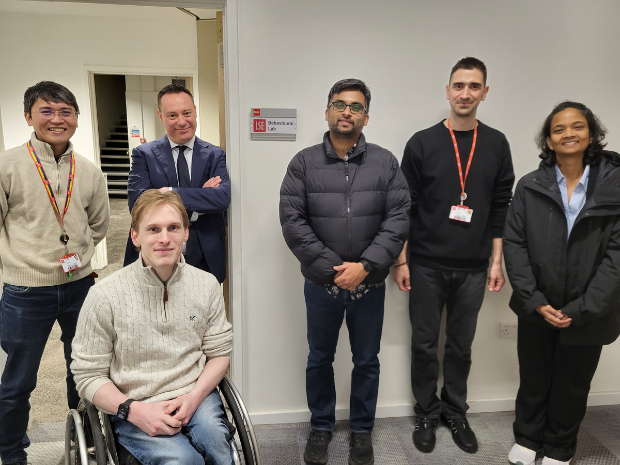
 Members of the Reap Benefit team visit the LSE Behavioural Lab
LSE Behavioural Lab, LSE’s world-leading lab for behavioural insights, has partnered with Reap Benefit to undertake a project focused on how behavioural interventions can encourage young people to adopt pro-environmental behaviours through digital nudges.
Reap Benefit, the Lab’s social venture partner, is an Indian non-profit organisation that empowers young people to take local civic and environmental action through a digital platform that engages hundreds of thousands of young people (their “Solve Ninjas”) across the country.
The project, funded by an £82,000 research grant from the 100x Impact Accelerator, will look to combine behavioural science with digital environments through a WhatsApp chatbot to identify interventions that can strengthen climate action at the community level and inform both policy and practice.
Barbara Fasolo, Director of the Behavioural Lab, said “We are thrilled to have the opportunity to work with Reap Benefit - not just to uncover new ways to have positive impact on the environment, but also because it gives us a unique opportunity to collaborate with a population on which very little behavioural research has been done - outside of school settings: young people! As this Nature piece fittingly put, youth are worthy of scientific investigation in their own right, representing a quarter of the world population. This is even more true in India, where over a quarter of the population is between 10 and 24 years old. We are grateful to 100x and the LSE for the support so far and are looking forward to launching our digital interventions soon.”
Matteo M Galizzi, co-Director of the Behavioral Lab, said: “This is a wonderful opportunity to partner with Reap Benefit, a leading NGO in India, in order to test, fine-tune, and implement behaviourally-inspired digital interventions involving a large pool of their young members and activists. The idea is to run a series of longitudinal randomized controlled field experiments to test the best ways of empowering young people in India to sustainably engage in environmental actions. We are really grateful to the LSE, to 100x and to Reap Benefit for this exciting and promising initiative!”
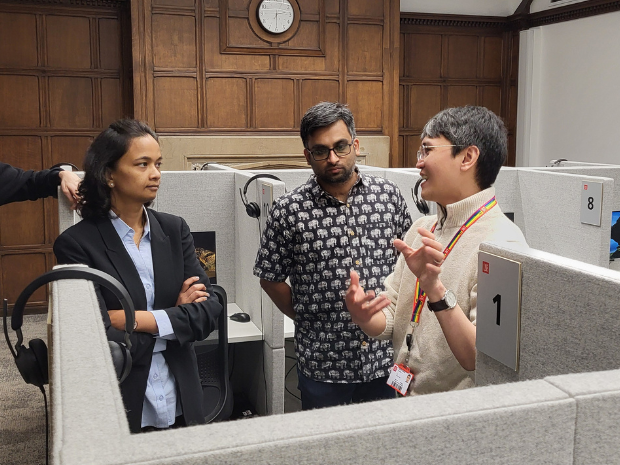 Reap Benefit receive a tour of the Behavioural Lab facilities.
Ploutarchos Kourtidis, postdoctoral researcher and Manager of the Behavioural Lab said: “This project offers an opportunity to generate evidence on how digital behavioural interventions can support climate action among young people in real-world settings.”
We hope this research contributes to a better understanding of behavioural interventions, climate-related decision-making, skill-building, and youth engagement in digital environments - areas where experimental field data is limited. Ultimately, the findings can inform and improve programme design for Reap Benefit, helping to maximise their meaningful impact on sustainability outcomes and community-led environmental actions.”
Kuldeep Dantewadia, Co-Founder and CEO at Reap Benefit said: “The core of our work is: how do we get young people in India, from the ages of 13 to 21 to start taking hyper-local climate and civic action. We believe that when they take this local action, not only are they building their own agency and skills, but they are also increasing the capacity of the government through quick data and quick solutions, closing the feedback loops.
“This collaboration with the LSE Behavioural Lab will help us understand what we’ve been doing well, what we’ve not been doing well, and provide a research-backed structure for how online engagement transitions into real-world action.”
Reap Benefit has extensive experience mobilising youth around sustainability issues, offering a unique opportunity to examine how behavioural science can be translated into meaningful, everyday environmental actions.
100x Impact dedicate up to £500,000 each year to support evidence-based research at LSE. Through these grants, they provide a link between LSE researchers and visionary social entrepreneurs.
Read our interview with Reap Benefit about the collaboration on this project.
If you like this story and are curious about the LSE Behavioural Lab or want to run a study, please contact the lab at bl@lse.ac.uk.
Wednesday 1 July 2026