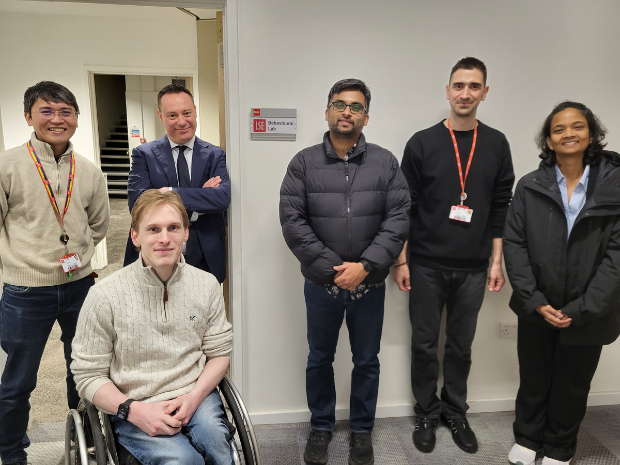
 Kuldeep Dantewadia (third left) and Pooja Pawar (first left) visit the LSE Behavioural Lab
We spoke to Kuldeep Dantewadia, Co-Founder and CEO, and Pooja Pawar, Senior Director, from Reap Benefit to learn more about the project, the collaboration with the Behavioural Lab, and how behavioural nudges can play a role in encouraging pro-environmental action among Indian youth.
Can you give us a summary of the project and how it’s going so far?
Pooja:
The idea for this project is to understand how over time, when you work with youth, they will start engaging with climate and civic issues and act on those issues, as well as how their skills will be developed while doing so.
The nudges that we send them play a pivotal role, so the scope of the project is to understand what impact these nudges have and how they incentivize certain behaviour, ultimately to get young people engaged and taking action on the ground.
Through the project, we hope to see what parts are working, what’s not working, and how we can improve our nudges to increase the numbers of young people we can engage and maintain action with.
Kuldeep:
The core of our work is to understand how we get young people in India, from the ages of 13 to 21, to start taking hyper-local climate and civic action.
The belief is that when they take local action, not only are they building their own agency and skills, but they are also increasing the capacity of the government through quick data and quick solutions, closing the feedback loops.
But the main focus is action-taking. Getting young people to take pro-social, pro-climate, action is very tough, and awareness does not always lead to action.
One of the advantages we have in Reap Benefit is that we have young people who are taking these community actions on the ground, but we also have a very strong tech platform, where we engage with around 150,000 – 200,000 young people. Once they are on the tech platform, the idea is that we still get them to start taking actions in their local communities.
Over the years we have realised that if it is very academic and school-like, young people start resisting it, so nudging has been a very powerful way to deliver just enough of a push to succeed.
We’ve reached a point where we’ve been doing things in an ad hoc way based on our ground understanding based our practitioner’s intuition. But now we are at a time when collaborating with the LSE Behavioural Lab will help us understand what we have currently been doing well, what we have not been doing well, and give us a template for how this online/offline transition works smoothly and leads to action. This is what we’re excited about.
Hopefully, through this project, we can scale much quicker in collaboration with governments and grassroots organisations.
What do you hope the collaboration with the LSE Behavioural Lab will lead to?
Kuldeep:
One of the things we hope to gather from the collaboration is an understanding of what a structured framework for operating would look like. As grassroots practitioners, we oftentimes operate on intuition, and while there can be a deep power within on-the-ground intuition, backing it up with an academic framework would be really valuable.
So, the AB testing we’ll be doing as part of the project will help us understand that framework and fill in the gaps, let us know what we should be doing and what’s working, and give us a game-plan to help address those gaps.
With our pool of 150,000-200,000 users, we’ll be looking at a how they’ll interact with the WhatsApp chatbot which will be delivering the nudges.
What do you hope the insights will give you in terms of real-world impact for your operation and Reap Benefit?
Kuldeep:
We hope insights from the project will give us two things:
The first is real-world community action taking. This is a huge gap, so hopefully after this intervention, we’ll be able to say we increased community action taking through the measures we’ll implement.
The second thing it will give us is hyper-local data on what types of actions are actually being taken, which will help at a systemic level but also at an individual level.
Pooja:
One additional area we hope to gain understanding is around AI and how it is impacting the youth currently. Not only is AI rapidly developing, but the environment around young people is also rapidly changing. So, we want to understand how we also keep evolving – is there a certain framework that we can keep in mind with these evolving changes?
What are some examples of action that people are taking through Reap Benefit’s outreach?
Kuldeep:
We classify actions young people can take into 5 buckets: reporting, campaigning, building and implementing technology, building and implementing solutions, and understanding local policy.
So, we have young people who report stubble burning - the practice of setting fire to leftover crop residue after harvest which is a big source of air pollution in the north of India – and they have created heat maps of their reports and taken them to the government, who instituted a short-term policy to combat air pollution in the region.
Another example is team members who have understood the sanitation facilities in public Schools, and they have influenced the government to increase their budget.
We have people who have built solutions, such a low-cost real-time air quality monitor station, and a smart water meter which nudges people to use less water from the tap when washing their hands.
The main thing is that it is hyper local in nature. They should see, feel, or experience the problem on an ongoing basis and take problem solving actions to address it.
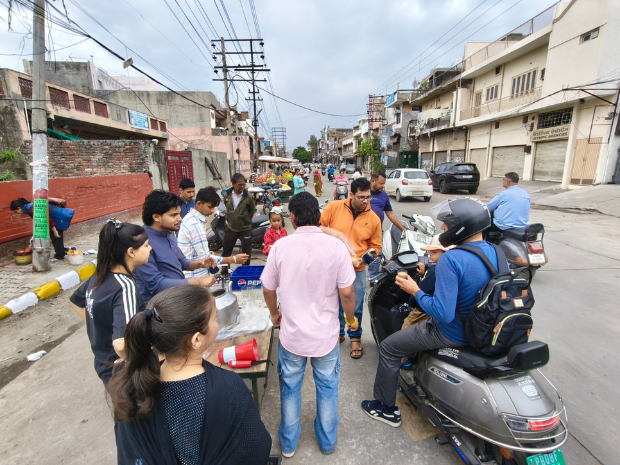 Reap Benefit's Solve Ninja take action in India.
What is your long-term goal for Reap Benefit?
Kuldeep:
We call our young people who take action, “Solve Ninjas”. Our goal is to see 10 million Solve Ninjas in India solving local issues, on a day-to-day basis. Technology will play a very significant role in contributing to scaling our operation, and nudging will play an even more important role. Because when we’re asking young people to come and solve real issues – which isn’t necessarily their mandate – we are trying to do something intrinsically and extrinsically for them to do that in their neighbourhood.
We’re building a new generation of human capital in India, with the skills and agency gathered from solving real world issues. And by doing that we’re adding value to the state and the system.
We would potentially like to build an alliance of similar organisations. Our key focus is hyper localised issues in India, as we believe that you need to be in a location to really understand its issues and the means to solve them. But there are a lot of practices that can be shared through a network-based approach.
What makes Reap Benefit’s approach unique?
Kuldeep:
The novelty in our approach is how we’re linking the pro-social and pro-climate behaviour with real world skill development - showing them that they’re not just doing this action in isolation, it’s building their skills and adding value to young people’s lives.
Lots of our Solve Ninjas get changemaker funds – microgrants to work on their ideas. We help them with learning and leadership opportunities and work entry opportunities, such as internships and apprenticeships.
The other unique thing about us is the production of hyper-local data about these specific issues. In India, this is particularly powerful where data like this is not always available.