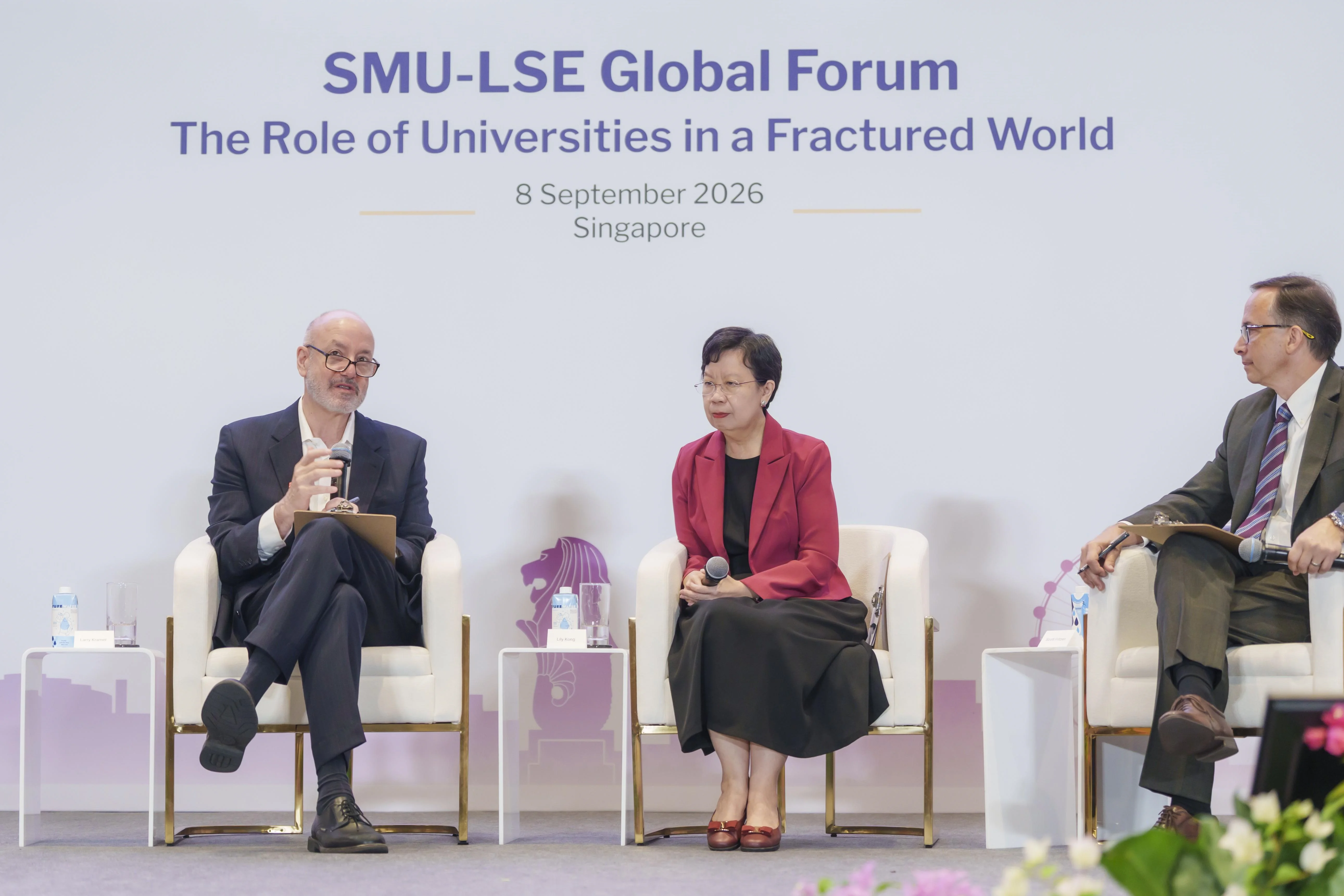

LSE-SMU Global Forum: The Role of Universities in a Fragmented World
On 8 September, LSE President and Vice Chancellor, Professor Larry Kramer, spoke at the inaugural LSE-SMU Global Forum, examining how universities can navigate the world’s most pressing challenges together.
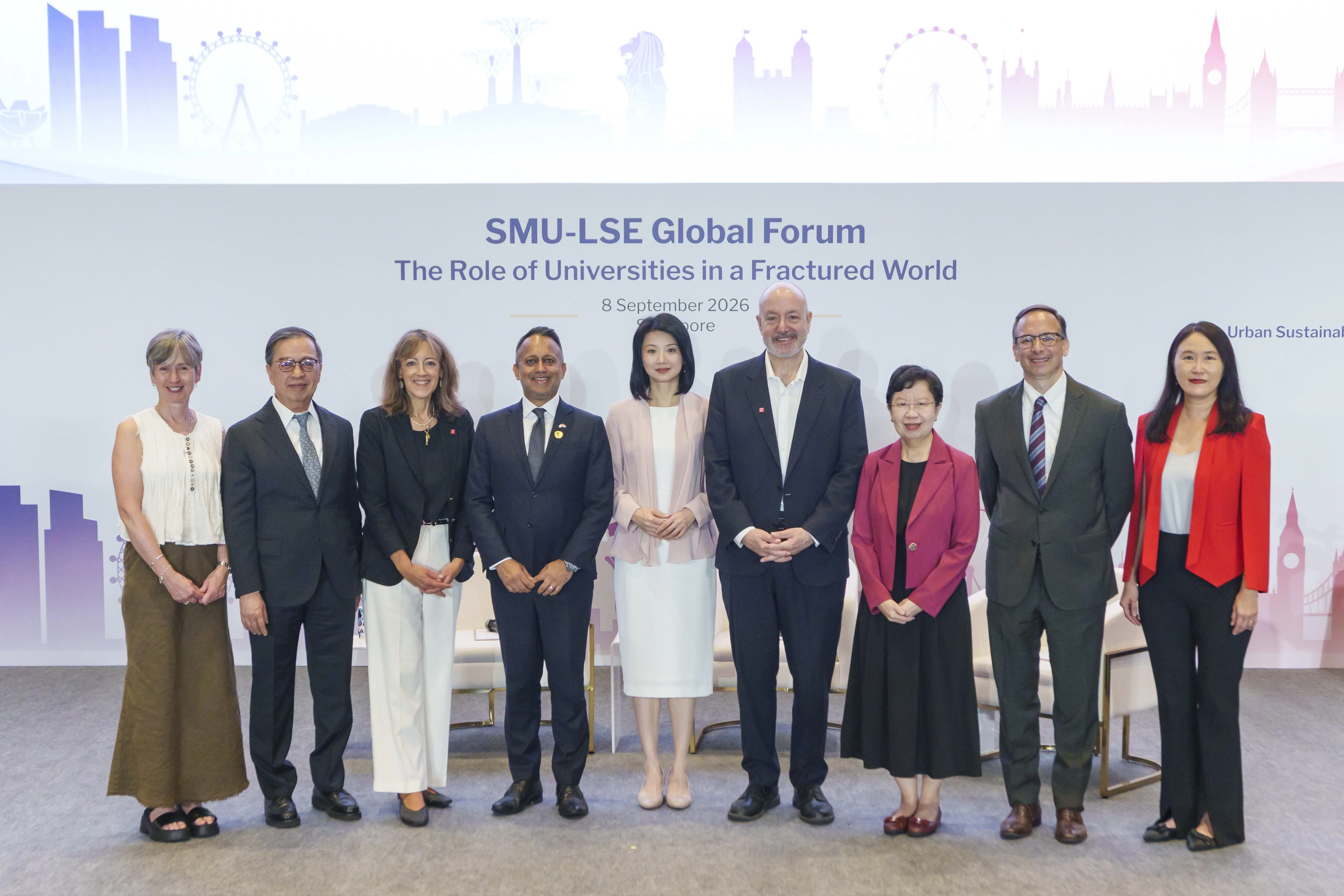
In an increasingly complex and fragmented world, universities are uniquely positioned to bridge communities, advance knowledge, and tackle society’s most pressing issues through collaboration.
LSE’s President and Vice Chancellor, Professor Larry Kramer, and Singapore Management University’s (SMU) President, Professor Lily Kong, had the opportunity to discuss this at the inaugural LSE-SMU Global Forum. Delving into the role of universities in an increasingly fragmented world, both senior leaders examined how LSE and SMU institutionally adapt to the changing global ecosystem in front of 150 attendees.
LSE and SMU's National and Institutional History
This fireside chat follows LSE and SMU's first official collaboration, when both institutions launched the LSE-SMU joint research seed fund in January 2026. The fund is intended to support projects related to Artificial Intelligence (AI), the future of work, urban sustainability, and healthy ageing, and reflects the bilateral priority of ambitious innovation.
This partnership is a continuation of years of engagement through collaborative research between LSE and SMU, including co-authored studies on political texts and issue salience for political parties using large language models, and our joint participation in the Global Alliance on Sustainable Urban Societies.
The event began with an address from the Guest of Honour, Senior Minister of State, Ministry of National Development & Ministry of Transport, Ms Sun Xueling. Sun is also an LSE alumna, having received her MSc in International Political Economy. She stated that "SMU and LSE are well-placed to observe first-hand how shifting socio-economic realities impact businesses, residents and communities. By serving as living laboratories, universities can contribute to building resilient cities that evolve and respond to changing needs."
Mr Nikesh Mehta, the UK High Commissioner to Singapore, also provided remarks. Mehta added that the partnership between LSE and SMU contributes towards the shared values held by the UK and Singapore in education and innovation.
The LSE-SMU Joint Seed Fund
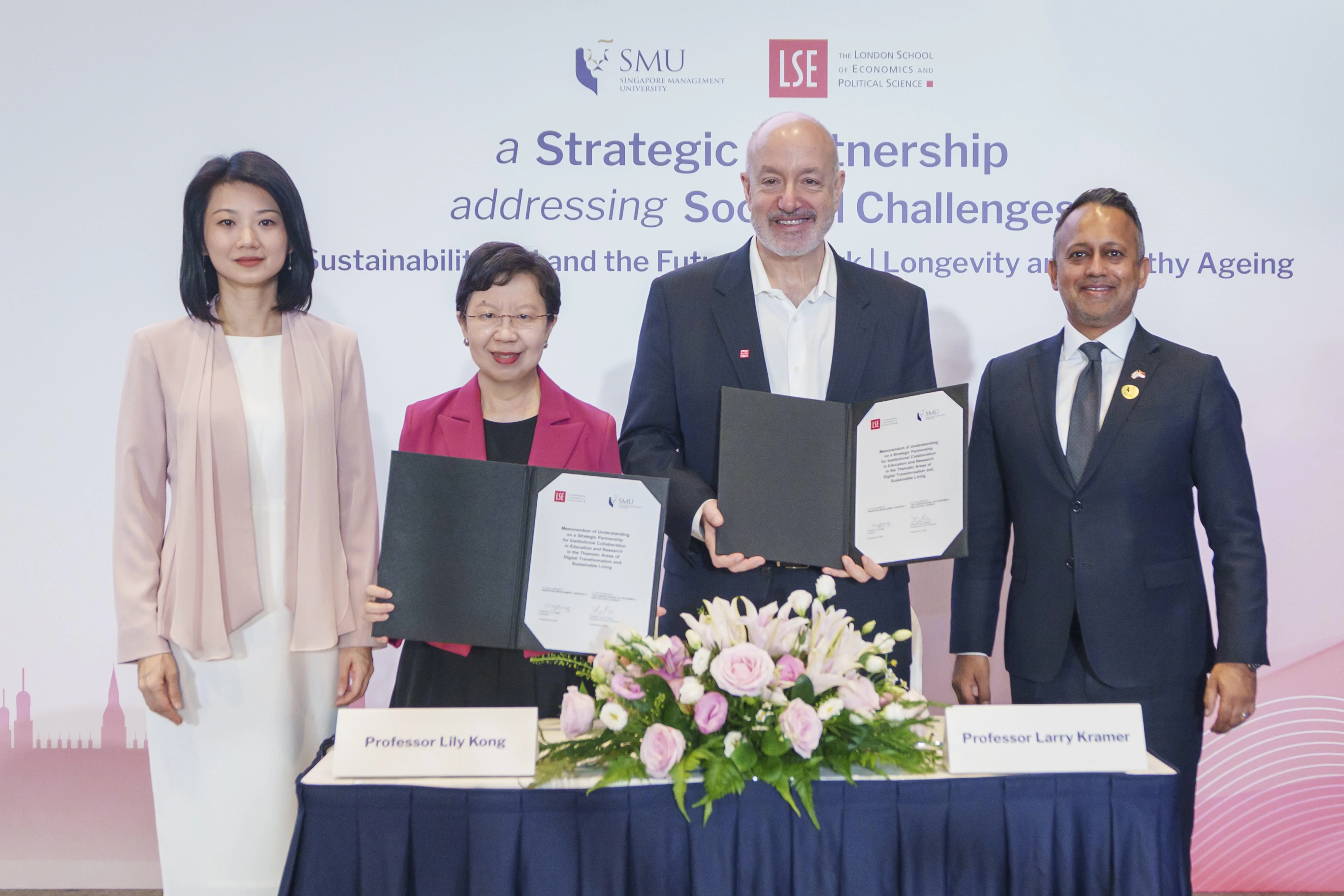
Professor Larry Kramer and Professor Lily Kong proceeded to sign the Memorandum of Understanding to formalise our strategic research partnership, with Sun and Mehta as witnesses.
Our institutions are delighted to award three projects:
- “Data Centre Urbanism in Comparative Perspective: Infrastructural Pathways, Cloud Capital, and Sustainability Transition in Johor, Singapore and London” with Professor Hyun Bang Shin (LSE), Professor Andrew Stokols (SMU) and Professor Orlando Woods (SMU)
- “Outsourcing the Leader Self: Generative AI, Agency, and Identity in Leadership Work” with Professor Burak Oc (SMU) and Professor Niranjan Janardhanan (LSE)
- “Valuing Ageing in Place: A Discrete Choice Experiment on Housing and Care Preferences Among Older Singaporeans” with Professor Seonghoon Kim (SMU) and Professor Joan Costa-Font (LSE)
Research related to these projects, examining urban sustainability, Artificial Intelligence (AI) and the future of work, and longevity and healthy ageing, will commence in October 2026 and continue until September 2027.
The Role of Universities in a Fragmented World
After the signing ceremony, Professor Larry Kramer and Professor Lily Kong held a fireside chat on ‘The Role of Universities in a Fragmented World,’ moderated by the SMU Vice President of Impact, Professor Scott Fritzen. Professor Fritzen asked each President questions relating to the mission, architecture and management of each institution in the current age.
This theme was chosen as universities are uniquely positioned to bridge communities and advance knowledge in an increasingly complex and fragmented world. With LSE and SMU both sharing a specialism in the social sciences, our institutions recognise the importance of maintaining an intellectually rigorous environment that responds to global challenges.
LSE President Larry Kramer affirmed the importance of social science institutions, stating: "If you think about the problems that we face within our societies, there are few institutions that are better set up than universities to be able to think clearly about this. The independence that universities have, the culture that we have for fostering honest and active debate across differences, is actually one of the best ways to get the best outcomes that we can. We are also training the generation of leaders who are going to go out and take the ideas that are coming out of universities and implement them in real life."
When discussing how universities demonstrate the value of their work to society, President Lily Kong said: "Academics have been trained to think about publications, citations and rankings. But in an increasingly complex world, universities must reinvent themselves to be relevant. We must encourage academics to think beyond publications—how their work can make a difference to business, government and society—and how university systems and academic culture can better support them. Policy change is usually based on the accumulation of knowledge, sometimes without attribution. And so we need to recognise the difference between an academic's contribution and attribution, and the equal importance of both."
Both Presidents reiterated that in a fragmented world, collaboration, like LSE’s active relationship and knowledge exchange with SMU, is a meaningful vehicle to tackle challenges across borders. It is the responsibility of universities to evolve with changing and complex landscapes for the betterment of society.