

LSE Collaborators: A Spotlight on Singapore

Since 2020, LSE has produced over 150 joint publications with top Singaporean institutions, ranging across subjects from medicine and biochemistry to psychology and business. Our collaborations reflect the UK-Singapore shared commitment to cutting-edge innovation, research and global engagement.
The UK and Singapore share longstanding cooperation in economic links, legal traditions, and educational excellence. This includes the bilateral UK-Singapore Strategic Partnership, signed by the UK Government in 2023, as a catalyst for transnational opportunities. One of the strongest priorities between the nations, as evidenced in the governmental partnership, is advancing collaboration to ‘tackle global challenges and drive economic growth, and to safeguard our future security and bolster economic prosperity.’
In January 2026, LSE cemented its historic transnational synergy through a joint research seed fund with Singapore Management University (SMU). The fund advances projects related to Artificial Intelligence (AI), the future of work, urban sustainability, and healthy ageing, and shares the bilateral priority of ambitious innovation.
But before official agreements between institutions and governments were made, LSE maintained meaningful engagement with top Singaporean universities through collaborative publications, providing cutting-edge research responding to global challenges.
Dr Ho and the ongoing collaboration between LSE and SMU
This includes the work of Dr Christine Ho, a Visiting Senior Fellow at LSE and Professor of Economics at SMU. Professor Ho, an LSE alumna who did her BSc in Economics, also serves as the Academic Program Director of the Women in Social and Public Policy Research Hub (WISPPRH) at LSE. The Research Hub sits within LSE’s Department of Social Policy and develops research on the ‘causes and consequences of gender inequality in education, labour markets and the family.’ Professor Ho has been involved with several events organised by the research hub, related to early childhood human capital and education technology.
Additionally, Professor Ho recently co-authored a publication, ‘Childlessness and health in middle age and older adulthood: Evidence from Singapore,’ with colleagues from Hong Kong Baptist University and National University of Singapore. The article adopts infertility and the number of childless siblings as instruments for childlessness, investigating the causal effect of childlessness on the health of middle-aged and older adults in Singapore.
With a growing trend of childlessness among middle-aged and older adults globally, Professor Ho’s research provokes the need for responsive policies that bolster health services for ageing populations without generational support for their wellbeing. She stated that “the model of caregiving for the elderly will need to change if we want to meet the needs of the upcoming elderly population.” Her other research projects investigate education interventions for children with disadvantaged backgrounds in countries including Bangladesh, China and Indonesia.
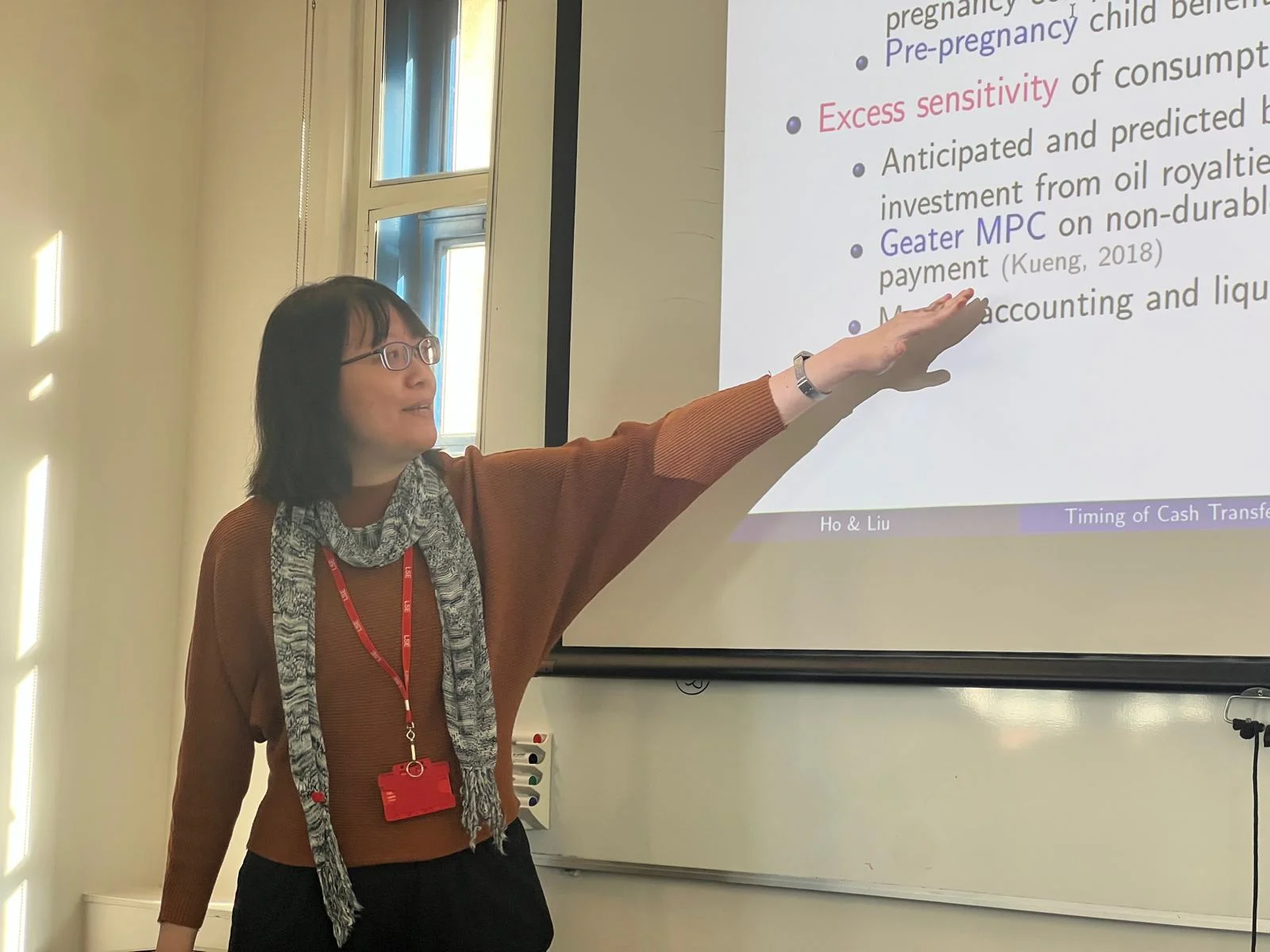
When asked about the significance and impact of her research portfolio, Professor Ho believes that the intersection of family and public policy is integral to improving human capital. “When designing a public policy programme, literature tends to focus on one family member,” Professor Ho shared. “But the husband and the wife will interact. If a grandparent helps with childcare, this will also interact.” As a result, Professor Ho’s research delves into the intricacies of family and intergenerational interactions, so that family-centred public policy accounts for a more complete understanding of household production.
Professor Ho believes that LSE and SMU have similar visions as global institutions. In particular, she sees a clear goal between the universities of wanting to produce impactful research. Collaborations like her project, in addition to our joint seed fund, represent the power of transnational thinking.
Expanding LSE’s research horizons with NTU
LSE and Nanyang Technological University (NTU) share a growing relationship, one where the social sciences and technology converse to respond to pressing global challenges. This momentum is best demonstrated in the collaboration between Professor Stephen Gibbons, in LSE’s Department of Geography and Environment, and LSE PhD alumni and current NTU faculty, Assistant Professor Cheng Keat Tang.
Professor Tang was originally Professor Gibbons’ PhD student in economic geography, and later a co-author on an LSE-NTU collaboration: "Are friends electric? Valuing the social costs of using power lines using house prices.” Their research uses a spatial difference-in-difference (DID) approach to isolate the causal effect of power lines on housing markets, revealing that real estate markets often discount housing prices when in close proximity to power lines. Professor Tang believes that "the project has roots in my PhD at LSE,” sharing that through collaboration with Professor Gibbons, “the project felt like a continuation of my training rather than a departure from it.”
Professor Tang has found both LSE and NTU to be hospitable environments for ambitious and policy-relevant research. This is complemented by their geography, stating: “Singapore is a city that takes urban and environmental policy seriously, and the university gives its faculty real room to pursue empirical research with a genuine policy relevance.”
Given that LSE and NTU have much in common, including “rigorous, policy-engaged social science, and are both based in global cities facing similar urban and environmental pressures,” Professor Tang hopes that this publication is the first of many collaborations between the two institutions.
In September 2026, A delegation led by LSE President and Vice Chancellor, Professor Larry Kramer, will visit Singapore to meet with current partners and discuss institutional synergy with new ones. Want to stay up to date with LSE’s International Strategy and Academic Partnerships team, including visits to our institutional partners? Be the first to know by subscribing to our newsletter.