

Global Alliance on Sustainable Urban Societies
An international partnership advancing interdisciplinary, people-centred research into the future of cities and urban societies.
AT A GLANCE
Five founding institutions spanning Europe, North America, Asia and Australia collaborate on comparative urban research, knowledge exchange and policy engagement.
About the alliance
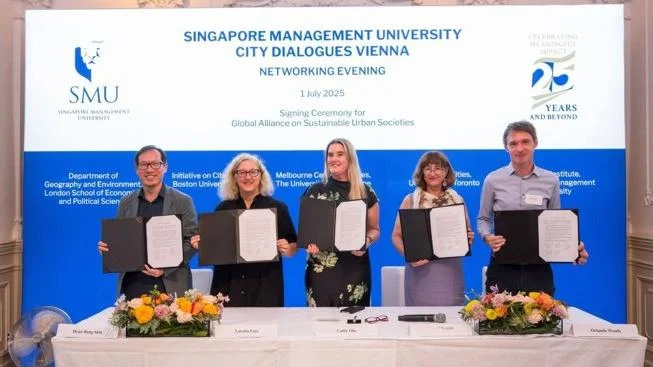
The Global Alliance on Sustainable Urban Societies (GASUS) brings together five leading urban research institutions: the Department of Geography and Environment at LSE; the Initiative on Cities at Boston University; the Melbourne Centre for Cities at the University of Melbourne; the School of Cities at the University of Toronto; and the Urban Institute at Singapore Management University.
Together, the founding partners provide a global platform for comparative research, intellectual exchange and collaboration on the social dimensions of sustainable urban change.
Our vision
People are not simply the recipients of urban policies and technologies. They are active participants in producing knowledge, shaping institutions and enabling sustainable change.
Formed around a shared vision of interdisciplinary and human-centred urban research, the Global Alliance aims to deepen understanding of how city dwellers sense, navigate and shape the urban environments they inhabit. The Global Alliance places particular emphasis on the “soft infrastructures” of urban life. These include, but not limited to, social and cultural norms, community networks, governance arrangements and economic relationships. Such infrastructures play an essential role in supporting resilient and sustainable cities and in shaping how societies respond to climate and digital transformations.
The Global Alliance strives to connect rigorous social-science research with practical urban-policy questions concerning resilience, equity, inclusion, behaviour and governance.
Research and collaboration
The Global Alliance aims to provide a framework through which its member institutions can:
- Develop joint research initiatives and academic publications;
- Co-host workshops and global conferences;
- Enable faculty and student exchanges;
- Support doctoral and early-career researchers;
- Adhere to responsible data-sharing protocols that uphold privacy and confidentiality;
- Build sustained partnerships across cities and regions.
Its initial areas of shared interest include housing justice, climate action and the digital infrastructure transition. The Global Alliance approaches these not as separate policy domains, but as interconnected processes that reorganise land, energy, data and everyday urban life.
Whether these transformations support just and sustainable urban societies depends not on technology alone, but also on the institutions, rules, relationships, public-participation practices and local knowledge systems that determine who benefits, who bears the risks, and who can remain and thrive.
Founding institutions and co-convenors
The Global Alliance is co-convened by representatives of its five founding institutions.
| Founding institution | Alliance partner | Co-convenor |
|---|---|---|
| Boston University | Initiative on Cities | Professor Loretta Lees |
| LSE | Department of Geography and Environment | Professor Hyun Bang Shin |
| Singapore Management University | Urban Institute | Professor Orlando Woods |
| University of Melbourne | Melbourne Centre for Cities | Dr Cathy Oke |
| University of Toronto | School of Cities | Professor Karen Chapple |
The Global Alliance’s first workshop
Soft Infrastructures for Sustainable Urban Societies
The first Global Alliance workshop will be held at LSE on 1 and 2 December 2026. The two-day workshop will bring together the Global Alliance’s co-convenors, invited contributors, early-career researchers, students and staff to develop a shared, people-centred agenda for building sustainable urban societies. Its discussions will connect three initial themes:
- Housing justice
- Climate action
- The digital infrastructure transition
The workshop will examine how governance, institutions, social norms, community networks and knowledge practices shape just transitions in different geographical contexts. It will also explore the connections among housing security, climate resilience and digital-energy infrastructures.
A dedicated early-career strand will support doctoral and early-career researchers in developing comparative research, shared methods and collaborative outputs. The programme will also include a public evening event.
Please visit this page for more details about the workshop.
News and press releases
- LSE: LSE joins other leading institutions to launch global alliance advancing human-centric urban research
- Singapore Management University: Rethinking cities through global collaboration