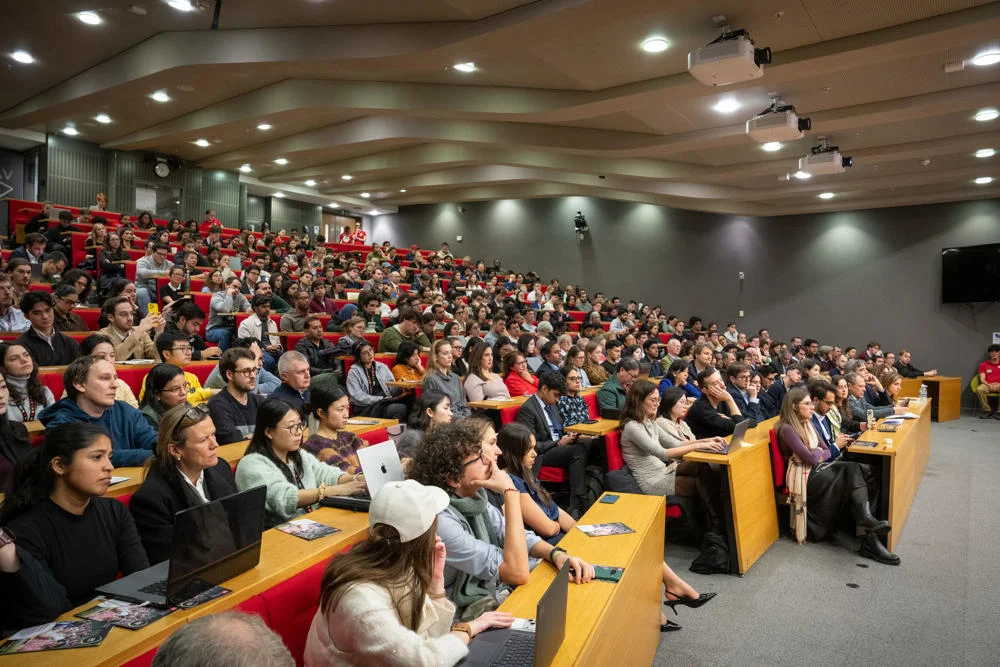
Celebrating Hilde Himmelweit: women, scholarship, and LSE’s intellectual history
Speakers


Join us to celebrate Hilde Himmelweit as part of LSE’s 130th anniversary programme, honouring the life and legacy of Hilde Himmelweit (1918–1989), a pioneering refugee scholar and one of the very few women to hold a professorship at the School in its early history.
Appointed Professor of Social Psychology in 1964, she played a pivotal role in establishing Social Psychology as a recognised field at LSE and made internationally influential contributions to media and communication research. Her landmark study Television and the Child (1958), the first major empirical investigation of television’s effects in the UK, helped shape debates about media and society for decades to come. Himmelweit’s remarkable journey, from forced migration to intellectual leadership, offers a unique perspective on the history of LSE, the contributions of refugee scholars, and the achievements of women in higher education. Bringing together colleagues, former students, family, and scholars, this event will reflect on her scholarship, leadership, and enduring impact on LSE and beyond.
Meet our speakers and chair
Susan Himmelweit is Emerita Professor of Economics at The Open University and the daughter of Hilde Himmelweit. A past President of the International Association for Feminist Economics, she is also the founding Chair and an active member of the UK think tank the Women’s Budget Group. Her research focused on gender, care, and intra-household inequality, with a particular focus on the gender implications of economic and social policy.
Sandra Jovchelovitch is Professor of Social Psychology in the Department of Psychological and Behavioural Science at LSE, directing the MSc in Social and Cultural Psychology. Her research focuses on community psychology, social representations, and development under adversity. She advises governments, international organisations, and NGOs on leveraging community knowledge for mental health and peace. Her publications include Knowledge in Context and the Favelas Communiqué.
Sonia Livingstone is Professor of Social Psychology in the Department of Media and Communications at LSE. The author of over 20 books, she has advised the UK Government, the European Commission, the UN Committee on the Rights of the Child, and UNICEF on media literacy, children’s rights, and digital risks and opportunities. She also directs the Digital Futures for Children Centre.
Shani Orgad is Professor of Media and Communications in the Department of Media and Communications at LSE. Her research and teaching focus on gender, inequality, migration, and feminist approaches to media and culture. She is the author of numerous journal articles, reports, and books, including Confidence Culture (with Rosalind Gill) and Heading Home: Motherhood, Work, and the Failed Promise of Equality.
Terhi Rantanen is Professor of Global Media and Communications in the Department of Media and Communications at LSE. She is the author of more than 120 publications, including nine authored and edited books. Her most recent book is Dead Men’s Propaganda: Ideology and Utopia in Comparative Communications Studies. Her research focuses on global media, news, and the history of media and communication studies.
Myria Georgiou is Professor and Head of the Department of Media and Communications at LSE. Author and editor of six books and over sixty peer-reviewed publications, her research explores migration, urban diversity, media, and social change. Professor Georgiou has served as a consultant to various regional and international organisations, including the Council of Europe on several major projects.
More about this event
Join us on campus or register to watch the event online at LSE Live. LSE Live is the home for our live streams, allowing you to tune in and join the global debate at LSE, wherever you are in the world. If you can't attend live, a video will be made available shortly afterwards on LSE's YouTube channel.
The Department of Media and Communications is a world-leading centre for education and research in communication and media studies at the heart of LSE’s academic community in central London.
Hashtag for this event: #LSEEvents
Any questions?
If you have a query see our Events FAQ or take a look at the information below.
You can also contact us at events@lse.ac.uk.
Many speakers at LSE events also write for LSE Blogs, which present research and critical commentary accessibly for a public audience. Follow LSE British Politics, LSE Business Review, LSE Impact, LSE European Politics and the LSE Review of Books to learn more about the debates our events series present.
If the event is live streamed, automated live captions will be available. Please note that this feature uses Automatic Speech Recognition (ASR) technology, or machine generated transcription and is not 100% accurate.
Photographs are regularly taken at LSE events both by LSE staff and members of the media and events are routinely filmed. Photographs from events taken by LSE staff are often used on LSE's social media accounts, with videos being made available on the LSE Player. If you have any concerns about this please contact the event organiser in advance of the event.
Please contact the Press Office if you would like to request a press seat or have a media query about this event, email LSE.Press.Events@lse.ac.uk. Please note that press seats are usually allocated at least 24 hours before each event.
We aim to make all LSE events available as a podcast subject to receiving permission from the speaker/s to do this, and subject to no technical problems with the recording of the event. Podcasts are normally available 1 week after the event. Podcasts and videos of past events can be found online.
Event updates and other information about what’s happening at LSE can be found on our Facebook page and for live photos from events and around campus, follow us on Instagram.
Livestreams and archive videos of past lectures are shared on our YouTube channel while event podcasts can be found on the LSE Player.
Attending our events in-person or online? Join the conversation using #LSEEvents.
If you are planning to attend this event and would like details on how to get here and what time to arrive, as well as on accessibility and special requirements, please refer to LSE Events FAQ. LSE aims to ensure that people have equal access to these public events, but please contact the events organiser as far as possible in advance if you have any access requirements so that arrangements, where possible, can be made. If the event is ticketed, please ensure you get in touch in advance of the ticket release date. Access Guides to all our venues can be viewed online.
LSE has now introduced wireless for guests and visitors in association with 'The Cloud', also in use at many other locations across the UK. If you are on campus visiting for the day or attending a conference or event, you can connect your device to wireless. See more information and create an account at Join the Cloud.
Visitors from other participating institutions are encouraged to use eduroam. If you are having trouble connecting to eduroam, please contact your home institution for assistance.
The Cloud is only intended for guest and visitor access to wifi. Existing LSE staff and students are encouraged to use eduroam instead.
From time to time there are changes to event details so we strongly recommend that if you plan to attend this event you check back on this listing on the day of the event.
LSE holds a wide range of events, covering many of the most controversial issues of the day, and speakers at our events may express views that cause offence. The views expressed by speakers at LSE events do not reflect the position or views of the London School of Economics and Political Science.
Subscribe to the LSE Events newsletter