

Prachetas Bhatnagar
Master of Public Policy (MPP) Class of 2021
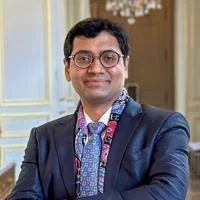
Name: Prachetas Bhatnagar
Programme: Master of Public Policy (MPP), Class of 2021
Job title: Head of Strategy & Operations, Policy & Politics at the Tony Blair Institute for Global Change (TBI)
Policy choices were too often reversed or met with backlash- not because the intent was wrong, but because the underlying thinking hadn't been sufficiently stress-tested. I wanted to understand why, and whether there was a better way.
Tell us about your role - what are your main responsibilities?
As Head the Strategy & Operations for the Tony Blair Institute for Global Change's Policy & Politics Practice, principally supporting the development of the Institute's 'Governing in the Age of AI' agenda, our central policy and political thesis is on how governments can reform the state around AI as the most consequential technology of our time, and rethink how they frame, sequence and deliver reform at a moment when technological capability, politics and public narrative are all moving at once.
My work at TBI sits at the intersection of policy, strategy and technology, including the creation of decision-grade leadership instruments that make the deeper structure around policy more visible: mapping actor constellations, tracing policy subsystems and identifying the patterns that determine how reform matures, aligns and holds. What makes this especially exciting is that many of these were previously mathematically intractable problems - AI now allows us to detect fine grained signals which are only analytically distinguishable.
These questions are not just institutional - they are global. I have spoken at the United Nations Office for Digital and Emerging Technologies, Palais des Nations, Geneva stressing on how Governments can drive AI adoption boldly, while building trust and ensuring that in doing so, no one is left behind.
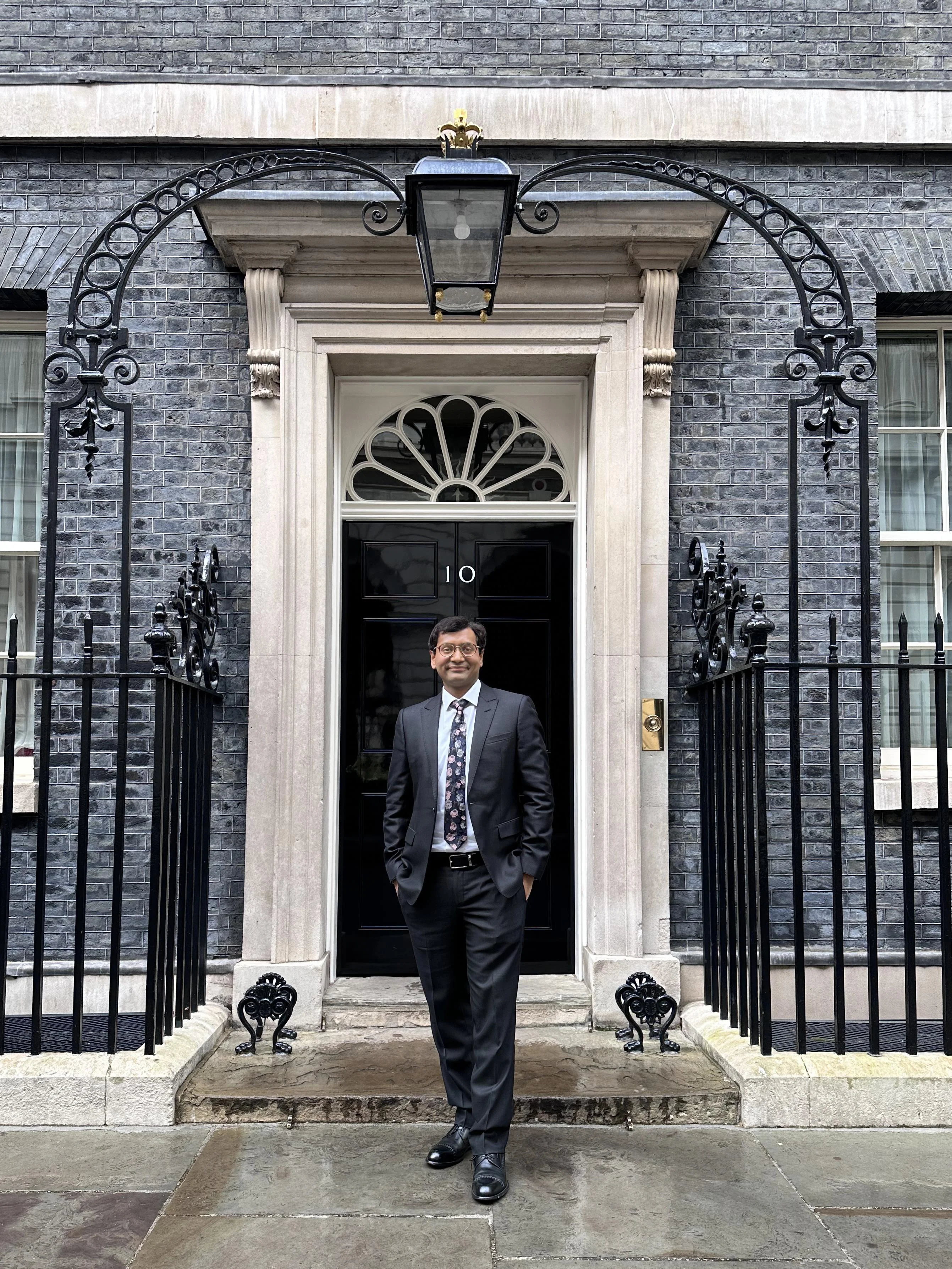
Congratulations on your recent visit to 10 Downing Street. What was
the purpose of your visit?
I visited Number 10 for a conversation with the Prime Minister's Chief Economic Adviser on how governments should think about AI adoption. At its core, this is not merely a tech conversation it is a civilisational one. AI has the power to reshape how states deliver for their people, how leaders make decisions, and how the relationship between citizen and state is experienced. By extension, it changes the very grammar of leadership itself. We discussed the multiple layers that need to come together for AI to deliver real value - from trust and governance, to foundational infrastructure and compute, through to the service layer where it improves frontline delivery.
These layers do not look the same everywhere. In countries such as India, trust in state-led digital adoption is often assumed much earlier. In the UK, it must be earned more deliberately, requiring governments to work on trust alongside adoption and execution. We also discussed the labour-market implications. AI tends to exert two forces: an augmentative force, enhancing human capability and raising productivity, and a substitutive force, replacing tasks though not necessarily whole roles. The balance between those forces differs by sector and depends heavily on adoption patterns.
What is the goal of your work? What are you hoping the impact will be?
The goal of my work is to ultimately help governments globally recognise the true scale of what is the Art of the Possible with AI, and to act with the seriousness that moment demands. The technology has already demonstrated extraordinary capability: DeepMind has mapped the structure of virtually every known protein, compressing decades of biological discovery into years and unlocking new frontiers in drug discovery. These are signals of what becomes possible when frontier AI is pointed at hard, consequential problems. The impact I hope for is tangible and human.
At TBI, we have already seen what this looks like in practice. Working with Starlink, we leveraged low-Earth orbit satellites to connect 100 rural schools across Africa, reaching 20,000 children, 2,500 teachers and over 30,000 learners in year one alone - while running intelligence over the data flowing from those schools to help governments make better, high precision policy choices. That work shifted the public narrative so powerfully that citizens began demanding more, which is the compounding effect I believe is possible at scale - technology deployed with clear governance intent, generating both immediate human value and the evidence base to drive deeper reform.

Why did you choose to study the MPP?
Having spent considerable time at McKinsey & Company and the United Nations working across the US, India, China and beyond mostly in public sector transformation I have always been deeply publicly spirited. The thread running through most of that work was a genuine conviction that government, and how it makes decisions, matters enormously for the lives it touches.
Across those experiences, I kept encountering similar patterns, though different in shape and form across geographies: government decisions, however well-intentioned, were rarely as rigorous, pre-emptive or analytically grounded as they could be. Policy choices were too often reversed or met with backlash- not because the intent was wrong, but because the underlying thinking hadn't been sufficiently stress-tested. I wanted to understand why, and whether there was a better way.
The MPP at LSE felt like the perfect convergence. Two things in particular drew me. The first was the art of developing counterfactuals: how do you construct the right what-if scenarios so that consequential choices are made with a clearer view of the road not taken? The second was understanding the deeper architecture of policymaking - how actor constellations form, how policy subsystems emerge, and how that shapes the possibility set available to governments.
How have your MPP studies and time at the SPP influenced your career journey and approach to your work?
The MPP gave me something I hadn't fully had before: the formal intellectual underpinning to match the instincts I had built over years in the field. It provided the right signalling to make a credible transition into the public policy space, but more importantly, it gave me the tools and analytical rigour to assess, frame and stress test policy in ways that genuinely hold up - the kind of rigour that LSE demands in its writing and thinking and that government and international organisations should rightly expect!
It fundamentally shifted my approach in two ways. First, it instilled a discipline of analytical precision - the understanding that every policy position must be interrogated, every assumption tested, every consequence traced. Culture, as the saying goes, ‘eats strategy for breakfast’. Seeing how the same problem is solved through entirely different means across different parts of the world and understanding why is not just academically enriching, it is practically essential for anyone working across geographies.
The network, too, has been enduring. Being surrounded by people equally passionate about these questions, drawn from over 15 countries, gave me both a global lens and a community of peers who continue to shape how I think. It is what allows me to contribute to these conversations not just as a practitioner, but as an informed global citizen.
What are the benefits of being part of the LSE SPP alumni
community?
The LSE alumni community is one of the most extraordinary professional assets I carry. The breadth and calibre of its alumni speaks for itself: from heads of state like Alexander Stubb of Finland; to UK Chancellor Rachel Reeves, IMF MD Kristalina Georgieva; and the Prime Minister's Chief Economic Adviser Minouche Shafik. These are people shaping the world's most consequential decisions. What I have found in practice is that reaching out with an LSE connection land warmly quite often. There is an immediate familiarity and affinity at minimum you get a good hearing, more often a genuine conversation. In a field where relationships and trust matter enormously, that shared foundation is not a small thing.
What inspires you?
What inspires me is that we are living through a period where the Art of the Possible is being rewritten in real time. AI above all energises me, not as a tech in the abstract, but for its sheer power and universality. It has something to offer everyone: the first-generation student navigating a complex system, the farmer receiving tailored advice in his own language, the clinician in an under-resourced hospital.
But the power of this technology runs deeper still. For governments, it is nothing less than a civilisational inflection point, a force that can fundamentally reshape how states deliver for their people, how leaders make decisions, and how the relationship between citizen and state is experienced. The very grammar of leadership is changing. What it means to govern, to serve, to build public trust - all of it is being rewritten. That is not hyperbole. That is the moment we are in.
And what grounds me through all of this is the belief that human imagination remains the final frontier. By conventional laws of aerodynamics, the bumblebee - whose wingspan is wholly disproportionate to its weight - should not be able to fly. And yet it does. That quiet defiance of expectation reminds me that reality always has more to offer than our current models suggest.
How we use this technology remains entirely within our hands. I often say that in the era of AI, imagination is the only barrier. That is what gets me up in the morning.
What is the best advice you have received? Do you have any advice for our students who are pursuing careers in your sector?
The best advice I have received is the distinction between Perception and Perspective. Perception is your interpretation of the world - unique to you but offering no informational advantage. Perspective is the ability to sit in the seat of the person opposite you, think like them, and gain an edge that most people in their own perception, simply don't have.
For students entering this field, one truth above all others: AI will be the most defining technology of your professional lives. It will reshape every sector, reframe every problem and change the very nature of how you interact with the world. The question is not whether AI will matter to your career- it will - but whether you learn to leverage it to test your imagination and solve problems that would otherwise remain out of reach. Those who master that combination will have no ceiling.
Third, apply the 10-10-10 test to every consequential decision - how does this choice feel in 10 minutes, 10 months and 10 years? Most people get the first two right. Getting all three is where wisdom lives! And remember – “In the era of AI, imagination is the only barrier” – Prachetas Bhatnagar.
Published in May 2026.