

Hasti Modi
Master of Public Administration (MPA) Class of 2022
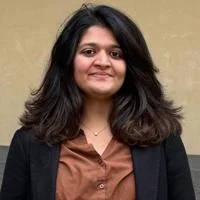
Name: Hasti Modi
Programme: Master of Public Administration (MPA) Class of 2022
Job title: Senior Consultant in Economic and Policy Advisory at EY Brussels
The MPA offered an interdisciplinary environment where economics, politics, governance and real-world implementation could all be studied together.
Congratulations on your new book! Can you tell us a bit more about it? What inspired you to write the book?
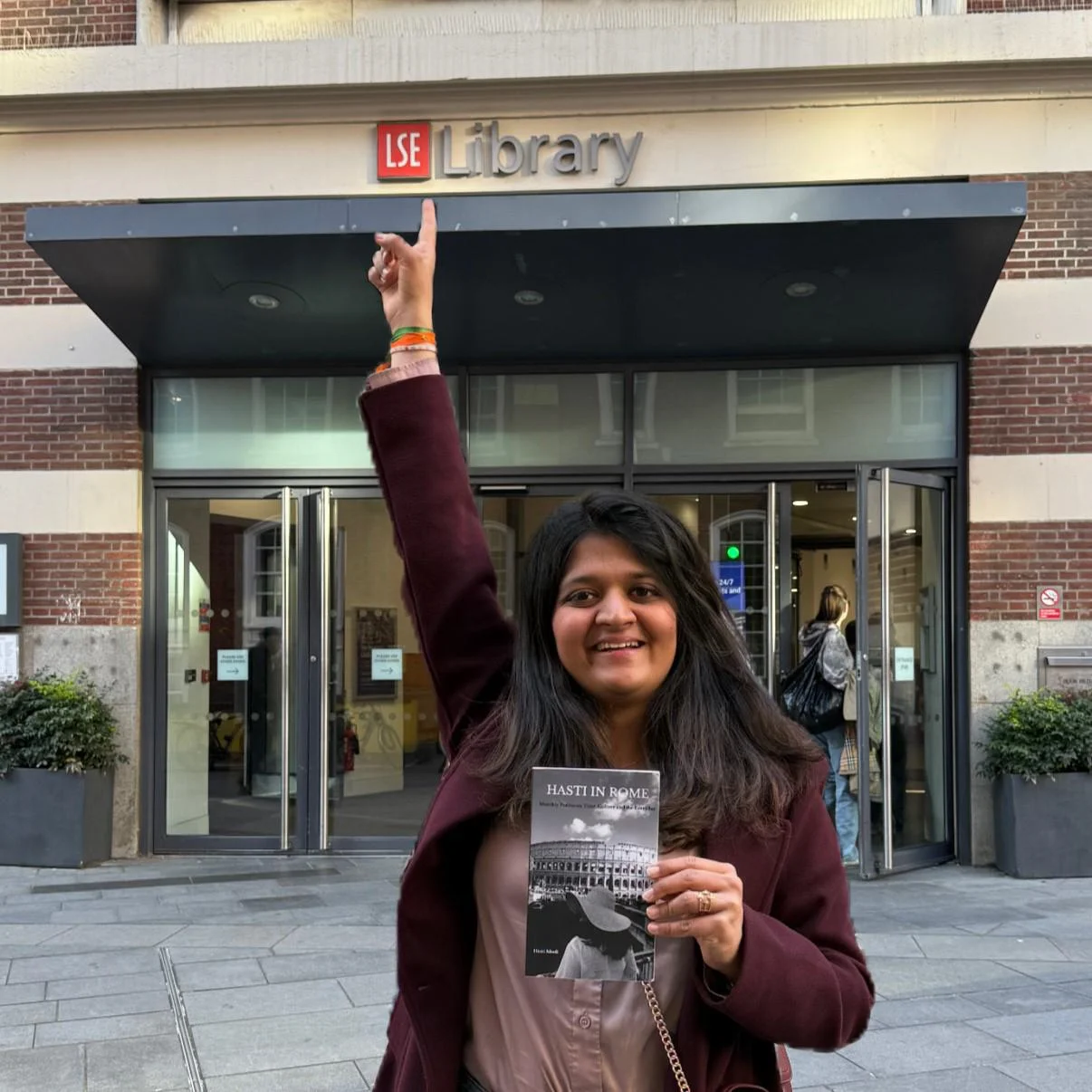
My book, Hasti in Rome, emerged from a very personal journey of living, studying and working across cultures over the past several years. Having lived across five countries and worked at the intersection of Indian and European public policy, sustainability and international cooperation, I often found myself reflecting on questions of identity, belonging, values and how societies evolve while still remaining rooted in tradition.
The book draws parallels between India and Italy — two ancient civilisations with remarkably deep cultural, social and philosophical similarities despite their geographical distance. In many ways, I describe Italy as “the India of Europe” because of the strong emphasis both societies place on family, community, food, history, spirituality and emotional warmth.
The work was originally penned as monthly letters to Rome, which eventually evolved into poetry exploring these intersections through the lens of migration, culture, public life and human connection. It was inspired not only by my professional experiences in Indian and EU policymaking, but also by countless ordinary moments of cultural exchange that shaped my understanding of the world.
The book was launched at the Indian Embassy in Rome by the Indian Ambassador during India’s Republic Day celebrations earlier this year, which made the journey especially meaningful. All proceeds from the book are being directed towards tree plantation and environmental initiatives in Europe and India, reflecting my belief that cultural dialogue and sustainability must go hand in hand. The book has now reached over 12 countries and it is available in our LSE library as well.
Tell us about your new role, what are your main responsibilities?
I currently work as a Senior Consultant in Economic and Policy Advisory at EY in Brussels, where I support European institutions on public policy studies, impact assessments, regulatory evaluations and stakeholder engagement processes.
My work focuses on areas such as digital policy, consumer protection, sustainability, industrial policy and governance. A large part of my role involves translating complex policy questions into evidence-based analysis that can support better policymaking at the European level.
This includes conducting research and policy analysis, engaging with stakeholders from across Europe, drafting reports for the European Commission and contributing to projects that sit at the intersection of economics, law, technology and society.
What I enjoy most is the opportunity to work on issues that have tangible societal impact while constantly learning from experts across disciplines and countries.
What is the goal of your work? What are you hoping the impact will be?
At its core, I hope my work contributes to making policymaking more impactful, human-centred, inclusive and globally connected.
Professionally, I am particularly interested in the intersection between India and Europe — two democratic systems navigating major transitions in technology, sustainability, industrial competitiveness and social protection. I believe there is enormous scope for deeper policy learning and collaboration between the two regions.
Over the long term, I hope to contribute towards building stronger India–EU public policy bridges, whether through research, institutional collaboration, public engagement or future work in governance and international cooperation.
Beyond policy itself, I also hope to encourage more young people from multicultural and international backgrounds to see public policy not as something abstract, but as a powerful tool to shape societies, communities and everyday lives. Equally, through my environmental initiatives, I hope to inspire more young people to reconnect with nature and contribute meaningfully towards sustainability through simple but lasting actions such as planting and nurturing trees.
Tell us an interesting fact about you that your fellow alumni might find interesting?
Alongside my policy work, I have been involved in environmental and community initiatives since a young age, including leading tree plantation campaigns across multiple countries.
I was also honoured to receive the Diana Award for social impact work, which remains one of the most meaningful recognitions in my journey because of its focus on young people creating positive change within their communities.
Why did you choose to study the MPA?
I chose the MPA because I wanted to better understand how governments, institutions and societies make and implement decisions during moments of complexity and change.
Coming from India and later working in Europe, I became increasingly fascinated by how policy shapes economic opportunity, sustainability, social cohesion and international relations. The MPA offered an interdisciplinary environment where economics, politics, governance and real-world implementation could all be studied together.
LSE particularly stood out because of its global perspective and its ability to bring together people from incredibly diverse professional and national backgrounds. I wanted to be in a space where ideas from different parts of the world could challenge and sharpen one another — and the MPA absolutely provided that.
How have your MPA studies and time at LSE SPP influenced your career journey and approach to your work?
My time at LSE SPP fundamentally shaped both the way I think and the way I approach professional challenges.
The programme taught me to think critically across disciplines, communicate clearly under complexity and approach policy questions with both analytical rigour and human sensitivity. It also exposed me to perspectives from across the world, reinforcing the importance of comparative learning and international cooperation in policymaking.
Outside the classroom, my involvement as President of the LSE Students’ Union India Forum was particularly formative. It gave me the opportunity to build communities, organise high-level India-centric policy conferences and represent Indian perspectives within a global academic environment.
LSE also strengthened my confidence in navigating international spaces while staying deeply connected to my own roots and values. That balance continues to influence both my professional work and personal projects today.
Who would you recommend the MPA programme to?
I would recommend the MPA to individuals who are genuinely curious about how societies function on the ground and who want to work at the intersection of policy, people and real-world impact.
The programme is especially valuable for those who enjoy interdisciplinary thinking and want exposure to international perspectives across public, private and multilateral sectors.
What are the benefits of being part of the LSE SPP alumni community?
The LSE SPP alumni community is incredibly diverse, intellectually curious and globally connected.
One of the most valuable aspects is that the community extends far beyond networking in the traditional sense. It is a space where people working across governments, international organisations, consulting, academia, civil society and entrepreneurship continue to exchange ideas and support one another. As a result, I have always tried to foster LSE SPP alumni communities wherever I moved, including in Rome and now in Brussels.
I have particularly appreciated how the community encourages interdisciplinary thinking and international dialogue. Even after graduating, there remains a strong sense of shared purpose around contributing meaningfully to public life and policymaking.
Who or what inspires you?
I am deeply inspired by people who dedicate their lives to causes greater than themselves. I am particularly inspired by figures such as Mahatma Gandhi, who demonstrated how diplomacy, principles, values, nationalism and spirituality can coexist while remaining grounded in humility and service.
Much of my inspiration also comes from India’s civilisational values — particularly the idea that development and progress should remain connected to ethics, sustainability and collective wellbeing.
I am equally inspired by ordinary people who quietly create impact within their communities without seeking recognition. Whether through education, environmental work, public service or cultural preservation, those forms of long-term commitment often leave the deepest impact.
Do you have a book or podcast recommendation for the SPP community?
A book I often recommend is The Argumentative Indian by Amartya Sen. It offers a thoughtful exploration of democracy, pluralism and public reasoning through the lens of Indian history and philosophy, while also raising questions that remain globally relevant today.
Can you describe your SPP experience in 3 words?
Transformative. Global. Grounding.
Hasti is happy to connect via LinkedIn.
Published in May 2026.