

Can climate lawsuits make polluters pay for global warming?
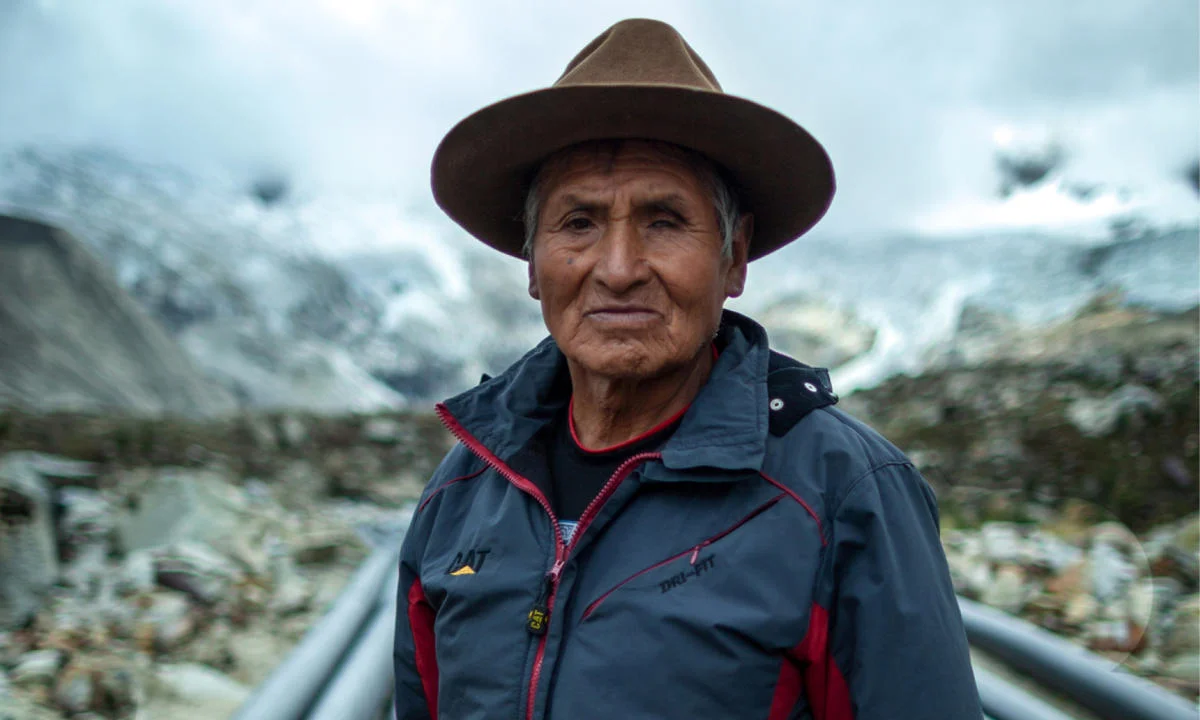
The decision to pursue what would become the world’s first case seeking to hold a private company liable for climate damage in another country was made not in a lawyer’s office, but over a meal of guinea pig – a local Peruvian delicacy – at the home of Saúl Luciano Lliuya in the Peruvian Andes. As Lliuya spoke about his fears over disappearing glaciers and the growing risk posed by glacial lakes above his town, Dr Noah Walker-Crawford, then working for the NGO Germanwatch, described ongoing discussions in Germany about the possibility of bringing a legal claim against a major polluter. It was during that conversation that the Peruvian farmer decided to take action.
What followed was a ten‑year legal battle of David and Goliath proportions. Supported by Germanwatch, Lliuya asked the court to find German multinational energy company RWE – which had never operated in Peru – liable for its proportionate share of the flood‑protection measures needed to safeguard his home. Dr Walker‑Crawford, now a Research Fellow at the Grantham Research Institute for Climate Change and the Environment at LSE, was closely involved throughout the case. He worked as a coordinator, translator, scientific adviser and public spokesperson while also studying the case for his PhD research. His observations are brought together in a new book, The Climate Trial: law and justice on a melting planet, which traces the story of the case from its beginnings in the Peruvian Andes to courtrooms and UN climate summits.
Although the case was ultimately dismissed, it marked a step change in climate litigation, establishing in principle that major polluters can be held legally accountable for climate damage – even when it occurs in another hemisphere.
A climate lawsuit the world was watching
“We’re seeing climate change impacts all around the world, and the people who are worst affected are often those who’ve contributed the least – especially in the Global South,” says Dr Walker‑Crawford. “And so even though formally the case was about two very specific actors – a Peruvian farmer and a German energy company – everyone involved knew it was about much more. The farmer was also a symbolic representative of vulnerable populations facing the worst impacts of climate change, while the company stood for the big emitters in the Global North who have made the most substantial contribution to the problem.”
As a result, while the €17,000 Lliuya was asking RWE to pay was, on paper, a negligible sum for a multinational energy company, the case quickly came to be understood as something far more significant: a test of whether existing legal frameworks could be used to hold major polluters accountable for climate damage beyond national borders.
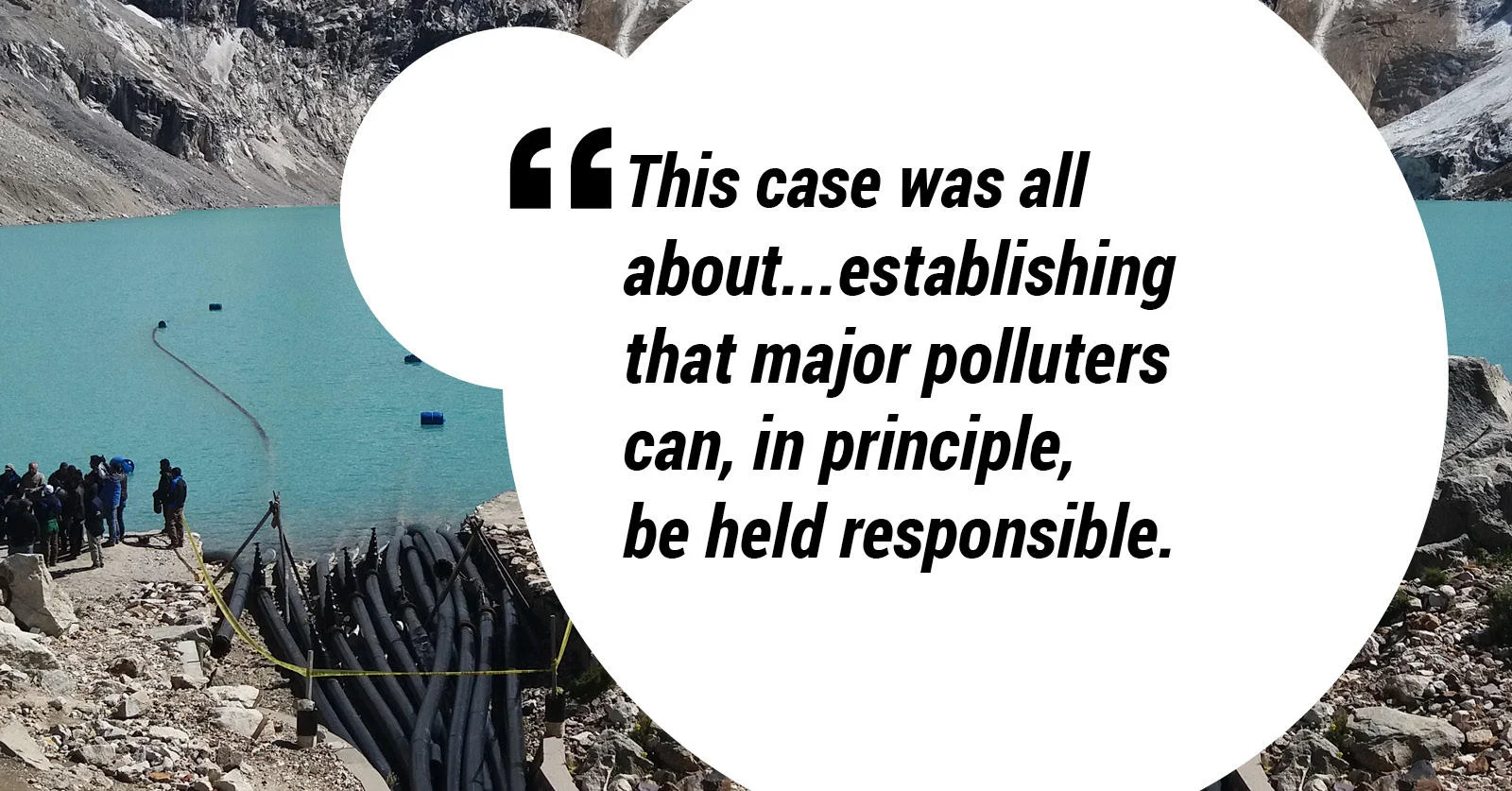
“This case was all about setting a legal foundation to bring these kinds of claims,” explains Dr Walker‑Crawford. “It was about establishing that major polluters can, in principle, be held responsible.”
Climate change makes us all neighbours
But how can a company operating on another continent be legally connected to melting glaciers in the Peruvian Andes?
At the heart of the case was an idea both simple and radical: neighbourliness. The legal claim drew on German property law, which is more typically used to resolve disputes between neighbours – for example, if a tree threatens a neighbouring property.
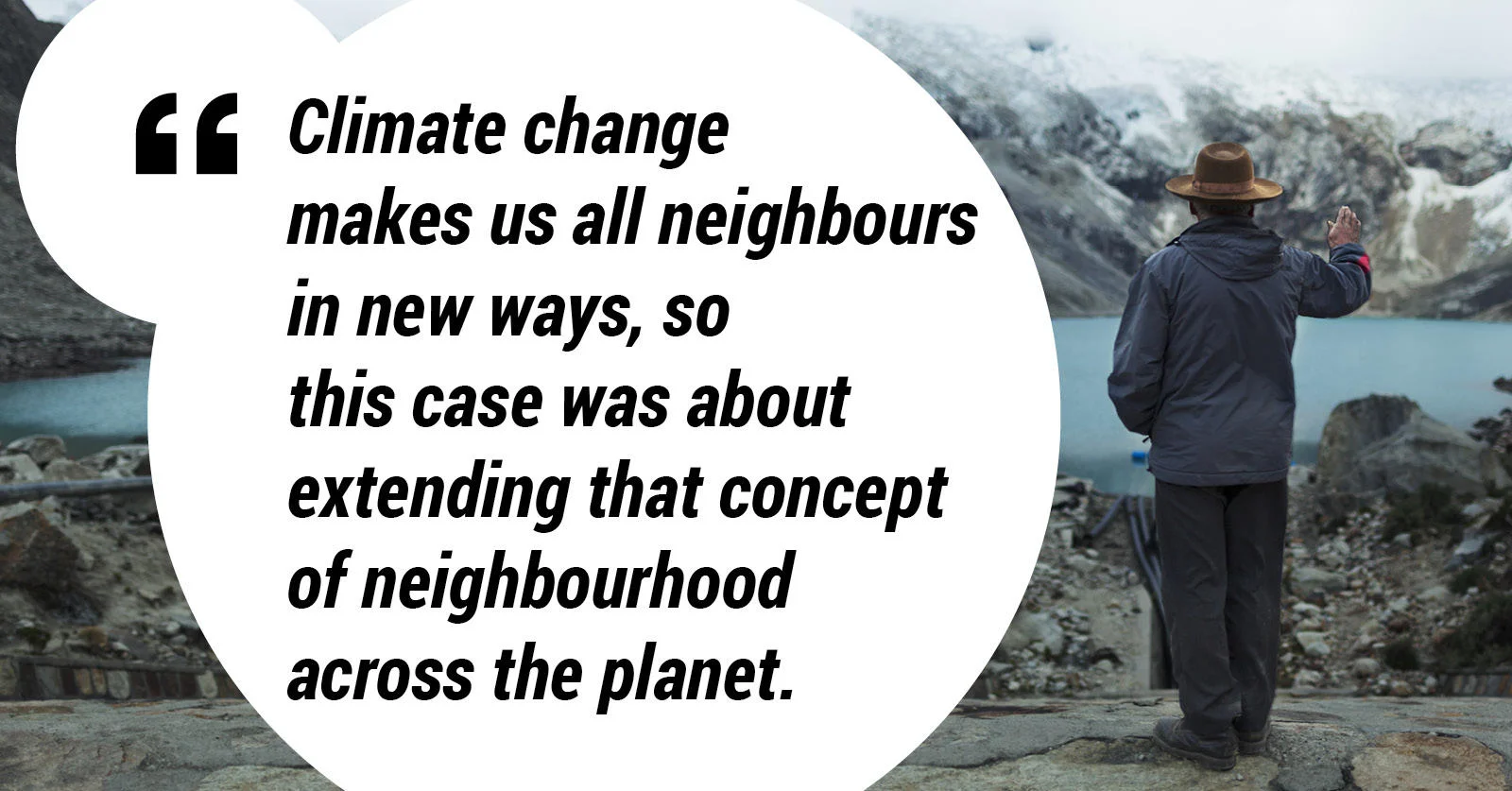
“The science has shown that emissions produced in one place contribute to harm somewhere else,” says Dr Walker‑Crawford. “What I find useful about the idea of neighbourliness is that it highlights climate change as a fundamentally human process – a social and moral phenomenon – because it connects us in ways we weren’t connected before. Climate change makes us all neighbours in new ways, so this case was about extending that concept of neighbourhood across the planet.”
In framing climate change not just as a physical process but as a deeply social and moral one, Lliuya was asking the courts to approach climate litigation in an entirely new way.
“The judges were being asked to do something completely new, which is always going to be a challenge,” says Dr Walker‑Crawford. “But law, by its nature, is universalistic. When laws are designed, the idea is that they apply both to situations we can foresee and to those we can’t.”
"Today, the mountains have won"
RWE contested Lliuya’s legal claim at every stage – a defence Dr Walker‑Crawford examines in detail in his book. The company ultimately emerged – on one level at least – the victor, when the case was dismissed in May 2025 following the finding that the specific flood risk to Lliuya did not meet the legal threshold, Its most dramatic moment, however, had come years earlier, in November 2017, when the panel of three German judges rejected the core defence argument that climate change was a regulatory issue for governments alone, rather than a matter for the courts.
“They concluded the case was legally solid,” says Dr Walker‑Crawford. “They found it admissible – meaning the law can be applied to climate change in this way. Nothing like this had ever been tried before, so to get that ruling at such an early stage was incredible.”
Inside the courtroom, shock turned to chaos. “The company’s defence lawyers ended up in a heated argument with the judge,” he recalls. “They were completely taken by surprise.”
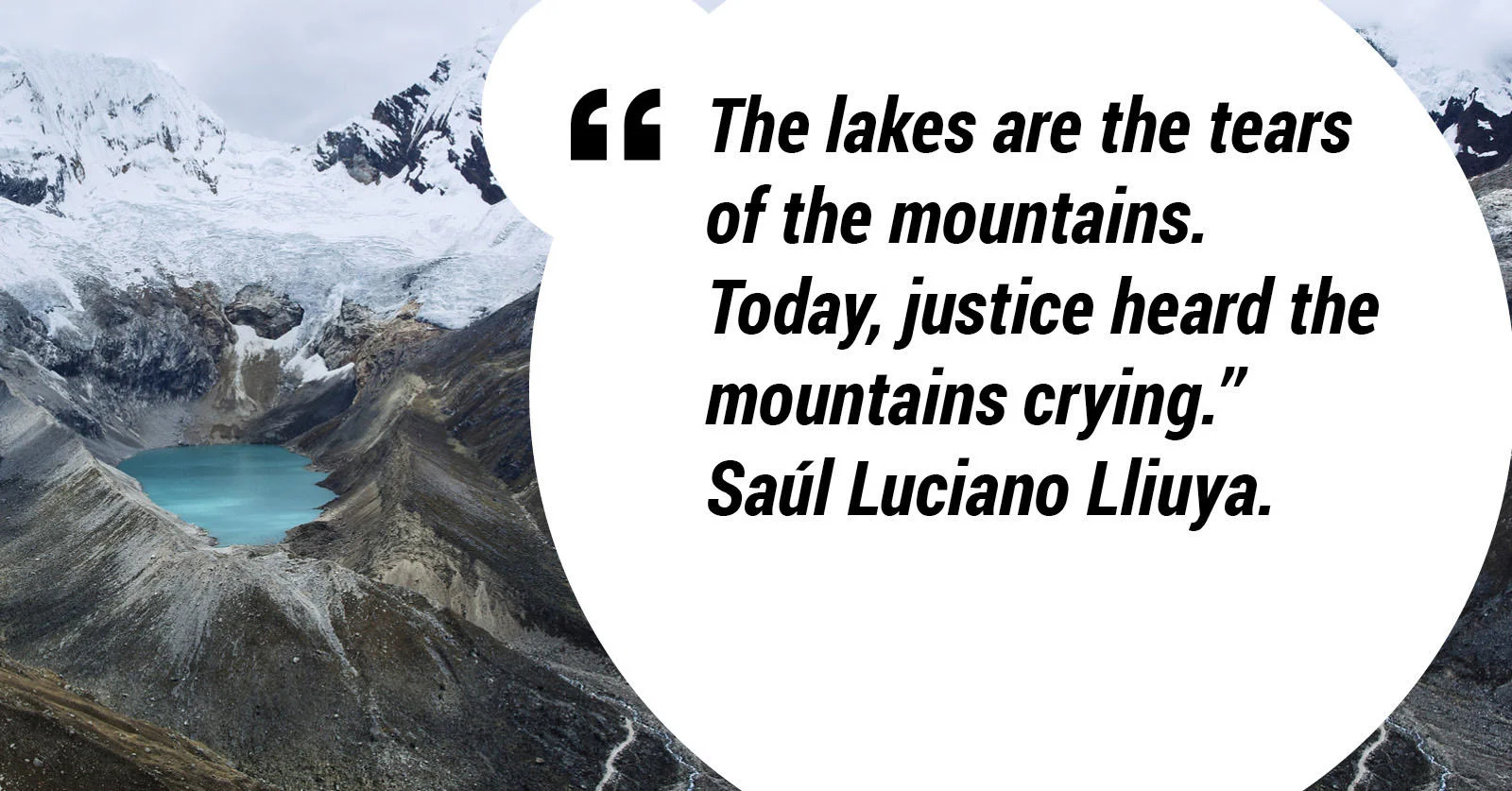
Outside, surrounded by television cameras, an emotional Lliuya addressed the world’s media. “He said, ‘The lakes are the tears of the mountains. Today, justice heard the mountains crying’,” Dr Walker‑Crawford remembers. “For me, that was an incredibly powerful moment. People had tears in their eyes.”
When climate science caught up with the law
Following the 2017 ruling, the case entered its longest and most technical phase: gathering evidence. Judges, lawyers and scientific experts eventually travelled to Peru to inspect the glacier above Lliuya’s town. Progress was slow, with the COVID‑19 pandemic creating additional obstacles. While personal frustrations may have been exacerbated as the years passed by, the passage of time brought an unexpected – and for Lliuya, very welcome – development.
“The case took so long that the science actually caught up with it,” Dr Walker‑Crawford explains.
Initially, while researchers could show that climate change contributed to glacier retreat across the Andes, they were unable to connect global emissions at the level of an individual glacier. In 2021, with global media spotlighting the Andes’ melting glaciers and Lliuya’s fight for RWE to take accountability, scientists published an independent attribution study examining the specific glacier at the centre of the case.
“They found that around 95 per cent of this glacier’s retreat was due to anthropogenic climate change,” Dr Walker-Crawford says. “That was incredibly important evidence because it undermined the argument that climate impacts are too uncertain to meet legal standards of proof.”
“As a researcher, you ask difficult questions...Sometimes that can be uncomfortable for activists. But asking those questions can give us a stronger footing and help us deal with conflicts in practice.
Why a dismissal was not a defeat for climate litigation
In 2025, the court delivered its final verdict, with Lliuya losing the case on a narrow technical point related to flood‑risk thresholds. Legally, however, its wider impact was seismic.
“All of the legal arguments were successful,” Dr Walker‑Crawford emphasises. “The court confirmed, very clearly, that it is possible in principle to hold a major emitter legally liable for climate harms.”
Even in defeat, the case therefore established that climate attribution science can be used to demonstrate legal liability – a foundation future cases can build on. “It felt like a big win,” he says. “Even though technically, it was a loss.”
When activism meets anthropology
Dr Walker‑Crawford describes himself as a “professional activist turned engaged anthropologist”. That dual role created tensions – but also insight.
“As a researcher, you ask difficult questions,” he says. “You ask why we’re doing this, or what unintended consequences might arise. Sometimes that can be uncomfortable for activists. But asking those questions can give us a stronger footing and help us deal with conflicts in practice.”
One example was the impact of the case on Lliuya’s own community.
“At first, he pursued the case on his own,” Dr Walker‑Crawford explains. “He’s quite a shy person, and he travelled to Germany and filed the case without telling anyone in his community. When news reached home, some people were suspicious. There were rumours that he was making money or even selling the lake to the Germans.”
“It was painful to see,” he adds. “None of us had anticipated that.”
Over time, understanding grew. Lliuya founded a local NGO focused on climate adaptation, and over the years, as the case progressed, he was able to better explain to his neighbours what was happening and what he was trying to achieve.
By the time judges visited the region in 2022, the community was visibly engaged. “That shift was really important,” Dr Walker‑Crawford says. “By the end, there was strong local support.”
Is climate litigation the way forward?
The case of Luciano Lliuya v RWE AG may have ended in dismissal, but with the precedent of legal action now being set, will the court case become the new frontline for climate action?
Ideally, Dr Walker‑Crawford argues, lawsuits should not be necessary at all. “There shouldn’t be a need for climate litigation,” he says. “These issues should be resolved politically. Legal action is really an act of desperation.”
In the absence of adequate political action, however, litigation is one way forward, and developments created by cases like this one ensure that legal action is not simply a lever of last resort but a strategic tool.
“Negotiators at UN climate summits told me this case was raised in talks,” Dr Walker-Crawford explains. “They said, if governments don’t act, there will be more lawsuits.”
By turning greenhouse gas emissions into financial risk, litigation also pressures companies and investors. “It’s likely a matter of time before we see a successful climate damages case,” he says. “This verdict was a stepping stone.”
Listening to the mountains
One final dimension of the case remains closest to Dr Walker‑Crawford’s heart: the mountains themselves. In the Andes, mountains are not seen as inert backdrops, but as living beings – a worldview with no place in German law.
“For many people, the mountains are powerful entities that need to be respected. There’s a real sense they are suffering,” he says. “Legally, however, while the court recognised the company as a ‘person’, the mountains had no standing. But by bringing these perspectives into public debate, the case widened understandings of what climate harm really means.”
“It showed climate change isn’t just about economic loss,” Dr Walker‑Crawford concludes. “There’s a lot more at stake.”
Image: Alexander Luna.
Dr Noah Walker-Crawford was speaking to Jess Winterstein, Deputy Head of Media Relations at LSE.
Subscribe to LSE Research for the World

LSE Festival 2026: How to save the planet
Research for the World is the online magazine by LSE - the London School of Economics and Political Science . LSE is a world-leading university, specialising in social sciences and ranked top in the UK by The Times and Sunday Times Good University Guide 2026.
Noah Walker-Crawford

Related content
Why are climate action cases rising?

How can we help vulnerable people to adapt to climate change?
How the TV drama Toxic Town captures the slow violence of industrial and environmental harms