

The limits of inequality: why feeling poor matters in an age of abundance

At a time when Elon Musk has become the world’s first trillionaire, inequality is increasingly framed in terms of the power and visibility of the super-rich – the one per cent whose wealth shapes economies and politics alike. Yet this focus obscures a striking paradox: for much of the world’s population, living standards are historically high, even as perceptions of deprivation intensify. Why, then, do so many still feel left behind?
Dr Séamus Power, Visiting Senior Fellow in the Department of Psychological and Behavioural Science at LSE, examines this question in his forthcoming book, Inequality: the view from manywheres. Drawing on more than a decade of research, Dr Power argues that understanding inequality today requires moving beyond economic indicators alone.
Highlighting the fact that, in material terms, today’s generations have never had it so good, he suggests instead that we need to examine how inequality is experienced psychologically and how these perceptions shape everything from protest movements to political polarisation.
“In terms of material goods, we live in a world that's very, very rich. But these riches are shared very unequally. As a result, even people who are better off when compared to their parents’ or grandparents’ generations, for example, may still feel like they don’t have enough,” he explains.
A puzzle that begins in Ireland
Dr Power’s work began not with abstract theory, but with a simple empirical puzzle. During the global financial crisis of 2007–08, Ireland experienced a severe economic collapse. Yet, unlike other European countries such as Greece, Spain and Portugal, there was little protest: a passivity that stood in sharp contrast to Ireland’s historical narrative of rebellion and resistance.
“In Ireland, people weren’t taking to the streets, which, given the scale of the crisis, was surprising,” he explains. “A few years later, however, when the economy began to recover, water charges were introduced, and this time mass protests did emerge.”
This suggested to Dr Power that their grievances were less about objective hardship and more about perceptions of fairness. “It wasn’t simply that people were worse off during the crash,” he says. “It was that later, when things were improving, the distribution of that recovery felt unfair.”
This insight became the starting point for a broader investigation into how people understand inequality across different contexts, from riots in London in 2011 to the 2018 Yellow Vest protests in France.
It wasn’t simply that people were worse off during the crash It was that later, when things were improving, the distribution of that recovery felt unfair.
Living in a world of plenty and still feeling deprived
At the core of Dr Power’s argument lies a striking contradiction. On the one hand, global living standards have improved dramatically over the past century, with many people enjoying levels of material comfort unimaginable to previous generations. On the other hand, dissatisfaction remains widespread and inequality only appears to be widening.
“We live in a world that is incredibly rich in terms of material goods,” Dr Power says. “But we are also living in more of a splintered world, where those goods are distributed very unevenly – and people are constantly aware of that.”
This awareness is intensified by modern forms of comparison. Social media platforms and global connectivity expose individuals to highly curated, often idealised versions of other people’s lives. The result is what Dr Power describes as a pervasive sense of relative deprivation.
“Even if someone is objectively very well off and are located at the bottom 10 per cent of the top wealthiest one per cent, they can still feel unhappy if they live in a local world where they compare themselves to the top 10 per cent of the one per cent,” he explains. “Even with such wealth, those people may still feel like they don’t have enough.”
This gap between material conditions and subjective experience helps explain why inequality can feel more acute today, even in societies that have experienced overall economic growth.
We already see how economic inequality can translate into political power.
Beyond economics: a “view from manywheres”
Dr Power’s approach differs from traditional economic analyses of inequality. Rather than focusing solely on metrics such as income or GDP, he adopts a multidisciplinary perspective, drawing on psychology, anthropology, sociology and philosophy.
“I see myself as a slightly unusual psychologist,” he says. “My training was inherently interdisciplinary, and that feeds into how I think about inequality.” This is reflected in the book’s title, “the view from manywheres” – an attempt to understand inequality from multiple vantage points across cultures, disciplines and lived experiences.
This perspective allows Dr Power to move beyond what he sees as the limitations of single-discipline explanations. Economic data, he argues, can capture trends in wealth and income, but it cannot fully explain why people react so differently to similar conditions. Instead, his work emphasises how inequality is interpreted, negotiated and felt by individuals and communities.
Three possible futures
Looking ahead, Dr Power outlines three possible trajectories for contemporary capitalism.
The first is a continuation of the status quo. In this scenario, inequality continues to rise, with wealth and influence increasingly concentrated among elites. This, he argues, risks fuelling further and more intense political instability, populism and authoritarianism.
“We already see how economic inequality can translate into political power,” he notes. “And that can intensify feelings of disenfranchisement.”
The second possibility is a sharp corrective response – policies or movements that aim to radically equalise society. While these may be driven by legitimate concerns, Dr Power warns that attempts to enforce equality without careful consideration can have unintended consequences.
“Historically, some of the most equal societies have emerged through very violent or destructive processes – wars, famines or systemic collapse,” he says. “Think of the disaster of the ‘great leap forward’ in Mao’s China where an attempt to rapidly engineer equality led to famine, coercion and mass suffering. So we need to be careful about what we mean by equality and how we pursue it.”
The third path, which Dr Power advocates, is more nuanced. It involves rethinking economic systems in ways that balance prosperity with fairness, while avoiding both unchecked inequality and overly simplistic solutions.
There’s a tendency for debates about inequality to become very binary. Either you defend the current system, or you reject it entirely.
Refocusing on poverty and rethinking what counts as progress
A key element of this third approach, and Dr Power’s idea of fairness, is a shift in emphasis from reducing inequality per se to alleviating poverty.
“In many debates about inequality, there’s a focus on making the rich less rich or expanding the middle class,” Dr Power explains. “But often the poorest are overlooked.”
For him, the central moral question should be how to make the world’s poorest populations less poor, rather than simply narrowing the gap between different income groups. This perspective challenges dominant narratives in both policy and academic discourse. It suggests that tackling inequality requires not only redistribution, but also a renewed focus on improving basic living conditions globally.
Dr Power also draws on the work of philosopher Martha Nussbaum to propose an alternative framework for thinking about economic success: the capabilities approach. Rather than measuring progress in terms of output or income, this perspective asks what people are actually able to do and to be. Can they access education? Participate in society? Live with dignity? “It’s about human flourishing, not just abstract economic indicators,” says Dr Power.
This shift, he suggests, could help policymakers and societies move towards a more humane and balanced model of development.
Understanding polarisation
Dr Power’s work also offers insights into contemporary political divides. From support for populist leaders to the rise of radical economic movements, he sees many of these developments as rooted in shared feelings of unfairness.
“I have a lot of sympathy for why people might turn to extreme options,” he says. “If they feel ignored or disrespected, they’re going to look for alternatives.”
Importantly, this applies across the political spectrum. Just as some voters are drawn to right-wing populism, others are attracted to more radical left-wing ideologies.
“People are often looking for shortcuts to fix problems in their lives,” Dr Power explains. “And those solutions can be appealing, even if they’re not well thought through.” By understanding these psychological dynamics, he argues, it becomes possible to engage more constructively with political disagreement.
We don’t need a single model for the whole world. But we do need better ways of thinking about fairness, prosperity and what we owe to one another.
The importance of nuance
In an increasingly polarised world, one of Dr Power’s central messages is the importance of nuance to creating desirable alternatives to the status quo.
“There’s a tendency for debates about inequality to become very binary,” he says. “Either you defend the current system, or you reject it entirely.”
His work instead seeks to navigate between these extremes, acknowledging both the achievements and the shortcomings of contemporary capitalism. On the one hand, the global economic system has lifted hundreds of millions out of extreme poverty. On the other, it has generated new forms of inequality and insecurity. Recognising both realities, Dr Power argues, is essential for developing viable alternatives.
Ultimately, Inequality: the view from manywheres is not just a critique, but an attempt to map possible futures for how to achieve a world where poverty is eradicated, economic systems are made fairer, and the achievement of human capabilities is fully realised. “We need stories about where we could go next. Without that, it’s very difficult to imagine change,” he says.
While he acknowledges that the solutions are complex and context-dependent, he remains cautiously optimistic. By fostering more informed and inclusive conversations about inequality, Dr Power believes it is possible to move towards a more balanced and humane economic system.
“We don’t need a single model for the whole world,” he concludes. “But we do need better ways of thinking about fairness, prosperity and what we owe to one another.”
Dr Séamus Power was speaking to Jess Winterstein, Deputy Head of Media Relations at LSE.
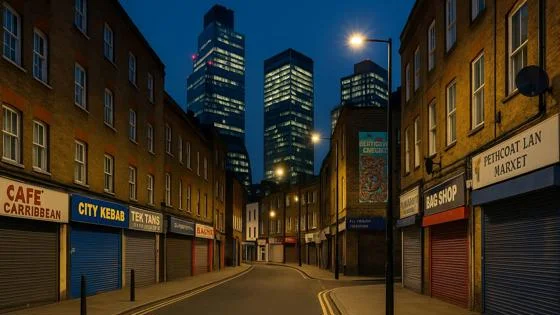
Element of the illustration created by AI and stock imagery by Jacob Wackerhausen at istock.com
Subscribe to LSE Research for the World
Research for the World is the online magazine by LSE - The London School of Economics and Political Science.
Related content
How empty buildings could help solve Britain’s housing crisis
How the TV drama Toxic Town captures the slow violence of industrial and environmental harms
Why we need to talk about wealth if we want to address poverty