Why investors can’t solve climate change alone
In the years following the 2015 Paris Agreement, investors were increasingly cast as central actors in tackling climate change. Financial institutions pledged to align portfolios with net zero targets, and investor coalitions driven by net zero aims rapidly expanded.
The idea that the private sector needed to mobilise behind the drive to net zero was particularly strong in the lead-up to COP26 in Glasgow, which was marked by a strong sense of collective momentum: investors were expected not only to support climate action, but to help drive it.
“There was very much a sense that it was a societal expectation that investors get on board with net zero, and part of this required making commitments around investing in line with 1.5°C warming, and committing to push companies onto decarbonisation paths,” explains Tom Gosling, Professor in Practice and Director of the Initiative in Sustainable Finance in the Financial Markets Group at LSE.
New research led by Professor Gosling, however, reveals that early optimism has given way to a more complex and contested landscape. Today, expectation about the role of investors in the transition to net zero is under strain.
There was a narrative that investors can decide where the capital goes and ... shift the economy. But actually, that's not how it works.
Can investors drive net zero action?
Professor Gosling identifies three major shifts that have complicated the role of investors.
First, there is a growing recognition that global targets are unlikely to be met. “It has become increasingly clear that the world is not on a trajectory of 1.5°C ,” he says. This raises a question: if the real economy is not aligned with those targets, what does it mean for investors to commit to them?
Second, the limits of investor influence have become more apparent. While it was once assumed that capital allocation could reshape corporate behaviour, in practice the relationship is more constrained. “There was a narrative that investors can decide where the capital goes and so they can shift the economy. But actually, that's not how it works,” states Professor Gosling.
To illustrate this point, Professor Gosling points to the experience of BP. In 2022 BP announced it would pivot towards renewables, going “further than any of the current kind of oil majors”, before unprofitability forced a U-turn. “Now BP has gone back to being almost further behind than before,” he says. “The reaction was such that they have now pivoted back to saying actually, we're an oil company and we just make money drilling oil.
“Ultimately, investors allocate capital to profitable opportunities rather than determining what happens. They can’t force a company’s board to do something [that] is non-commercial.”
The third major shift Professor Gosling identifies is around political support for climate action, which has become more fragmented, particularly in the United States. “This idea that investors have unquestioning support no longer holds up,” Professor Gosling notes.
Taken together, these developments have caused investors to review the basis of their actions on climate. “We still heard strong commitment about the importance of tackling climate change, but at the same time a recognition that the approach taken by investors needs to be adapted,” he says.
We first need to acknowledge the reality that investors play a supporting and not a leading role.
A research project to rethink investor action on net zero
Against this backdrop, Professor Gosling and his colleagues set out to reassess what investors can realistically contribute to action on climate change. They convened workshops with over 60 participants across major financial centres, including London, New York, Amsterdam and Singapore. The participants included both asset owners – such as pension funds – and asset managers, who invest on their behalf.
“We wanted to provide a space where there could be candid discussions to ask: what can investors realistically do?” Professor Gosling says.
The methodology combined structured discussion supported by a detailed pre-read with transcription and analysis, allowing the research team to identify common themes across participants. Importantly, the resulting report does not present a consensus view. Instead, the LSE team draws on these perspectives to develop an independent analysis of investor strategy.
Investors play a supporting role in net zero transition
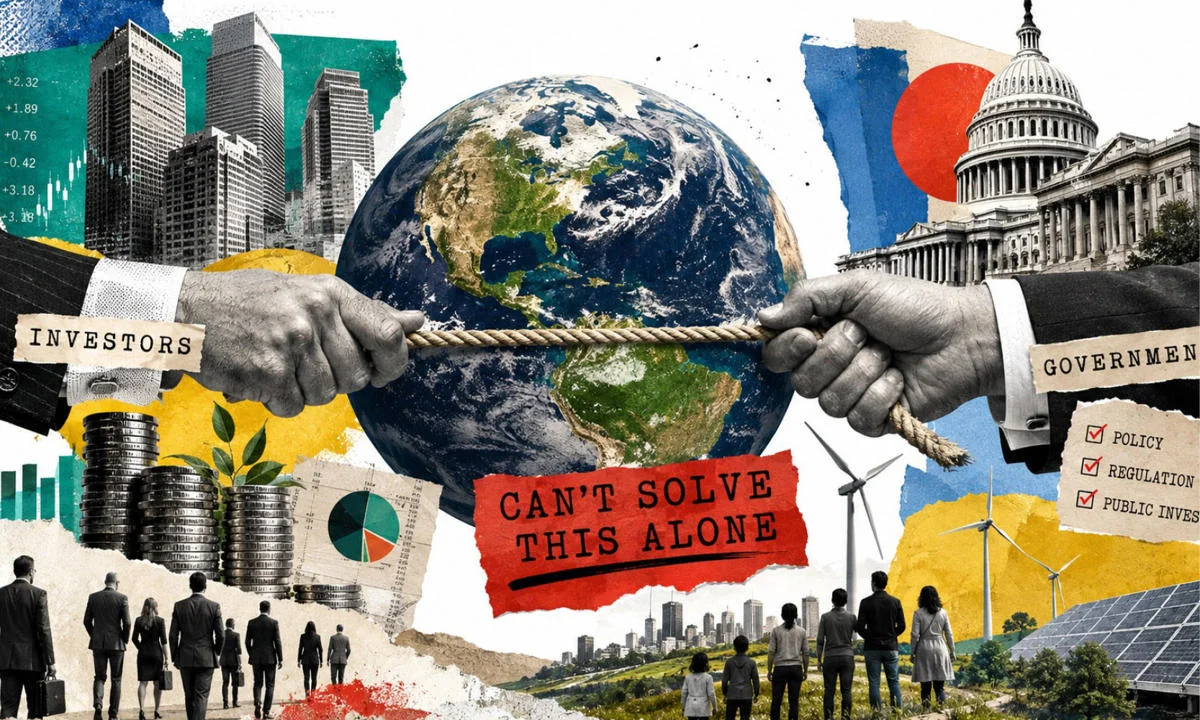
The central conclusion of the report is both simple and controversial: investors cannot lead the transition to net zero. “We first need to acknowledge this reality, which is that investors play a supporting and not a leading role,” Professor Gosling says.
This does not mean, he stresses, that investors are unimportant – indeed, they play a vital role. Rather there is a need to reframe the investor role within the broader system. Governments remain essential because they set the policies and incentives that shape market behaviour.
Without that framework, investor action can lead to unintended consequences. One example is “portfolio alignment”, where investors reduce reported emissions by selling high-carbon assets. “This allows them to say that emissions have fallen,” explains Professor Gosling. “But in reality, it’s just that somebody else has bought those companies. So the companies still exist. You haven’t actually changed anything at all.”
These kinds of approaches can create the appearance of progress without delivering real-world emissions reductions, he highlights.
Engaging with companies on operational improvements may be more effective than demanding wholesale business model transformations.
Rethinking what effective climate action looks like
If investors are not leading the net zero transition, what should they be doing? The report argues for a shift away from top-down targets towards a more pragmatic, bottom-up approach.
Rather than adopting standardised commitments such as aligning portfolios with 1.5°C, investors should focus on where they can have genuine influence.
“What are the opportunities and inhibitors to decarbonisation? How do those relate to where you play as an investor?” Professor Gosling asks. This requires developing a clear “theory of change” – an understanding of how specific actions lead to real-world impact.
It also means focusing on achievable interventions. For example, engaging with companies on operational improvements may be more effective than demanding wholesale business model transformations.
“Telling an oil company not to be an oil company is probably not going to be a successful long-term strategy,” Professor Gosling says. “But telling an oil company to get a grip on methane leakage – that is a very viable thing to do.”
Five areas where investors can do more
Within this reframed approach, the report identifies five areas where investors can strengthen their contribution.
First, the relationship between asset owners and asset managers is critical. Asset owners – such as pension funds – have long-time horizons and ultimately bear climate risk, but their priorities are not always reflected in investment mandates. “The asset manager is only going to do that if it’s embedded into the mandate or if they believe it will influence whether they are appointed or retained,” Professor Gosling explains.
Second, investors can play a more active role in shaping public policy. Governments rely on signals from capital markets when designing regulations, yet investors have often been hesitant to engage. “The investor voice in all of this is really, really important, but underdeveloped,” Professor Gosling emphasises.
Third, there is scope to increase investment in emerging markets, where much of the future transition will take place. Barriers are often institutional rather than financial, including unfamiliarity and governance challenges.
Fourth, investors need to better integrate physical climate risks – such as extreme weather – into decision-making, an area that has received less attention than policy risk.
Finally, large investor coalitions may need to be restructured. “They’ve become a bit unwieldy,” Professor Gosling notes, suggesting a move towards more focused and issue- or region- specific collaboration.
A fragmented global landscape
The research also highlights significant regional differences in how investors approach climate action. In the US, political tensions have created a more challenging environment. “We had some people who said they couldn’t attend a workshop that had climate in the title,” Professor Gosling notes. In Europe, ambition remains high, but there is growing concern about a gap between commitments and reality.
By contrast, participants in Singapore adopted a more pragmatic perspective. “It was kind of like, ‘what’s all the fuss about? We never thought we could change the world’, and here a collaboration between investors and government is a more normal way of doing business,” he says.
These differing contexts reinforce the report’s conclusion that there is no single, universal model for investor action.
Realism on climate without retreat
Despite these challenges, Professor Gosling emphasises that investor engagement remains essential. “There was appetite still to find a way through to do something that worked,” he says.
The key, the report argues, is not to abandon climate ambition, but to ground it in realism. Investors cannot do the job of policymakers, but they can support, reinforce and accelerate policy-led change. “If governments are pulling back, there’s only so much investors can do,” Professor Gosling says. “They can’t substitute for governments, but they can still keep the issue on the agenda.” In doing so, investors may ultimately play a less prominent – but more effective – role in the transition to a low-carbon economy.
Professor Tom Gosling was speaking to Jess Winterstein, Deputy Head of Media Relations at LSE.
Subscribe to LSE Research for the World

Tom Gosling

Related content
Pass-through voting: can greater investor voice strengthen sustainable stewardship?
Could sustainable investing be the answer to the world's environmental problems?

What role do banks play in the low carbon transition?