

What role do banks play in the low carbon transition?

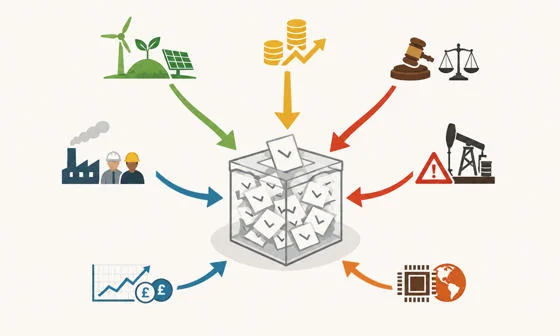
Banks channel capital and provide financial services across the economy, including to both high-emitting activities and low-carbon solutions. This gives them influence over the pace and direction of the net zero transition. For example, banks can offer incentives and set lending conditions that encourage clients to cut emissions.
At LSE’s TPI Global Climate Transition Centre (TPI Centre), a dedicated team tracks whether banks' net zero commitments are backed by transition plans containing concrete policies and initiatives. In the State of the Banking Transition 2025, an annual report led by Policy Officer Algirdas Brochard, the team found that overall progress on the low carbon transition was weak.
While many banks have made net zero pledges, especially since the 2021 UN climate summit (COP26) where many signed up for transformational commitments, progress has been slow. In many cases, the headline decarbonisation targets set by banks only cover a limited set of sectors and business activities.
“When you look at a bank’s overall climate commitments, initially you’ll think: ‘This bank’s targets are very comprehensive.’ But when you dig down, you realise the business activities for which they set decarbonisation targets only cover 15–30 per cent of their revenues,” explains Algirdas.

Political and economic factors shaping net zero transition
The TPI Centre’s analysis suggests that some banks have scaled back their climate commitments in recent years. Algirdas believes there are several reasons for this: research published on the European Central Bank’s (ECB) website suggests that banks may be reluctant to disrupt existing relationships with high-emitting clients as carbon-intensive sectors account for more than 60 per cent of total non-financial corporate interest income.
Banks are also responsive to the political context in which they operate. As an example, European banks perform better than US banks in the TPI Centre’s assessments, but they also benefit from a more supportive policy environment. While the EU has overall consistently supported initiatives to transition away from fossil fuels to reduce emissions and increase energy security, US banks have faced pressure to retreat from climate commitments and maintain support for the fossil fuel industry. One example Algirdas points out is the US state of Texas, where its Attorney General launched an investigation into banks’ membership of the Net-Zero Banking Alliance in 2022.
There is also ongoing disagreement over banks’ role in the low carbon transition. Should they lead the transition, or simply support their clients in doing so?
“Do banks have a central role to play in the decarbonisation? I would argue yes,” says Algirdas. “How active banks’ role is in supporting their clients’ decarbonisation is, however, shaped by many factors, including how commercially viable and profitable low-carbon technologies and activities are, as well as politics and societal pressures.” We assess banks worldwide … and it's not always straightforward to understand what they're financing.
Lack of transparency and consistency in climate reporting
Diverging policy contexts have also made it hard to compare banks’ climate claims and assess progress. One example is the topic of “climate solutions” and green financing targets. While the EU, China and some industry bodies have created taxonomies to define the term, these often differ or conflict. For example, while the EU taxonomy explicitly excludes all types of coal as an eligible economic activity, China and Indonesia have included coal in some circumstances and others, like the UK, have no taxonomy at all. This lack of alignment makes it difficult to assess where banks allocate capital.
Banks’ individual definitions of their activities can also lack transparency. “We assess banks worldwide, including from the EU, Japan or the US, and it's not always straightforward to understand what they're financing,” explains Algirdas. “You might have two banks with targets to decarbonise their oil and gas portfolio, but then each bank might define oil and gas differently, and they might not cover all parts of the oil and gas value chain.”
Indeed, there have been controversies in recent years with some banks disagreeing with NGOs about the scale of their fossil fuel financing.
Some signs of progress on decarbonisation
All this being said, there are some positive signs. A few banks are setting more concrete targets – for example, financing renewable energy or increasing electric vehicle lending – and stronger regulation, especially in Europe, is improving disclosures. “Some banks are showing that what others say is ‘impossible’ can actually be done,” says Algirdas.
However you see their role, there’s no doubt that banks hold significant power over the pace of the net zero transition. And that power isn’t currently being fully realised.
Progress is patchy, transparency is limited, and commitments often fall short of real-world impact. Closing the gap between ambition and action will be key to whether banks help finance the carbon transition – or risk slowing it down.
Algirdas Brochard was speaking to Charlotte Kelloway, Media Relations Manager at LSE.
Subscribe to LSE Research for the World

Research for the World is the online magazine by LSE - The London School of Economics and Political Science.
Algirdas Brochard

Related content
Are big companies doing enough to meet climate goals?

Prioritising the climate: why international organisations are reinventing policy from the bottom-up
Pass-through voting: can greater investor voice strengthen sustainable stewardship?