


Pass-through voting: can greater investor voice strengthen sustainable stewardship?

When a pension fund or individual invests for the future, they often have no direct say in shareholder votes at the companies in which they invest. Instead, these decisions are made on their behalf by asset managers who manage their investments, often through mutual funds or unit trusts. The votes can address how the companies are governed or how they respond to issues such as climate change, worker rights or diversity.
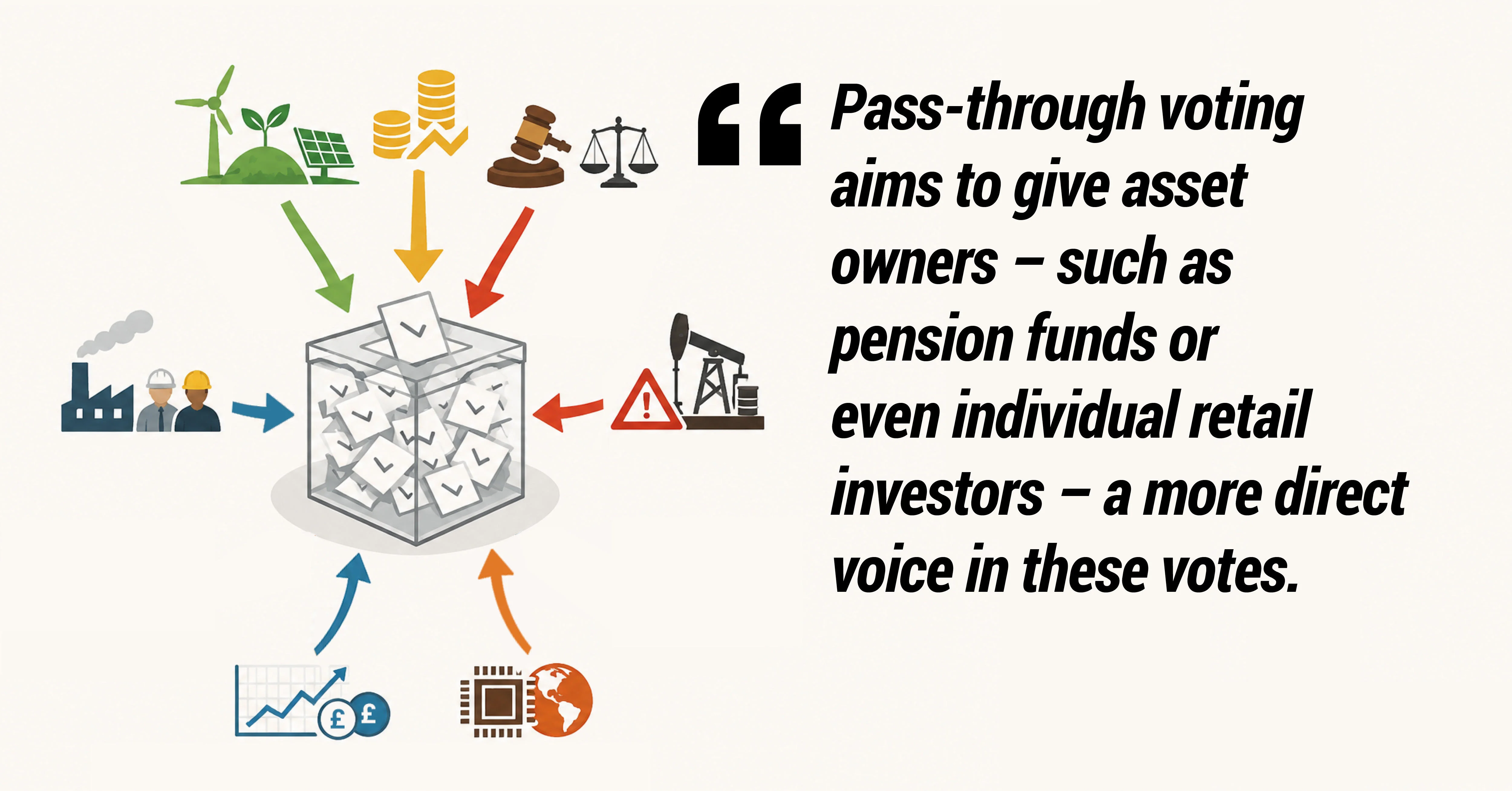
A growing trend known as pass-through voting aims to give asset owners – such as pension funds or even individual retail investors – a more direct voice in these votes. But while this may strengthen alignment with investor values, it also raises difficult questions about how effective stewardship works in practice.
What is pass-through voting?
The growth of pooled investment vehicles like unit trusts and mutual funds has enabled low-cost and convenient access to markets for institutional and retail asset owners. But the trade-off is that they would have to accept the fund manager’s decision on how to vote the shares. The fund manager may not always reflect the asset owner’s priorities.
For example, a fund manager may vote against a shareholder resolution calling on an oil and gas company to set and disclose emissions-reduction targets if they believe the proposed timeline is unrealistic or would impose undue costs on the business. But if the underlying pension fund or individual cares about the long-term impacts of climate change, they may want to vote in the opposite direction. Until recently, that hasn’t normally been an option.
A growing trend to deal with this problem is what we refer to as “pass-through voting” (also sometimes called client-directed voting, voting choice or proxy voting choice). Pass-through voting allows asset owners investing through pooled investment funds to choose how their share of assets in the fund is voted. It comes in many different forms: asset owners may be given a menu of pre-set voting policies; they may be able to apply their own policy; or they could even make voting recommendations on specific companies or issues, such as in the above example of an oil and gas company.
Enabling underlying asset owners to express their voting preferences sounds like a good thing, but could cutting the fund manager out of the loop have negative consequences for stewardship of companies?
To assess the implications of pass-through voting for investor stewardship in the UK market, we interviewed representatives of 33 organisations from across the UK investment chain: asset owners, asset managers, issuers, service providers, and regulators. The Investor & Issuer Forum, an organisation that facilitates dialogue between institutional investors and issuers in the UK, assisted with access to the interviewees. Our focus was on the institutional investor market in the UK, rather than retail investors.

Why pass-through voting is gaining traction
Until around a decade ago, investor stewardship and voting focused on corporate governance issues such as board independence and composition, shareholder rights and executive pay, where there was broad agreement amongst investors as to the best outcome for shareholders. In these cases, delegating voting to an asset manager makes sense – they have the resources and expertise to work through complex proxy documents and engage with companies on governance details.
However, as sustainability debates polarise, large asset managers struggle to reflect diverse client views: one client’s material environmental or social risk is to another client just a “woke agenda”. Large asset managers (especially the US index managers) with a diverse client base have found themselves in the middle of these disputes. They are unable to please all of their clients all of the time with their voting decisions – indeed, increasingly unable to please any of their clients any of the time – as well as coming under significant political pressure over their voting policies.
At the same time UK asset owners – in particular, pension funds – are under growing pressure to demonstrate ownership of their stewardship responsibilities. A good proportion of them view issues like climate change as system-level risks, which affect the entire economy rather than individual companies, and which harm their ability to deliver the long-term returns needed to pay pensions. With large US managers scaling back on some of their sustainability commitments and efforts, UK pension funds find themselves increasingly at odds with their asset managers on the approach to voting on sustainability matters.
It is not hard to see why some UK asset owners want a greater say in how “their” votes are cast. And, at the same time, why some asset managers may be keen to provide that option.
Alignment versus effectiveness for sustainability
Asset owners say their main motivation for adopting pass-through voting is to achieve alignment with long-term sustainability-related investment beliefs – especially where they see environmental or social risks as system-level issues affecting long-term returns. For larger, well-resourced asset owners, pass-through voting can also be a way of ensuring consistency: the same company should be voted the same way whether held directly by the asset owner or through a pooled fund.
But alignment is not the same thing as effectiveness.
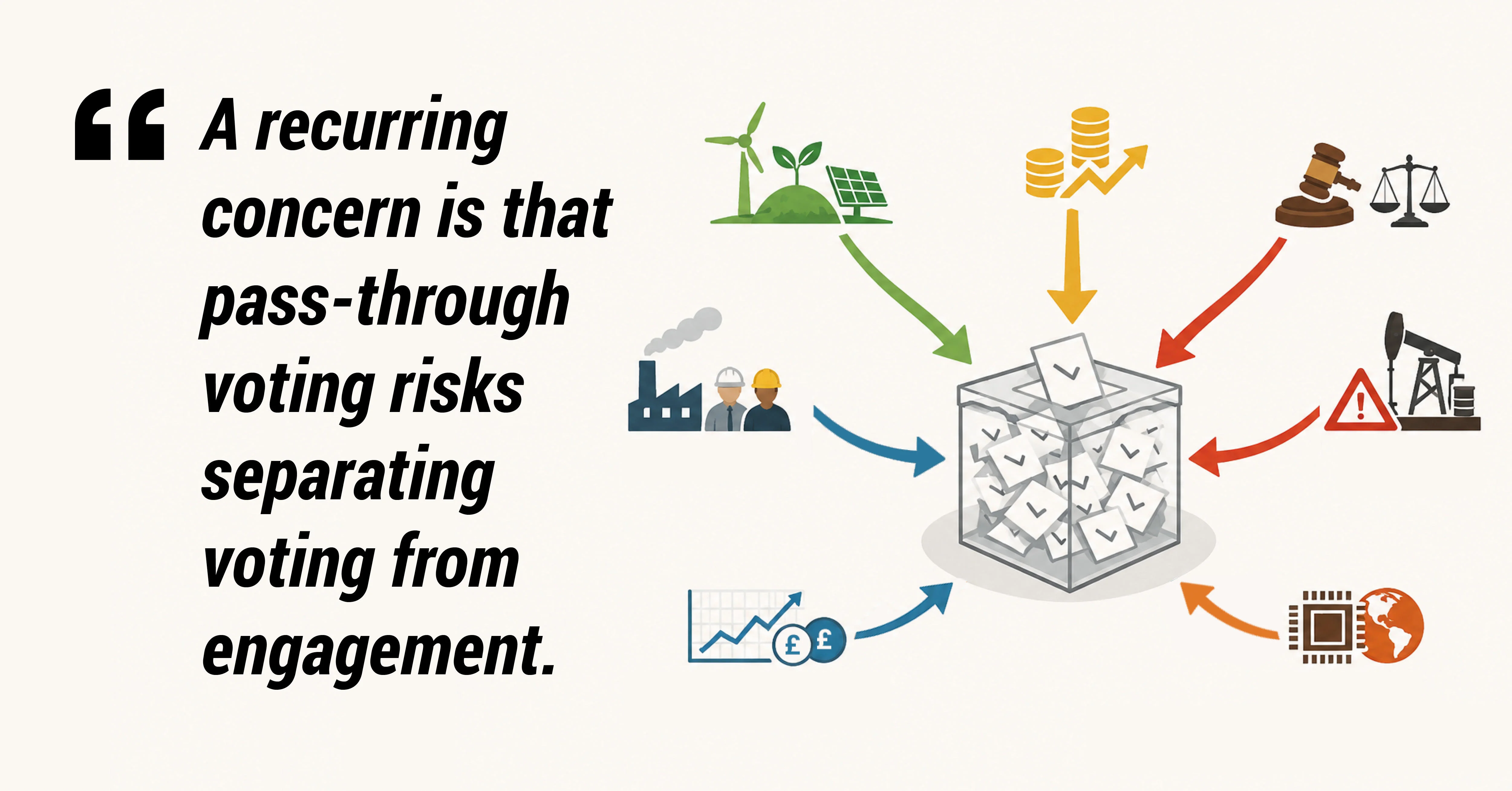
A recurring concern is that pass-through voting risks separating voting from engagement. For many active managers, stewardship is not just about how a vote is cast, but about the ongoing dialogue that surrounds it. If managers no longer control a meaningful proportion of the votes attached to their holdings, their leverage with companies may diminish – and with it, the quality of engagement.
A widely expressed concern is that asset owners, especially smaller ones, will be less informed than asset managers, and so voting quality overall may decline. Issuers worry about a chaotic process if voting authority is dispersed across multiple asset owners and policy menus, resulting in “split votes” where a single asset manager votes in more than one direction on a single resolution.
Advocates counter that the concerns about pass-through voting are overstated. Split voting already exists through segregated mandates – bespoke investment strategies run by asset managers for their clients – and differing fund strategies. Pass-through voting, they argue, merely extends to pooled funds the options that have long been available elsewhere.
Moreover, asset owners adopting pass-through voting tend to be those who care enough to become informed. Those arguing against empowerment of end investors are taking a fundamentally elitist position, instead of welcoming greater dialogue and engagement with the views of clients.
The proxy adviser problem
A significant implication of pass-through voting is the extent to which the practice – particularly when implemented through policy menus – implicitly hands more power to proxy advisers.
Where voting decisions are automated according to pre-set policies, there is in practice little or no vote-by-vote fiduciary oversight by the asset manager. Even asset owners who have carefully selected a policy may have limited visibility into how it is applied in specific, nuanced situations.
For critics, this raises the spectre of more formulaic, performative voting, driven less by considered judgement and more by box-ticking. Given the criticisms levelled at proxy advisers in recent years, it is ironic that the proposed solution to a supposed alignment failure could have the effect of relying more on their voting recommendations with little fiduciary oversight. In the retail market there is a serious concern over whether investors will understand all the implications of the highly complex policies they select.
Pass-through voting: a second-best solution?
Pass-through voting is neither a panacea nor a pathology. For some asset owners, particularly those unable to achieve alignment on voting and stewardship by switching asset managers, it may be a pragmatic second-best solution. The practice could highlight issues and client concerns that asset managers are missing in their voting approaches.
But it is not cost-free. Voting alignment achieved at the expense of engagement quality may be a poor trade. And pass-through voting cannot substitute for the harder work of clarifying stewardship objectives, improving manager selection, and strengthening the market for stewardship as a whole.
At the moment, take-up of pass-through voting is at an early stage and its impact on UK vote outcomes is very limited. Although in the near term it’s unlikely to be transformational for UK governance practice, it’s an issue to watch for the future.
Subscribe to LSE Research for the World

LSE Festival 2026: How to save the planet

Research for the World is the online magazine by LSE - the London School of Economics and Political Science. LSE is a world-leading university, specialising in social sciences and ranked top in the UK by The Times and Sunday Times Good University Guide 2026.
Imaged generated by AI and Adobe Photoshop
Tom Gosling


Related content
Could sustainable investing be the answer to the world's environmental problems?

The illusion of control: why the financial sector is more vulnerable than ever to a financial crisis

AI and the stock market: are algorithmic trades creating new risks?