

Living near a park protected wellbeing during COVID-19 lockdowns, new research finds
Living close to a park significantly protected people’s mental health and wellbeing during the COVID‑19 pandemic, according to new research by LSE’s Dr Christian Krekel and collaborators.
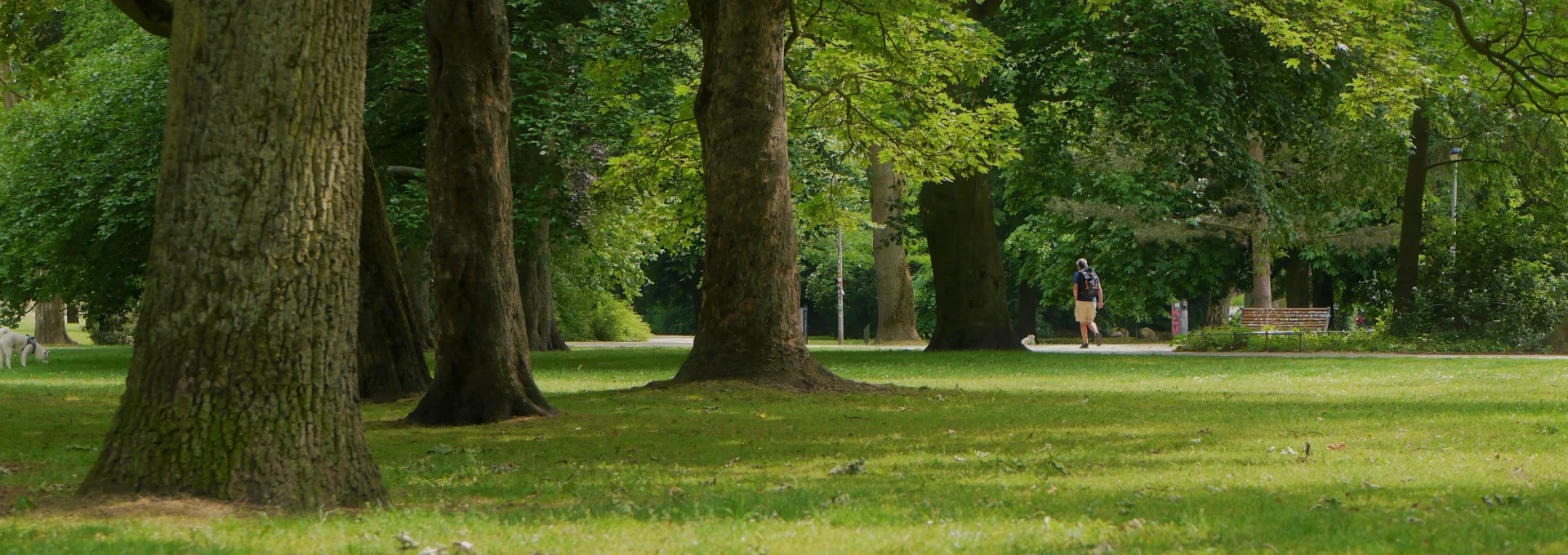
The study, published in the Journal of Health Economics, provides causal evidence that access to urban green spaces can improve life satisfaction and mental health, particularly during periods of crisis.
A natural experiment during the pandemic
While previous research has linked green space to wellbeing, it has been difficult to establish whether parks directly cause these benefits. This study overcomes that challenge by using the COVID-19 pandemic as a natural experiment.
During lockdowns in Germany, parks remained open while many other activities were restricted. This significantly increased the value of having access to nearby green space in ways that were largely unrelated to people’s residential choices.
The researchers combined data from the German Socio‑Economic Panel, a nationally representative household survey, with satellite images of urban green spaces. Precise location data made it possible to compare changes in wellbeing over time for people living close to parks with those living further away.
Wellbeing and economic benefits
The results show that people living within 1,000 metres of a park reported significantly higher life satisfaction during the pandemic, with the strongest effects found for parks of around 15 hectares. On a 0 to 10 life satisfaction scale, living near such a park was associated with an increase of around 0.22 points.
The study also finds clear mental health benefits, including lower anxiety and fewer symptoms of depression, as well as some indications of reduced loneliness.
Importantly, the researchers also put a monetary value on these effects. They estimate that, during COVID‑19 restrictions, an individual without access to a nearby park would have needed around €6,600 per year to achieve the same level of life satisfaction as someone living close to one. Taking into account the possibility of future pandemics, the minimum estimated annual value of living near a park is about €132 for each person, even during periods when there are no lockdowns or restrictions.
Krekel commented: "To show policy-makers how precious public goods like parks can be, we need to put a pound sign onto them. Our method allows doing that, for parks but also other public goods with similar valuation issues."
Implications for cities and policy
The findings highlight the role of urban green spaces as an important public good for wellbeing, particularly during periods of crisis. The authors show that the benefits of parks are substantial and argue that these effects are likely to be under‑accounted for in social welfare analysis, with important implications for urban policy and planning.
Krekel, C., Goebel, J., & Rehdanz, K. (2026). The value of a park in crises: Quantifying the health and wellbeing benefits of green spaces using exogenous variations in use values. Journal of Health Economics, 107, 103123. https://doi.org/10.1016/j.jhealeco.2026.103123