

“Every so often a world order changes, and I think we are in one of those moments”: President of Finland Alexander Stubb speaks at LSE
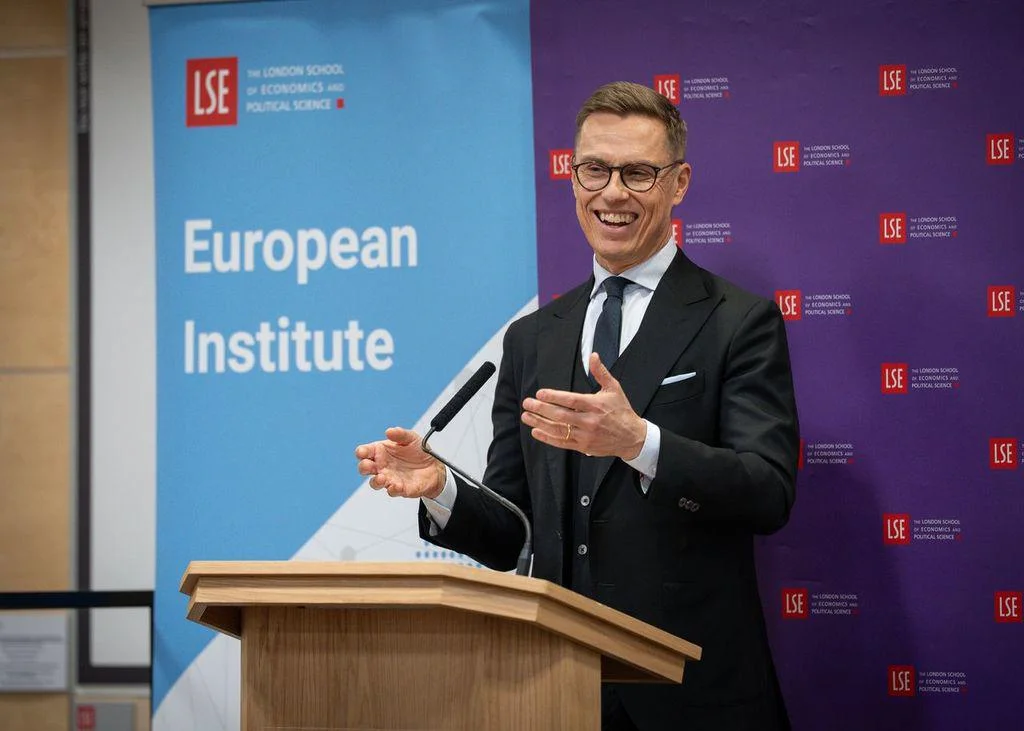
Cai-Göran Alexander Stubb, the 13th President of the Republic of Finland and an alumnus of LSE, visited the School last week to deliver a lecture on rebalancing the international order in an era marked by fragmentation.
The event, chaired by LSE’s Vice President and Pro-Vice Chancellor (Research) and Professor of Environment Economics, Susana Mourato, centred on the shifting architecture of contemporary international relations.
During his speech, Stubb recognised the changing value proposal for the current generation, outlining its trajectory as a move from a bipolar world (anchored in Soviet Union-United States relations) to a unipolar world dominated by the US, and ultimately, to the present-day multipolar system characterised by a diverse range of actors.
“The big question that I think all students of international relations have to ask themselves: is this a rupture, or a death of the old system, or is this a transition?” he said, noting that he leans towards the last category.
“Every so often a world order changes, and I think we are in one of those moments”, he added, explaining that choice in this emerging order is fairly binary but complex, with some states aligning themselves with principles of multiplurality, while others advance multilateralism.
Shifting power dynamics
The lecture explored the implications of these shifting power dynamics, with Stubb highlighting that he increasingly sees “instruments of power that are now being used also as instruments of war”. While the European Union appears more unified than ever within the contemporary geopolitical landscape, he expressed concern over the proliferation of regional conflicts. In this context, he warned, “if we don’t contain competition, it will spillover to conflict; therefore, we need cooperation”.
“I think we live in a world disorder”, he observed, adding that “we are seeing a whole bunch of power vacuums, and whenever there is a power vacuum someone is going to fill it”. To underscore this point, Stubb turned to the United Nations, where constraints to conduct peace mediations are giving rise to transactional political practices, in turn enabling what he described as “unholy alliances” between countries. As a result, he further stressed, there is a need to rebalance the power structures of the UN and other international institutions.
“Values-based realism”
Nevertheless, he emphasised that the transition toward a new world order will take time to be crafted. “It’s going to be the Global South that decides what the next world order looks like…If the West wants to have skin in the game or at least save the remanence of the liberal world order, it needs to use something which I have called ‘values-based realism’”, he said. This proposed model rests upon a value-based and realistic perception of the world, which Stubb noted needs to be combined with dignified foreign policy.
“What we need is a new San Francisco moment or new Bretton Woods moment where world leaders come together…. to try to figure out ‘what are the institutions we need to work with to preserve peace?’, ‘who does the peace mediation?’, ‘what is the power structure of the financial institutions?’ and ‘how do we deal with it?’ Is this idealistic? Perhaps a little bit, but I think it’s at least worth a try.”
Listen to a recording of President Stubb’s lecture.