

LSE celebrates topping out ceremony at the Firoz Lalji Global Hub
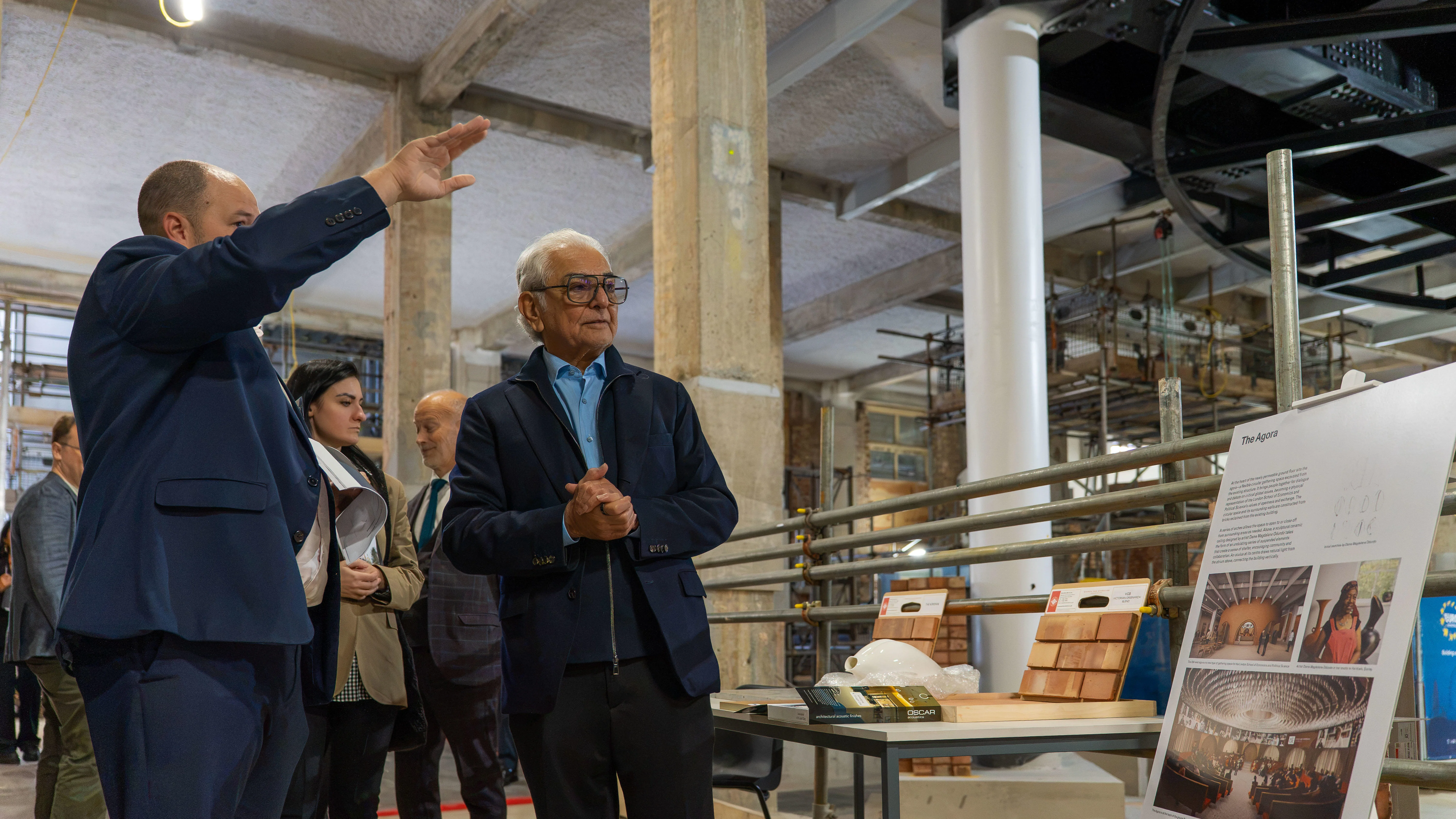
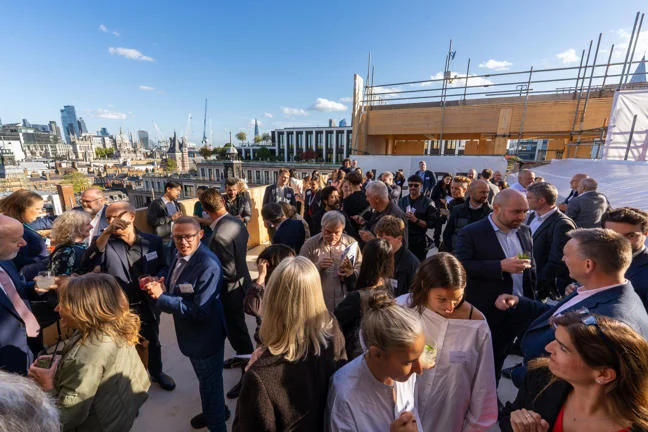
LSE’s newest building, the Firoz Lalji Global Hub, reached a major construction milestone with a topping out ceremony held on Tuesday 13 October. Located at 35 Lincoln’s Inn Fields, the building will create new spaces for research, teaching, collaboration and debate, bringing several academic departments and activities together under one roof.
Designed by award-winning practice David Chipperfield Architects with construction by McLaren Group, the Firoz Lalji Global Hub will be LSE’s most sustainable building to date. It will be all-electric, drawing energy from renewable and green energy sources, with photovoltaic panels incorporated into a biosolar roof. Biodiverse green and blue roofs will also help manage rainwater and create habitats for nature. The development is on track to achieve several sustainability and wellbeing certifications, including Passivhaus, BREEAM and WELL.
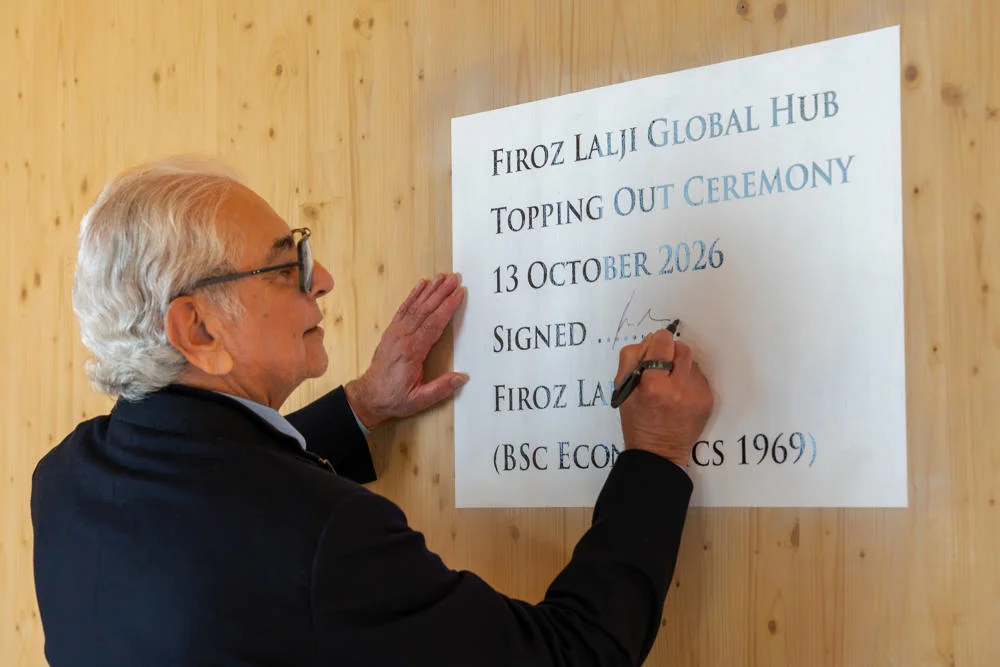
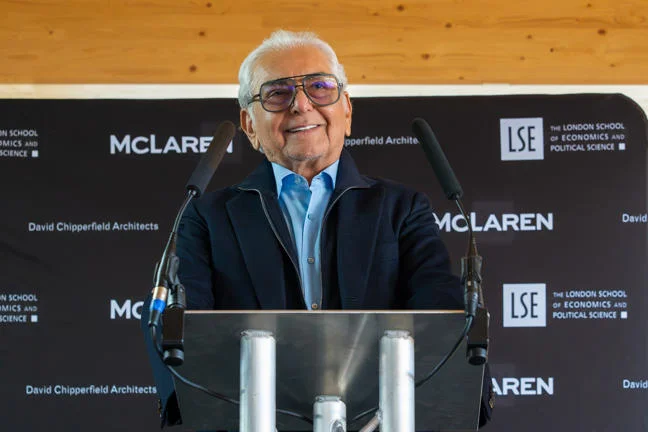
Speaking to a packed audience of project partners and LSE representatives, alumnus and donor Firoz Lalji said: “What makes this occasion truly meaningful is what the building will make possible in the years ahead. This project represents a shared ambition, a place where people come together to share ideas, challenge assumptions and deepen our understanding of the world around us.
“I hope the building will embody the spirit of curiosity and enquiry, bringing together a place for the complex challenges facing our world and how we address them. LSE’s commitment to the social sciences, its international stature, outlook and willingness to tackle the most pressing challenges of our time are as important today as they’ve ever been.”
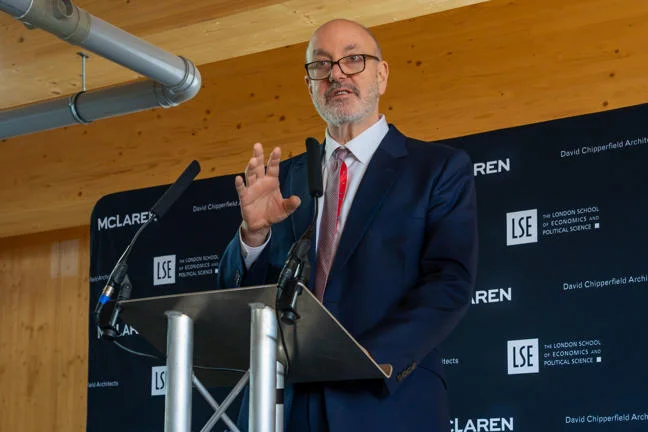
Professor Larry Kramer, LSE President and Vice-Chancellor said: “With this building we are creating conditions for new ideas, new partnerships, and new solutions to emerge and flourish. At the centre is the Agora, designed as a modern interpretation of the ancient Athenian gathering place to discuss issues and exchange ideas in a spirit of openness and reason. It will bring people together to learn through lectures, debates, conferences, events, and daily conversation—not just the LSE community but a global community.
“The Firoz Lalji Global Hub will help LSE fulfil its broad mission to 'understand the causes of things' and use that understanding to make the world a better place.”
Firoz Lalji Global Hub Topping Out Ceremony
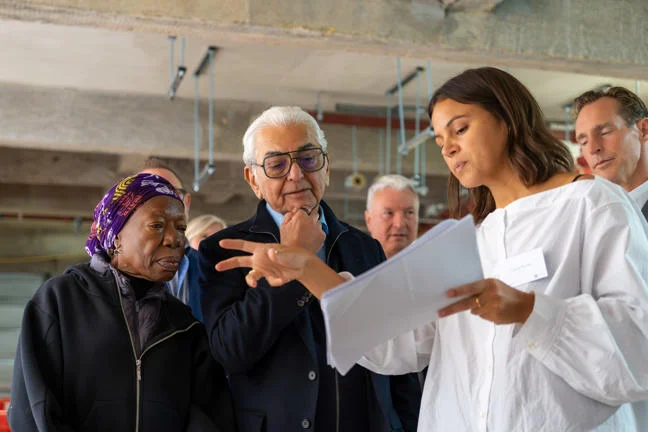
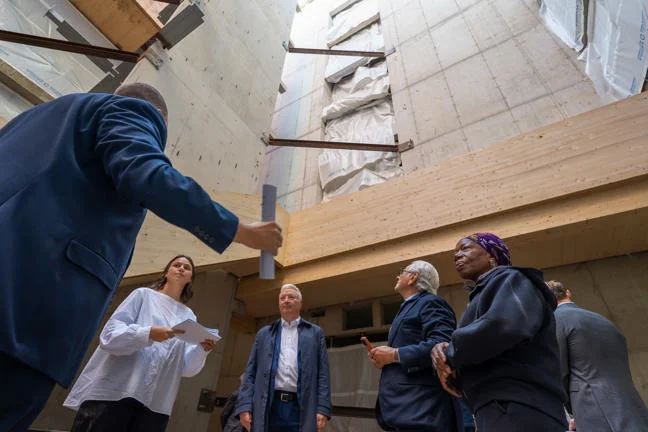
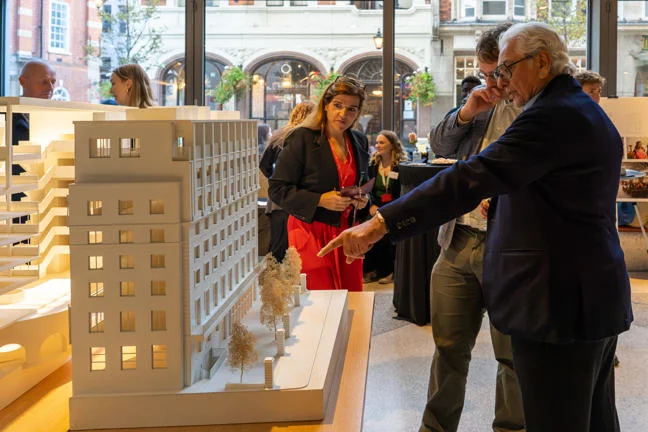
The heart of the building hosts the Agora, a multipurpose circular space designed to bring the LSE community together for teaching, events and discussion. It will accommodate up to 291 people and host activities including lectures, conferences and formal debates.
The Agora’s circular layout is designed to encourage audience participation, while its reclaimed-brick walls incorporate more than 40,000 bricks salvaged from the existing building. Above it, a sculptural ceramic ceiling designed by Dame Magdalene Odundo will form a central architectural feature, with an oculus drawing natural light into the space from the atrium above.
The ground floor will also include a café and informal gathering areas, creating opportunities for conversations and spontaneous encounters alongside the building’s formal programme.
The Firoz Lalji Global Hub will bring together several departments and activities, creating opportunities for collaboration across disciplines.
On the first floor, the Firoz Lalji Institute for Africa (FLIA) will comprise a dedicated suite of offices, meeting rooms and shared spaces to support its research, teaching, events and collaborations. The additional space will allow the Institute to welcome more visiting professors, researchers and academics from Africa and around the world. It will also support the growth of the Programme for African Leadership, LSE’s flagship extracurricular programme for postgraduate students of African nationalities. The first floor will also provide office space for LSE’s Data Science Institute and will house the new Wolfson Data Visualisation Studio, which will enable cutting-edge data science to be integrated into LSE’s research and teaching.
The second, third and fourth floors will house the Departments of Mathematics and Statistics. New offices, teaching facilities, student spaces and co-working areas will support the departments’ expanding research and teaching programmes, while bringing colleagues and students into closer proximity.
The upper three floors will be dedicated to Executive Education and Lifelong Learning. Designed to support hybrid teaching and professional development, the facilities will include seminar rooms, lecture theatres and breakout spaces for group work and individual coaching. A terrace on the sixth floor will provide outdoor space, while an executive lounge and restaurant on the seventh floor will offer settings for networking and events.
Together, these facilities will support LSE’s ambition to expand its global network of researchers, students and leaders, creating more opportunities to exchange ideas and develop responses to complex global challenges.
Darren Gill, Managing Director, McLaren said: “This has been a boundary-pushing project with nearly 60% of the original building retained, knitting together old and new. The commitment and passion poured into this project from all the teams involved, including the LSE team, has been remarkable.”
Maria-Chiara Piccinelli and Laura Burley from David Chipperfield Architects said: “LSE is leading the way in sustainable design . . . the lessons learnt here will extend far beyond this building. The move towards achieving Passivhaus, BREEAM and WELL demonstrate that a highly complex, civic and academic building can combine environmental responsibility with generosity, flexibility and architectural quality.
“The Firoz Lalji Global Hub stands as a demonstration of the kind of architecture that the climate emergency now demands. We look forward to the Firoz Lalji Global Hub becoming part of LSE’s daily life.”
The project has been made possible by LSE alumnus and founding donor Firoz Lalji, who contributed £25 million to the development. The building will be a centrepiece of LSE’s plans for a new university quarter in central London.