

Kristalina Georgieva, Christine Lagarde and Ngozi Okonjo-Iweala speak at LSE panel in honour of Nicholas Stern
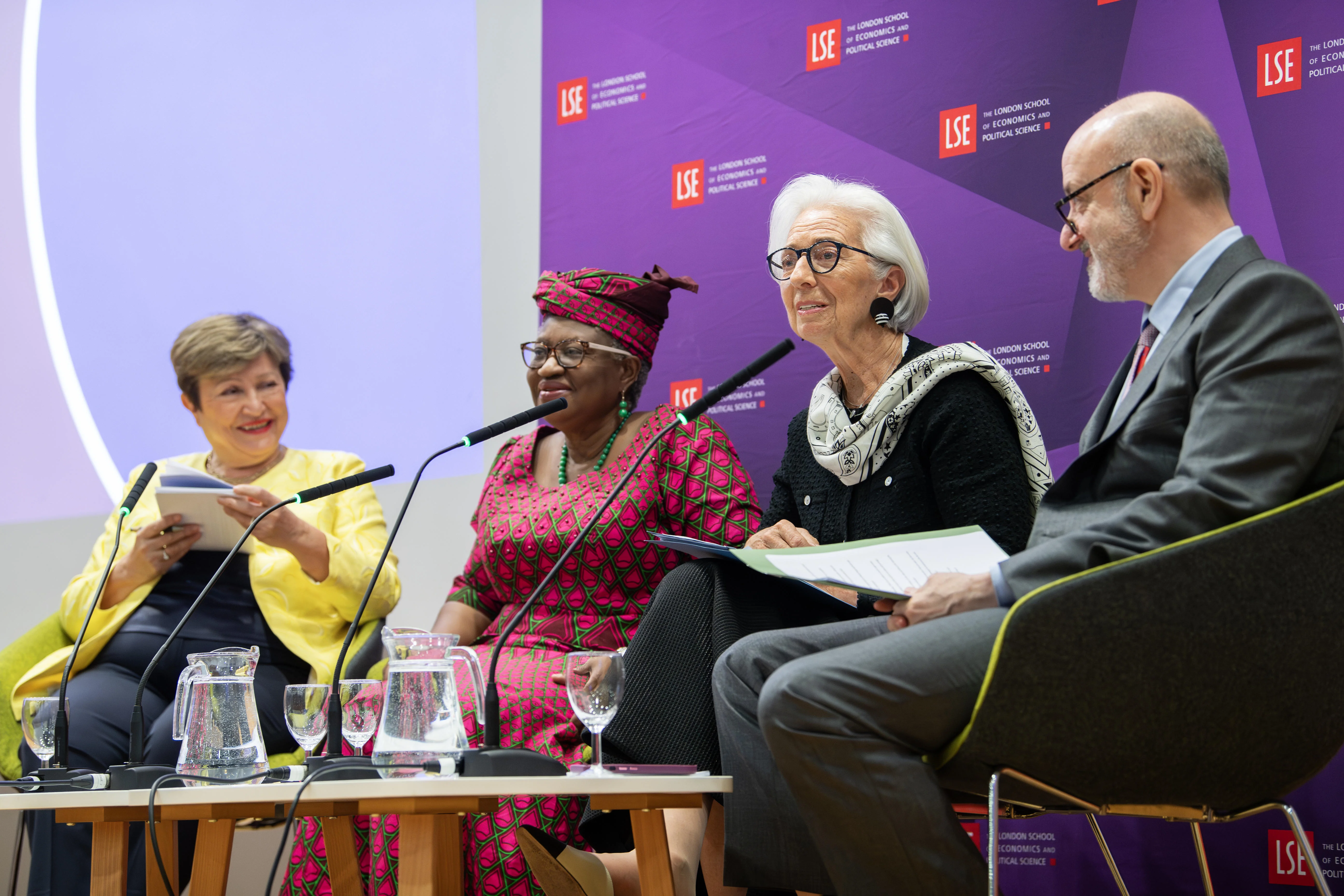
Last week, LSE’s Global School of Sustainability, the Grantham Research Institute on Climate Change and the Environment and STICERD hosted a panel discussion in honour of the Institute’s Chair, Professor Lord Nicholas Stern, for his 80th birthday.
The event, chaired by LSE President and Vice Chancellor, Larry Kramer, brought together the International Monetary Fund’s Managing Director Kristalina Georgieva, President of the European Central Bank Christine Lagarde, and Director-General of the World Trade Organisation Ngozi Okonjo-Iweala for a conversation centred around ideas.
During the discussion, the panelists explored the need for societies and global institutions to evolve in order to address daunting challenges including climate change, inequality and risks arising from new technologies.
Care for the environment is good for the economy
The speakers began by reflecting on the ideas that have had the most impact on their careers. “One of the most significant developments, and Nick was the one to drive it, was when we finally realised that care for the environment, care for our climate is good for the economy”, said Kristalina Georgieva.
She further shared how important it has been to move this conversation from environment and finance ministers to making it about the prospects for economies, businesses and people to grow.
Ngozi Okonjo-Iweala noted the importance of interdependence between societies, countries and global institutions, stressing that the idea has largely kept the world away from major conflict, lifted 1.5 billion people out of poverty, and led to consumers benefitting from global supply chains. Building on this, Christine Lagarde stated that a balance between interdependence and independence has also served well.
The panel then moved on to examine the role of ideas in addressing the key challenges facing society today, with Georgieva centering this around the tensions arising from today’s multipolar world. These tensions, coupled with the changes observed in terms of technology and artificial intelligence, have led to a world that is simultaneously exciting and worrying.
The role of universities
In the face of such challenges, Lagarde encouraged the audience to serve communities as well as preserve the principles and institutions challenged with courage, community and creativity. She stated that this is especially a mission for academic institutions: to help those who work within global institutions and are, in a way, prisoners of the paradigm in which the world has evolved.
Lagarde further explained that universities, across a lot of different dimensions, offer bridges, open doors and open knowledge. “…When we talk about building walls, separating, protecting, preserving, being so risk-averse that we don’t want to let others look at what we’re doing and over our shoulders, I’m always reminded of two particular areas where having open knowledge and being prepared to share was actually a fantastic service to humanity”, she said, pointing to agricultural and scientific research that previously served populations at risk of famine and the COVID-19 pandemic.
“So, what universities can do is continue to do research in sometimes unpredictable directions, in areas that you don’t suspect will be transformational, but make it as open as possible and be as welcoming to new ideas as you can.”
Contributing to the conversation from a trade perspective, Okonjo-Iweala emphasised the need for the academic community to produce facts and transparency. “In the trading community, there is a lot of lack of trust. And so, if the facts do not support ‘my own ideas’ and ‘my own domestic policies’, then they are not facts”, she shared, noting that objective information produced by universities as “independent neutral parties” is helpful in bringing about transparency and innovation.
The end of the discussion saw each of the panelists reflect on the impact Nicholas Stern has had on their work. They highlighted his contribution towards ideas on the cost of inaction (transition is less costly if dealt with timely and properly), not approaching everything in economics as a trade off, and making things ultimately about people.