

LSE Health at 30: three decades of evidence-based policy analysis
Annabel Fenton and Elias Mossialos chart the origins of LSE Health and share 30 years of policy engagement and research impact.
When LSE Health was formally established in 1995 by Brian Abel-Smith and Elias Mossialos, it represented a continuation rather than a departure. For decades, the London School of Economics and Political Science (LSE) had been home to influential figures such as Richard Titmuss and Brian Abel-Smith, whose work helped establish modern health and social policy as fields grounded in both evidence and social justice. Their legacy created an environment where a research centre focused on health systems, health economics and policy could develop naturally.

Brian Abel-Smith and Richard Titmuss. Credit: LSE
Creating a research centre
Elias Mossialos arrived at LSE in 1990, shaped by this intellectual tradition. By the mid-1990s, he had developed a vision for a research centre that would bring social science disciplines together to study health systems through comparative analysis.
LSE Health began as a Unit in 1993 within the European Institute and was formally established in January 1995 as a research centre affiliated with the Department of Social Policy. LSE Health began modestly, under Professor Mossialos’s directorship, building on the School’s existing strengths rather than attempting to chart an entirely new course. Following Brian Abel-Smith’s inaugural chair of Steering Committee of LSE Health, Professor Julian Le Grand took over, bringing his influential work on quasi-markets and choice in welfare services — ideas that would prove central to debates about NHS reform throughout the 2000s.
The Centre’s institutional development continued with the establishment of the Department of Health Policy in 2017, with Mossialos as founding Head, bringing research and teaching under a unified framework and expanding opportunities for interdisciplinary collaboration. The Department has since 2020 also been led by Professor Alistair McGuire (2020-2023) and then Professor Andrew Street (2023-2026), with Professor Joan Costa-Font taking over in September 2026.
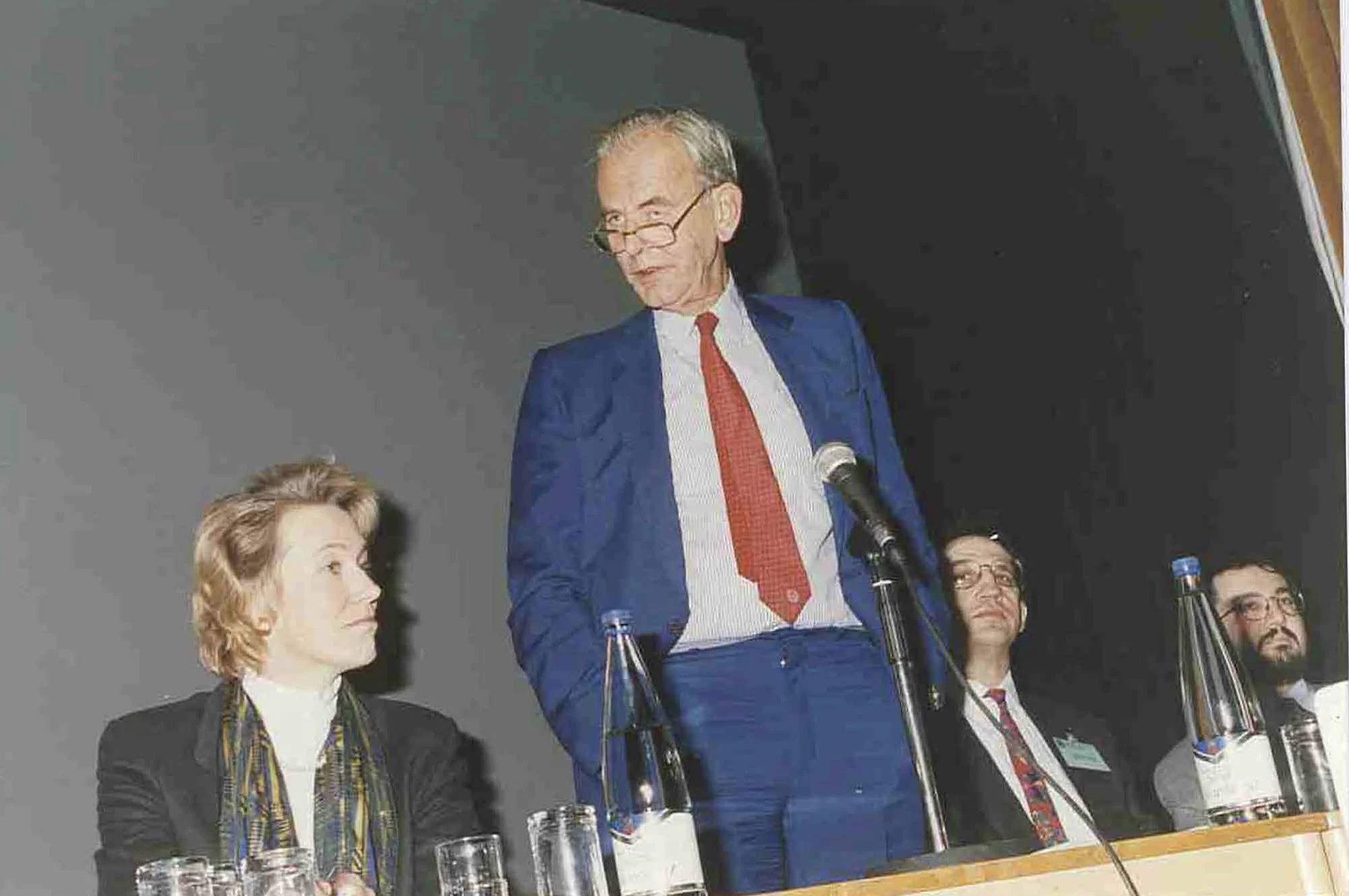
LSE alumna Virginia Bottomley, then Secretary of State for Health, with Brian Abel-Smith, Julian Le Grand and Elias Mossialos on the panel at the formal launch of LSE Health. The launch event took place at the Old Theatre on 27 January 1995
A significant development came in 1998 when LSE became a founding partner of the European Observatory on Health Systems and Policies, hosted by WHO/Europe in collaboration with the European Commission, national and regional governments (Austria, Belgium, Finland, Ireland, Netherlands, Norway, Slovenia, Spain, Sweden, Switzerland, the United Kingdom and Italy’s Veneto Region with Agenas); other health system actors (CNAMS – the French National Union of Health Insurance Funds, the Health Foundation). and academia (The London School of Economics and Political Science, London School of Hygiene and Tropical Medicine).
Professor Mossialos, together with Dr Josep Figueras from WHO and Professor Martin McKee from LSHTM, founded the Observatory, enabling systematic comparative analysis of health systems across Europe. LSE continues to host one of the Observatory’s research hubs today.
The Centre’s contribution to health and social care policy research was recognised nationally in 2009 with the Queen’s Anniversary Prize, reflecting the impact of its work over the previous fifteen years.
The Centre is an international leader in health policy analysis with a strong reputation and influence within Europe, the USA, and the rest of the world. The Centre’s work is a model for policy-relevant research.
– Professor Alan Garber, President of Harvard University and former Professor of Economics, Health Research and Policy in the Graduate School of Business at Stanford University

HM The Queen and Prince Philip present the Queen’s Anniversary Prize to Elias Mossialos and then LSE Director Sir Howard Davies in 2010
Building a research agenda: connecting disciplines, comparing systems
From its earliest years, LSE Health’s research has spanned several interconnected themes that continue to define the Centre’s work today.
Resilient and sustainable health systems
A core strand of the Centre’s research examines how health systems can adapt to shocks while maintaining equitable access to quality care — from analysing the fiscal consequences of austerity to developing frameworks for climate-resilient healthcare delivery.
Researchers including Dr Ranjeeta Thomas, Dr Miqdad Asaria, Dr Ilias Kyriopoulos, and Dr Jonathan Cylus, have contributed to work on financing mechanisms, workforce strategies, and governance structures that enable health systems to withstand disruption while delivering value for populations. LSE Health also actively contributes to the Partnership for Health System Sustainability and Resilience (PHSSR) with Alistair McGuire, George Wharton and others.
Global health policy and equity
LSE Health’s research on global health equity examines how economic policies, trade agreements and development assistance shape health outcomes across low- and middle-income countries, and evaluates interventions that can narrow health gaps. The Health Inequalities Lab, led by Dr Emilie Courtin, and the Global Surgery Policy Unit, led by Dr Rocco Friebel and co-hosted with the Royal College of Surgeons, tackle these issues.
Other key researchers in this area include Professor Mylène Lagarde, Dr Lesong Conteh, Dr Clare Wenham, Professor Tiziana Leone, Dr Justin Parkhurst, Dr Zlatko Nikoloski and Professor Ernestina Coast, whose work spans reproductive health, surgical access, and health system resilience across Africa and beyond.
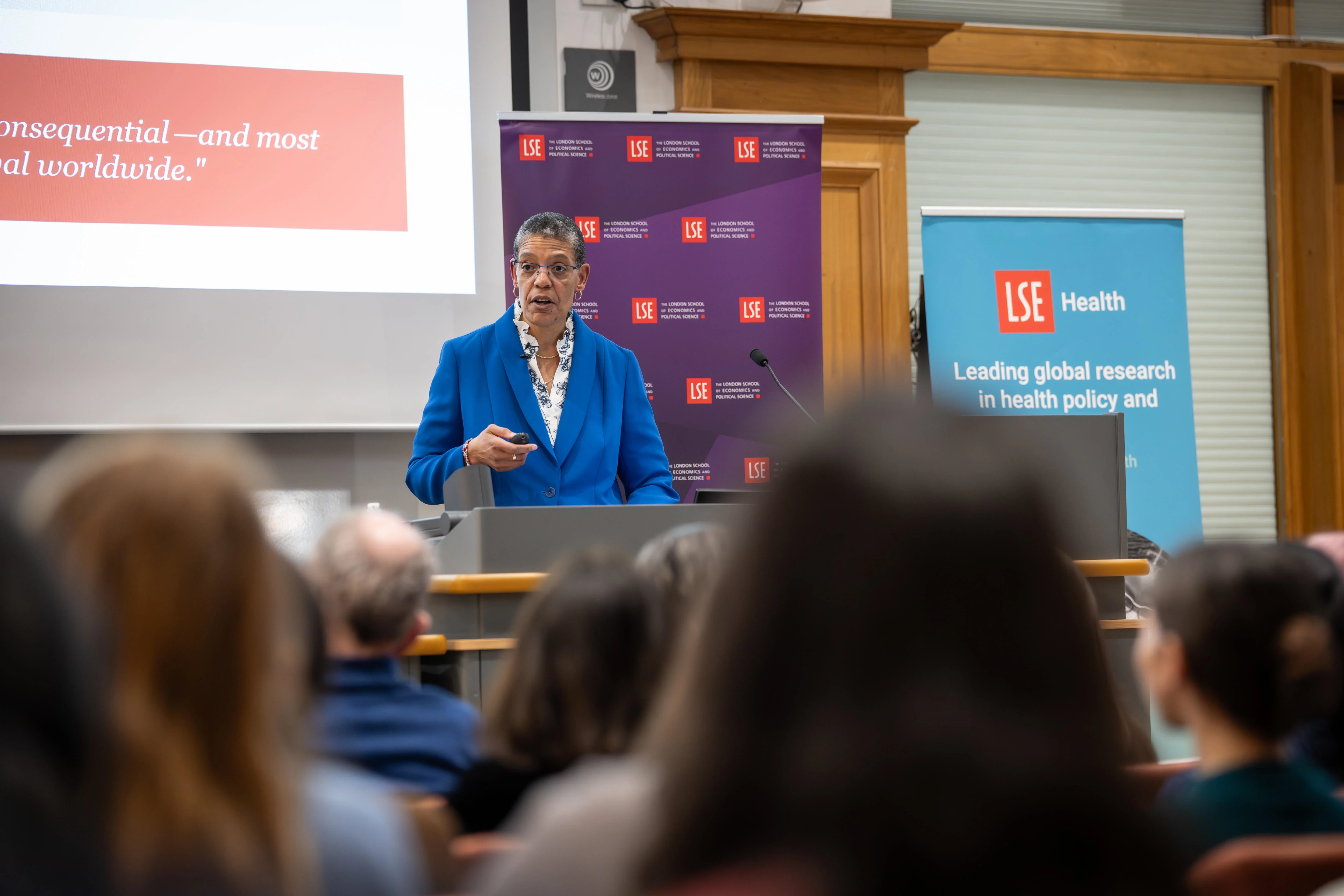
Professor Michelle A Williams, Stanford University, delivering the joint LSE Health and Department of Health Policy Annual Lecture, March 2026.
Ageing and frailty
As populations age across Europe and beyond, LSE Health has developed significant expertise in the economics of long-term care and the determinants of healthy ageing. Professor Joan Costa-Font leads the Ageing and Health Incentives Lab (AHIL) which investigates how financial incentives, behavioural factors, and social policies shape health and care outcomes across the lifecourse. Professor Andrew Street brings particular expertise in frailty, examining how health and social care systems can be better designed to support people with complex, multiple conditions. This strand of work connects closely with the Centre’s broader interest in health system resilience and sustainability.
Pharmaceutical policy
LSE Health has long been at the forefront of pharmaceutical policy research, examining drug development, regulation, pricing, and access. The Centre analyses how pricing and reimbursement mechanisms affect both innovation incentives and patient access, and investigates strategies for rational prescribing. Professor Huseyin Naci and Professor Panos Kanavos have been central figures in this work, alongside Professor Alistair McGuire. In December 2025, the Centre launched its Pharmaceutical Policy Lab, led by Dr Huseyin Naci.
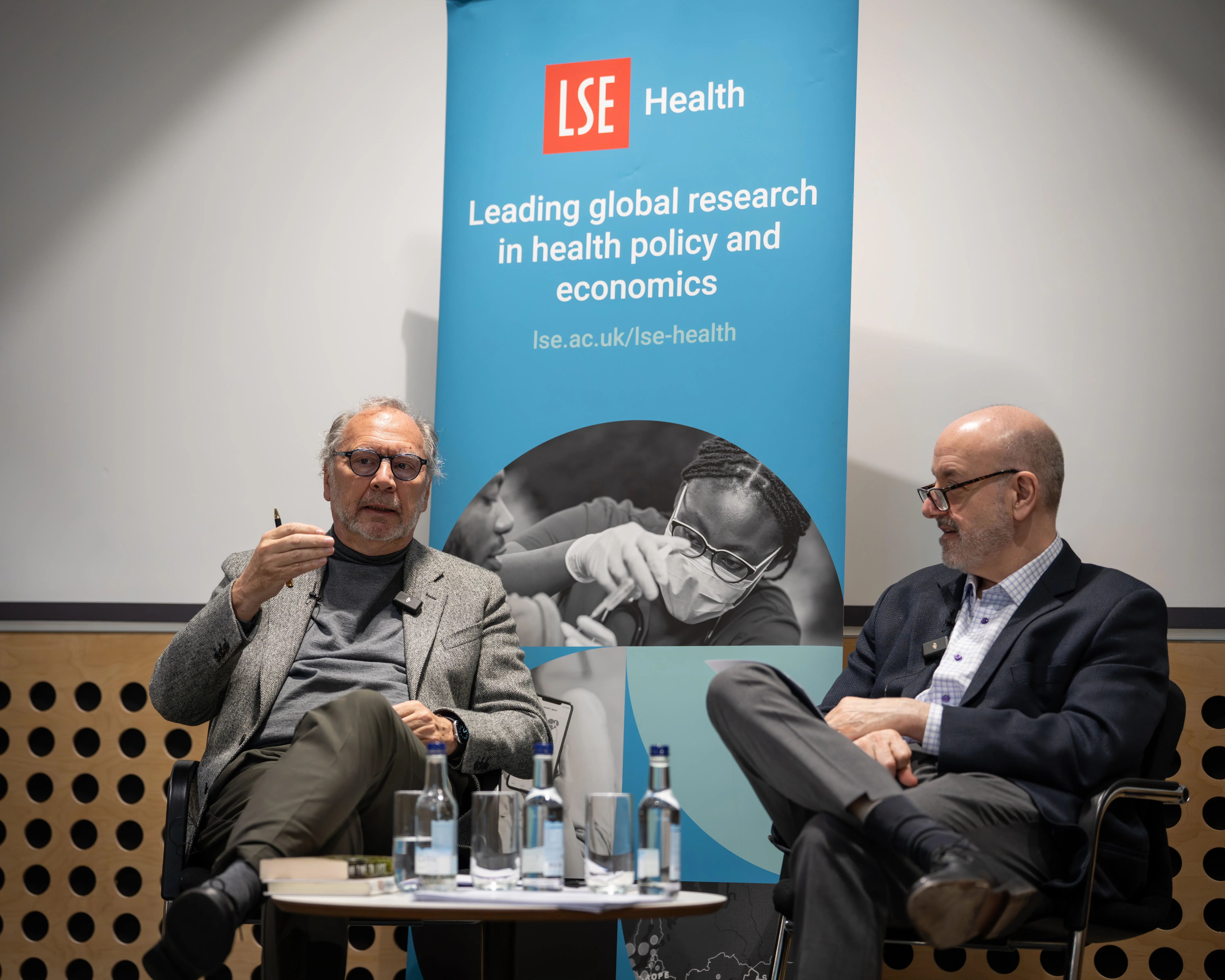
Professor Peter Piot, who co-discovered Ebola, and established UNAIDS, in conversation with LSE Vice Chancellor Larry Kramer, at an LSE Health event on 11 March 2026
Digital health and AI
Through its Medical Technology Research Group (MTRG) and AI and Digital Unit, the Centre examines how new technologies can improve health outcomes while ensuring equity and safety. Research by Professor Panos Kanavos, Dr Alex Carter, Dr Robin van Kessel, Madeleine Haig, and Mackenzie Mills, spans health technology assessment, the regulation of AI in healthcare, and digitalisation of health services — examining both the promise of innovation and the governance challenges it raises.
Antimicrobial resistance (AMR)
The Centre has been at the forefront of global AMR policy research, including a landmark partnership with WHO Europe to develop the world’s first AMR Accountability Index — a tool designed to hold governments accountable for their commitments on drug-resistant infections. Professor Elias Mossialos, Dr Emily O’Neill and Dr Michael Anderson contribute to this work, examining market failures that limit antibiotic development and evaluating governance mechanisms for coordinating global AMR responses.
Responding to the COVID-19 pandemic
The COVID-19 pandemic presented an acute test of health system resilience worldwide. Researchers at the Centre worked on policy analysis that fed into longer-term thinking about preparedness and recovery.
This work contributed to the LSE-Lancet Commission on the Future of the NHS, which examined priorities for sustainable investment, integrated care and preparedness for future crises. Professor Mossialos also served as Scientific Director of the Pan-European Commission on Health and Sustainable Development, an independent group convened by WHO and chaired by former Italian Prime Minister Mario Monti.

LSE–Lancet Meeting of Commissioners in Edinburgh, September 2018: The LSE team travelled to Edinburgh to meet a range of NHS stakeholders representing the Royal College of Physicians on Edinburgh, the Royal College of Surgeons, the Royal College of General Practitioners, NHS Scotland, the University of Edinburgh and the Scottish Government. This was followed by a general meeting of the Commission to discuss the initial results of a situational analysis of the major challenges facing the NHS in each UK countries, followed by open debate regarding potential policy recommendations.
Dr Clare Wenham co-led the Gender & COVID project, which conducted research and advocacy on gender-sensitive responses to diverse public diverse public health emergencies, including disease outbreaks, climate events, and humanitarian crises.
Policy engagement
The Centre’s approach was shaped by practical engagement from the outset. In 1994, researchers undertook a major evaluation of the Greek national health services for the Ministry of Health. The analysis led to concrete improvements in funding allocations, resource distribution and productivity, establishing an early template for how LSE Health would operate: rigorous research directed towards real policy challenges.
Around the same time, LSE Health contributed to Choices in Health Policy: An Agenda for the European Union for the European Commission, addressing cost containment, efficiency, and access gaps across member states. The report made the case for evidence-based policymaking and technology assessment, and explored where EU institutions could add value on cross-border health threats and coordination. Many of its themes continue to shape European health debates, and it is often seen as a precursor to frameworks like the European Semester’s health system resilience agenda.
In 2002, commissioned by the Belgian Presidency of the EU Council, LSE Health produced the first comprehensive analysis of EU Law and the Social Character of Health Care, showing how legal principles designed for trade, competition and free movement were being applied to healthcare through European Court of Justice rulings, with consequences few had anticipated. As former French Prime Minister Michel Rocard noted: “The importance of this subject cannot be overestimated and the authors have approached the issues in a comprehensive and innovative way.”
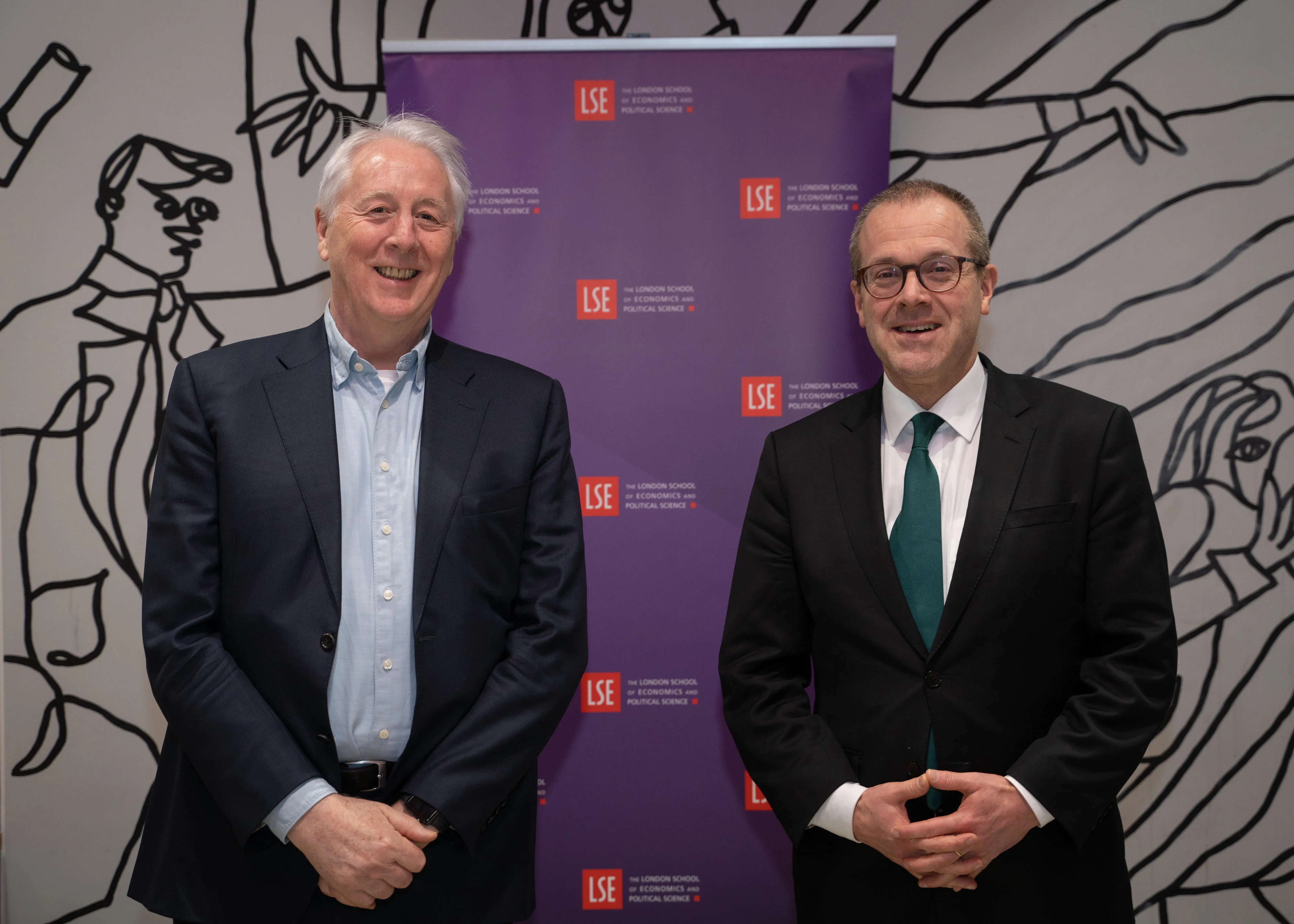
Professor Alistair McGuire with Dr Hans Kluge (WHO Regional Director for Europe) for LSE Health’s 2023 annual lecture
Over three decades, LSE Health’s comparative research has contributed to health system reforms in several countries.
A review of pharmaceutical regulation in Finland (2008) identified practical improvements in pricing, transparency and pharmacotherapy that were subsequently implemented. In 2014-16, research on the pharmaceutical system in China shaped significant regulatory reforms with implications for access to medicines. And in 2017, a comprehensive review of the social insurance and healthcare system in Austria informed a government restructure completed in 2020.
In each case, the pattern was the same: rigorous comparative analysis combined with engagement with policymakers at moments when reform was actively under consideration.
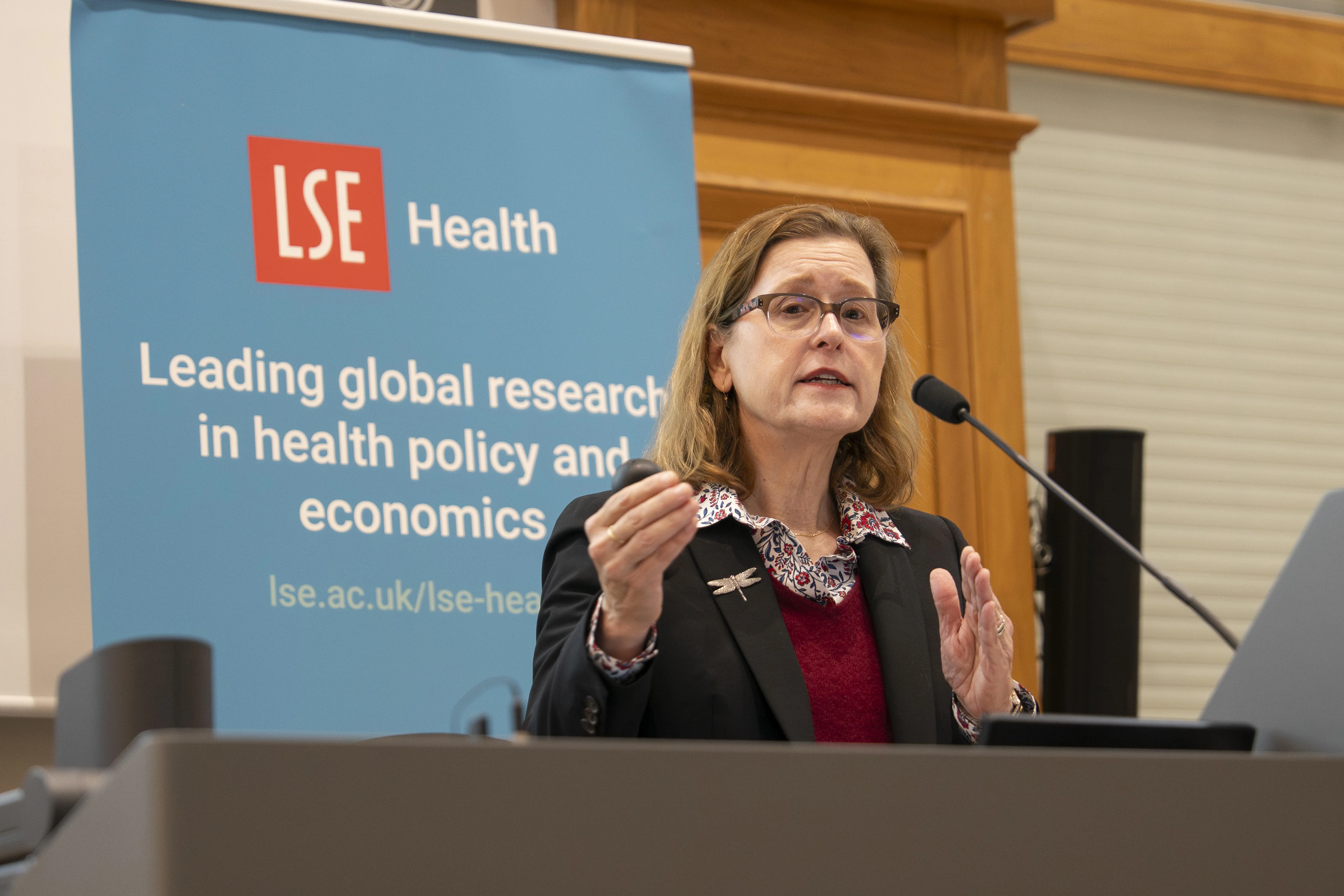
Professor Janet Currie (Yale University) delivering a lecture on youth mental health at LSE on 13 October 2025
LSE Health and the School’s history
LSE Health’s 30th anniversary coincides with LSE’s 130th year. Viewed in this broader context, the Centre’s development represents a continuation of LSE’s long-standing commitment to addressing societal challenges through social science research.
The Centre’s influence has been built gradually, through consistent engagement with practical policy problems, enduring partnerships, and work that has proven useful to policymakers across different contexts. Its approach has always been grounded in strong social science methods, multidisciplinary perspectives, and a deep understanding of how health systems function on the ground.
As health systems confront digital transformation, demographic change, and the ongoing tensions between equity and financial sustainability, the Centre’s approach remains as relevant as it was 30 years ago. By combining rigorous research with direct policy engagement, LSE Health continues to offer the kind of grounded, evidence-based analysis that policymakers need to navigate an increasingly complex landscape.
The challenges may have evolved, but the Centre’s commitment to asking the right questions and producing work that makes a practical difference has not.
Find out more about LSE Health’s 30th anniversary celebrations.
Orignally published: “LSE Health at 30: three decades of evidence-based policy analysis” by Annabel Fenton and Elias Mossialos, originally published on LSE Blogs, licensed under CC BY 4.0. No changes made.