

Graduate destinations

LSE history students continue to have one of the best rate of employability and earnings after graduation in the UK. The Complete University Guide 2022 places History at LSE 1st overall for job prospects and the 2021 report on Graduate Outcomes Subject by Provider from the Department for Education places History at LSE second with earnings superior to any other university in the UK, except Oxford.
LSE has helped me process complex information more quickly on a practical level, whilst the degree has also been perceived very positively in terms of ‘opening doors’ by my employers.
Natalie Büchin
LSE History graduates find employment in almost any job sector due to the wide range of transferable skills developed during their studies.
Very few people with a degree in History go on to work as historians, but students with a degree in International History have many skills that are in high demand today.
History students learn to read and process large amounts of information, to sift out unreliable data, to analyse and organise the material available, and to form a coherent argument orally or in writing. Students at the LSE learn to set and achieve personal goals, manage their time to meet deadlines, and have confidence speaking in public. In our knowledge-based economy, employers value these skills.
Students at the LSE have an opportunity to engage in a wide range of extracurricular activities that help to build their career prospects. Student societies range from political and charity work, to societies focused on specific career paths. See the full list of LSE Student Union Societies.
Throughout the academic year, LSE Careers with the support of the Department organises events and panels specifically tailored for History students.
LSE Careers helps you guide through the careers maze with a comprehensive range of careers and employment services. It offers one-to-one appointments, practice interviews, careers events and fairs, the chance to meet employers, job listings, volunteering opportunities, advice about further study, support if you’d like to set up your own business, and numerous online resources.
In addition, Careers Service helps you in your search for employment during the summers and after you graduate. The Careers Service organises Careers Fairs, Forums, Seminars and Employer Presentations throughout the academic year.

Natalie Büchin
MSc History of International Relations (2018)What job do you do now and how did your degree help you to get it?
Since graduating from LSE, I have been contracting as a Project Management consultant. I am very excited about my current project where I coordinate the 2019 Spending Review Programme for the Home Office, shaping what will be delivered by the Home Office over the next three year period. Although this is a field I worked in prior to my studies, LSE has helped me process complex information more quickly on a practical level, whilst the degree has also been perceived very positively in terms of ‘opening doors’ by my employers.
What courses did you most enjoy at LSE and why?
During my degree, I enjoyed the breadth that the International History Department was able to offer in terms of course choices. I loved that my courses took me all the way from studying how the Ottoman Empire was formed in 1299 amid nomadic warfare to the fall of the Berlin Wall in 1989.
What resources at the LSE did you find most useful?
LSE’s numerous societies, talks and networking events allowed me to meet lots of interesting people - and go to some pretty fun events, too, such as a concert hosted by Facebook. Going forward I am hoping to work on projects within a more international context.

Oindrila Sanyal
MSc Empires, Colonialism and Globalisation (2018)What courses did you most enjoy at LSE and why?
I had a very rewarding experience during my masters at LSE. I thoroughly enjoyed my course on empires, colonialism and globalisation because of its subject range. We started with the Ottoman Empire and talked through different empires, we looked scientific racism and ended with an intriguing question as to when did globalisation begin. I enjoyed the classes because of discussions that took place as well as the quality of the same. It was a very diverse class and I encountered some of the most promising arguments put forward by my fellow classmates. We also took turns in bringing an archival source to class on a topic of our choice and that kind of kept it interesting.
What resources at the LSE did you find most useful?
LSE library not only has an exhaustive range of books, archival resources, it also gives us access to a number of online sites which makes it easier for us. Apart from that, LSE life organised a number of workshops to enhance writing skills for an assignment, for dissertation which was beneficial.
What job do you do now and how did your degree help you to get it?
I’m currently teaching international history to A level students at an international school in India. The profile was for an international history teacher and the courses I opted for gave me an upper hand here.

Becca Trieu
MSc History of International Relations (2018)What courses did you most enjoy at LSE and why?
Political Islam HY435 was the course I enjoyed the most and felt like a privilege, considering I undertook a History degree. Indeed, not only did this course go through the history of terrorism, but also the ideologies of extremist groups, as well as their structure and organisation. It enhanced my analytical skills and made me feel like I studied something relevant to the present, more than other modules I took. It felt like a strength, once back on the job market. Finally, the layout of the class truly enabled students to get the grades they deserved.
What resources did you find most useful?
I spent so many hours in the library, I almost miss it. Almost. Because these hours were not only filled with learning, but stress and hardwork. Nevertheless, it felt like a comfortable place to study with my mates. Air conditioning would be a good addition though.
What job do you do now and how did your course help you to get it?
I am now interning at the United Nations High Commission for Refugees, in the Public Outreach and Campaigns Section. I believe my LSE degree helped me validate the Communications background I previously acquired, to a more political context.
View the main destinations of International History graduates by visiting What do LSE graduates do.
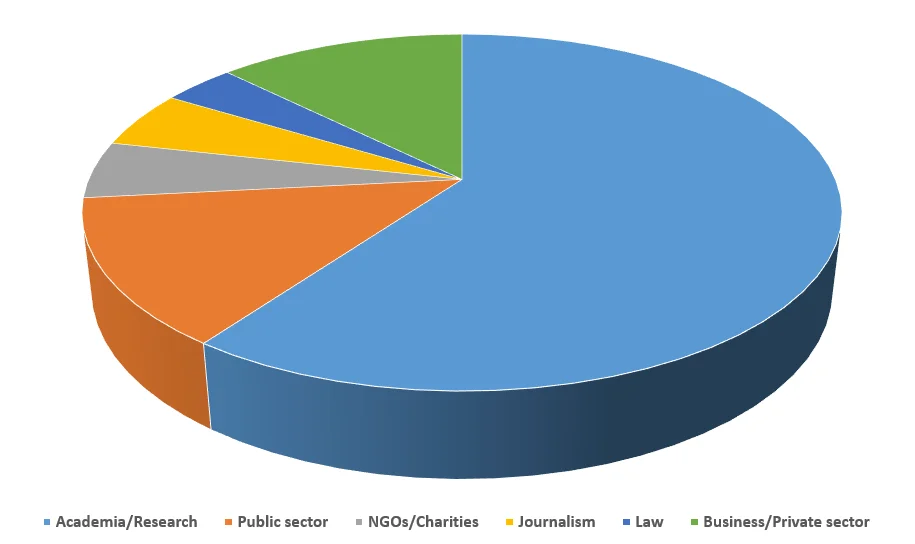
The data on research students' employment post-PhD since 2005 is as follows.
The majority of International History PhD graduates, or sixty percent, continue to work in Academia or Research.
This is followed by employment in the Public sector (fifteen percent) and the Private sector (fifteen percent).
The rest (ten percent) are split almost equally between employment in Law, Journalism, NGOs and Charity organisations.
Click here to view the survey results. They indicate the employment sectors where our graduates (broken down between ALL, Postgraduate and Undergraduate).
LSE History students continue to have one of the ten best rates of employability after graduation in the UK. For graduate prospects, the LSE ranked 3rd in the UK in the Complete University Guide for 2026, and 4th in the UK in the Guardian's Best UK Universities 2026 league table.
Collected as part of the Graduate Outcomes Survey, data is collated at the five-year aggregate level and currently includes data from respondents in cohorts that graduated between 2018/19 and 2023/24. This Survey captures details such as what jobs LSE graduates go into and how much they earn, 15 months after graduating.
The data shows that for LSE International History graduates, the median salary is £30,000 (based on 135 respondents). Job roles include Policy Advisor, Consultant, Research Assistant, Financial Analyst, and Account Executive.
The Value of the humanities degree report from Univeristy of Oxford highlights that humanities degrees foster the skills most needed in a changing world: adaptability, critical analysis, and the ability to communicate and create meaning.
LSE Careers has information about what jobs LSE graduates go into approximately 15 months after they graduate, which can be a useful starting point when thinking about your own career journey. You can filter Graduate Outcomes data by ‘Programme Name’ to find data specific to your degree course including salary, job roles, and working location.