

Capitalist Value Chains: Labour Exploitation, Nature Destruction, Geopolitics
Speaker


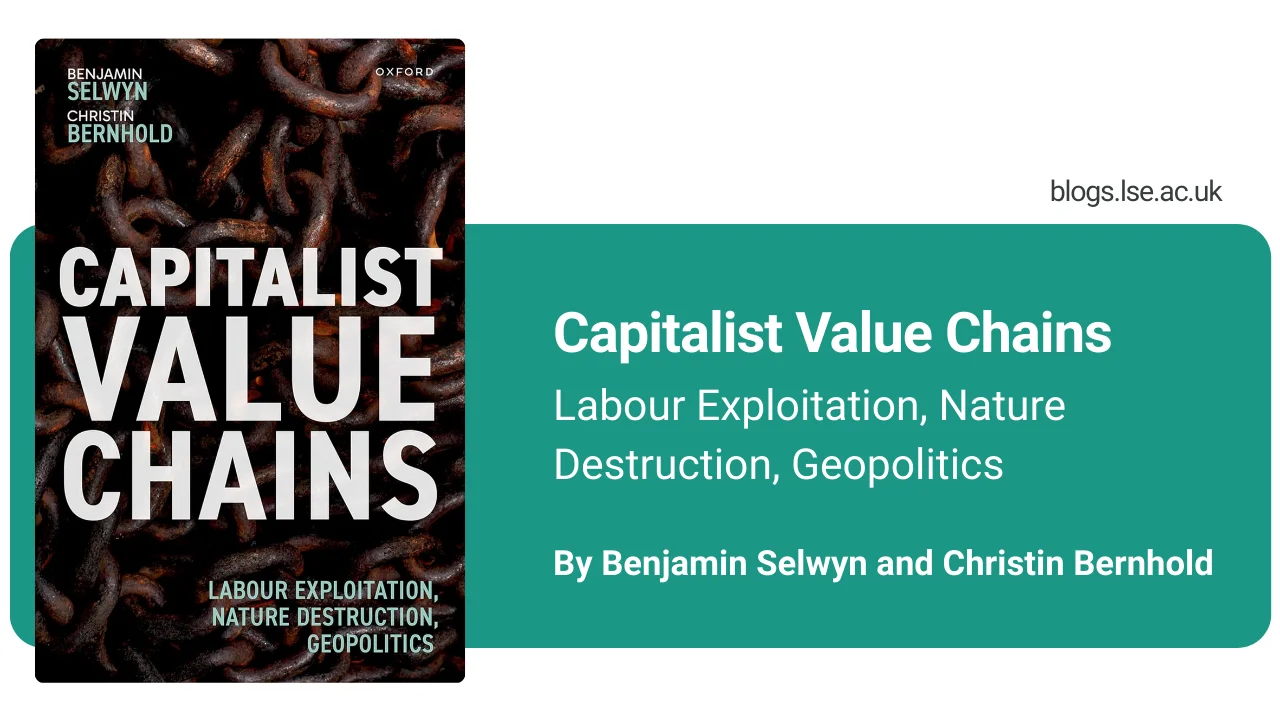
Join the Department of International Development for the launch of Benjamin Selwyn's book Capitalist Value Chains: Labour Exploitation, Nature Destruction, Geopolitics.
About the Book
Is it true that Global Value Chains (GVCs) 'boost incomes, create better jobs, and reduce poverty', as commonly claimed? In this compelling book, Selwyn, Bernhold, and Leyden show how the mainstream notion of GVCs obscures their capitalist character. To transcend this shortcoming, the authors introduce the concept of Capitalist Value Chains (CVCs). They explore how and why CVCs generate many highly exploitative jobs, new forms of poverty, are stunting real human development, and are destroying the world's environment.
CVCs are a historically-specific configuration of capitalist class relations that have been restructured and bolstered through geopolitics. The authors argue that rather than waiting for the elusive benefits of 'economic, social, and environmental upgrading' as promoted in mainstream GVC scholarship, workers' collective actions can improve their pay and conditions-under historically and geographically specific conditions of uneven development. The authors clearly explain how, instead of striving to make CVCs more 'resilient', progressive political economists need to envision a world beyond these capitalist relations of generalized exploitation and appropriation.
Selwyn’s essay, inspired by the book, is available to read in the LSE Review of Books here.
Reviews
"The twenty-first century world economy is organized around what corporate CEOs, Wall Street investors and now nearly everyone else are accustomed to call global value chains. But what exactly are these value chains that so continuously circulate around the globe? The authors of this book reveal that these are in reality capitalist value chains. They then take you on a fascinating journey into the hidden abodes of global capitalist value chain production, exchange, and distribution, and the effects on the relations of labor and capital, Global North and Global South, and humanity and the environment. If you want to know about the political economy of global power in our time, there are hundreds of works you will want to study. But first read this book." - John Bellamy Foster, Professor of Sociology, University of Oregon, and author, The Theory of Monopoly Capitalism
"Capitalist Value Chains takes a familiar concept, Global Value Chains, and approaches the empirical evidence with a newly constructed theoretical lens. Unlike most of the literature, it places capital, class struggle, collective action, and geo-politics at the center of the understanding of the expansion of capitalist production and trade. Anyone who wants a new theory of capitalism and enjoys the company of articulate, provocative, off-beat intelligences should read the book. And maybe pick a fight with it." - Robert H. Wade, Professor of Global Political Economy, London School of Economics
"The results are in. The gains from globalization have been captured at the top. In clear and concise prose, Selwyn, Bernhold and Leyden explain how, and why it could not have been otherwise. Drawing on essential tools of class-relational analysis, Capitalist Value Chains is required reading for anyone who wants to understand the contemporary architecture of uneven development and the accelerated destruction of nature." - Marion Werner, Professor, Department of Geography, University at Buffalo, State University of New York
"Capitalist Value Chains pushes readers to think critically about participation in global value chains as a 'development' tool - reminding us that the exploitation of labour and nature are deeply embedded at the core of capitalism. It shows how capitalism makes it impossible to generalise economic, social or environmental upgrading and concludes that 'immiserating growth regimes' can only be counteracted by a class-relational conception of labour and by collective action." - Stefano Ponte, Professor of International Political Economy, Copenhagen Business School
About the speaker
Benjamin Selwyn is a professor of international relations and international development at the University of Sussex. He researches and teaches about global supply chains, global food system, and global labour.
He is also the author of The Struggle for Development (2017), The Global Development Crisis (2014), and Workers, State and Development in Brazil (2012), and co-editor of Class Dynamics of Development (2017).
About the chair
James Putzel is Professor of Development Studies and served as the Director of the Crisis States Research Centre. He headed the Centre's research programme on Crisis States, which was funded by the Department for International Development of the UK government. From 1996 to 1999, Professor Putzel was a member of the British Academy's Southeast Asia Committee, a managing editor of the Journal of Development Studies from September 1999 until January 2001 and remains a member of the editorial board. He was a member of the advisory board of the Institute for Latin American Studies of the University of London between 1999 and 2002.
Any questions?
You can contact us at intdev.comms@lse.ac.uk
From time to time there are changes to event details so we strongly recommend that if you plan to attend this event you check back on this listing on the day of the event.
Whilst we are hosting this listing, LSE Events does not take responsibility for the running and administration of this event. While we take responsible measures to ensure that accurate information is given here this event is ultimately the responsibility of the organisation presenting the event.
LSE holds a wide range of events, covering many of the most controversial issues of the day, and speakers at our events may express views that cause offence. The views expressed by speakers at LSE events do not reflect the position or views of the London School of Economics and Political Science.