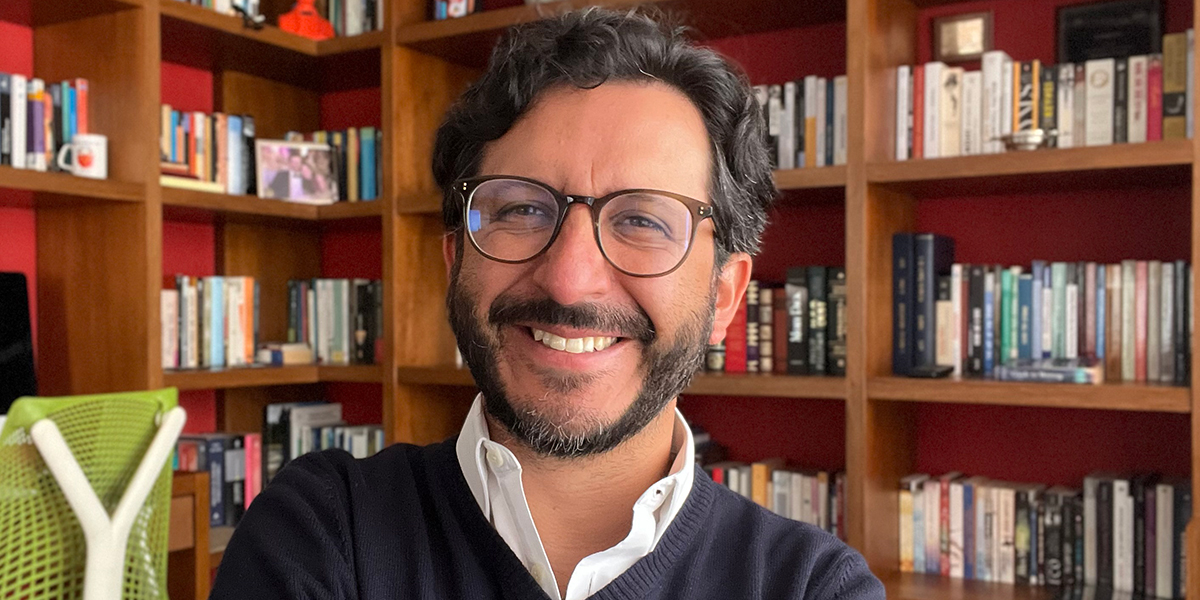
Tell us about your journey since graduating from LSE
Since completing the MSc in Regulation in 2012, my career has moved between three worlds that LSE taught me to see as deeply connected: government, academia and consultancy. The thread running through all of them is a conviction that Latin America does not suffer from a shortage of regulation, but from a shortage of regulatory intelligence — and that building institutions capable of telling the difference is work worth a career.
After LSE, I read for a DPhil in Politics at Oxford under Christopher Hood and Eduardo Posada-Carbó, examining why Colombia — a country that had embarked on one of Latin America's most ambitious decentralisation experiments — had been quietly recentralising itself. That research became Recentralisation in Colombia (Palgrave Macmillan, 2022).
In 2020, with two partners, I founded Nalanda Analytica, which is celebrating its sixth anniversary this year. The firm was built to fill a gap we kept seeing in the Latin American market: combining the analytical rigour of a think tank, the strategic orientation of a top-tier advisory firm, and the operational capacity of a specialised public law practice. We have led projects across eight Latin American countries, with a particular emphasis on water security, but also on energy, telecommunications, food regulation, business and human rights, and behavioural interventions in public services — drawing on traditions familiar to anyone trained at LSE. Our clients include multinational corporations, leading trade associations, national and subnational governments, and international organisations.
That work rests on foundations laid in several earlier roles: Superintendente Delegado for Water, Sanitation and Solid Waste at Colombia's Superintendency of Public Utilities, where I led the team responsible for overseeing a sector that reaches the vast majority of Colombian households; Dean of the Faculty of Social Sciences at Universidad de Bogotá Jorge Tadeo Lozano; and substitute judge at the Administrative Tribunal of Cundinamarca. I have also advised the World Bank, the IDB, CAF and NORC at the University of Chicago on regulatory and water governance challenges across Latin America and the Balkans.
How has studying in the Department of Government helped you since graduation?
The MSc in Regulation, jointly run by Government and Law, gave me something unusual: a genuinely interdisciplinary lens. I learned to move fluently between legal doctrine, political economy and public administration, without ever settling into a single one.
From Christopher Hood, in particular, I took something I still rely on weekly: the cultural theory of risk as a discipline for keeping one's own biases in check. It is a constant reminder that the way we frame a regulatory problem is never neutral, and that good analysis requires pausing to ask whose worldview is doing the framing. I remain in touch with Martin Lodge, my regulation professor, whose mark on how I teach and practise regulation has stayed with me.
That training is the backbone of how Nalanda works today. When we advise a regulator on a tariff decision, a multinational on water risk, or a constitutional court on the limits of emergency decrees, we never approach the problem from one angle alone. LSE also instilled a healthy scepticism towards regulatory fashions: the temptation to import "best practices" wholesale into Latin America is constant, and what the Department of Government taught me was the discipline to ask, every time, under what political and institutional conditions a particular instrument actually works.
What's been the highlight of your career so far?
Two things, intertwined.
The first is institutional: turning Nalanda from a conversation between three people into a firm whose work has reached eight countries in Latin America. I am especially proud that our analyses of water security, regulatory governance and decentralisation have been cited by Colombia's Constitutional Court, the OECD, the World Bank, the UN Special Rapporteur on the human rights to water and sanitation, and PAHO.
The second is more personal: the recognition that ideas I first explored as a student at LSE have made their way into regulatory and judicial decisions affecting millions of users of essential public services in Latin America. Most recently, this has included leading constitutional litigation on behalf of Colombia's electricity generators concerning the use of emergency powers in the energy sector — hard, demanding work, but exactly the kind of intersection between scholarship, advocacy and public service that drew me to LSE in the first place.
What is your fondest memory from LSE?
The Shaw Library. I spent countless afternoons reading there — a room that managed to feel at once intimate and expansive, where ideas seemed to circulate as freely as the conversations around them. Some of my best thinking was sketched out in its chairs, inspired by LSE's founding call rerum cognoscere causas: to know the causes of things.
The weekly public lectures were another highlight, with speakers I much admired, such as Paul Krugman. And beyond the library, some of my most vivid memories are the Colombian Society parties, famously popular across the whole School, and the Latin–Scandinavian party on the Thames. It was a reminder that LSE is, at its best, is a place where international friendships are forged with the same seriousness as ideas.
How long has it been since you returned to LSE campus?
The last time I returned to Houghton Street was in 2017, with my wife — also an LSE alumna — and our two young children, who took to the campus immediately and spent the afternoon running between buildings hunting down the animal statues scattered around the School. It was a different kind of visit from my student days, but no less meaningful: a reminder that LSE is one of those places that quietly becomes part of a family's story. Staying in touch with colleagues such as Martin Lodge has also kept LSE close in spirit. Another return visit is overdue — ideally one that combines family time with a more systematic engagement with the Department of Government and the Centre for Analysis of Risk and Regulation.
Do you remember having interaction with alumni during your time as a student, and how important is this factor today?
During my MSc I had more contact with alumni than is perhaps typical — particularly with the unusually strong community of Colombians who had studied at LSE and were working in the public sector back home. Many of those conversations had actually begun in Bogotá and simply continued in London, and they did something the classroom alone could not: they translated the abstract prestige of the School into concrete career trajectories I could imagine for myself. Today, as someone who hires and mentors junior professionals at Nalanda, I have come to appreciate the LSE network in a way I could not as a student: there is a recognisable thread running through how its graduates think about problems, and that thread is itself a kind of professional infrastructure. I would be glad to play a more active role in maintaining it.
Is there anything you would like to add that might inspire students?
What I would say to current students — particularly those coming from Latin America — is this. LSE, more than any place I have known, teaches you that the interesting questions are the ones you would rather avoid: the uncomfortable ones, the ones without a clean answer, the ones your discipline has not quite caught up with. Learning to live with those questions, rather than rushing past them, is the real training.
The harder part comes afterwards. Once you have been taught to think that way, following the well-trodden path becomes a kind of intellectual surrender. The School equips you to propose new ones — to disagree well, to risk being wrong in public, to do work that does not yet have a template.
And there is a regional dimension to this that I think matters. Graduating from LSE, particularly if you come from somewhere like Latin America, cannot be treated as a private privilege to be quietly cashed in over a career. It is a responsibility — and one that, in my view, should be exercised with ambition rather than timidity. Our region does not need more cautious technocrats; it needs LSE-trained minds willing to argue, to build, and to take the consequences.