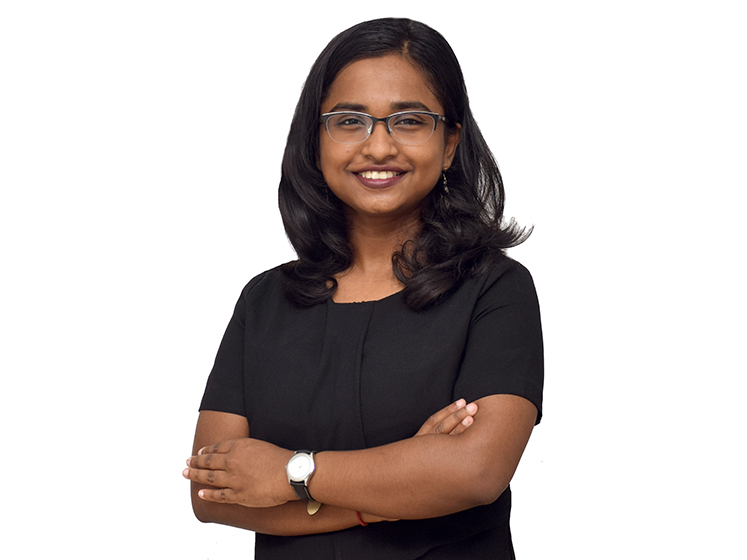
What are you currently working on?
I'm a Consultant at Ernst & Young India, and work with the Ministry of Electronics and Information Technology, Government of India. My work spans AI governance and digital policy from comparative research on how countries around the world are building their AI and technology ecosystems, to supporting how major policy announcements are communicated to the public. The thread running through all of it is what I'd call narrative economics: the conviction that policy succeeds or fails not just on its analysis, but on whether people can hold onto its story. That instinct traces directly back to the structural thinking my MSc in Global Politics gave me.
Do you have any news to share?
Most recently I've started writing publicly: a Substack on institutions and everyday politics, and Blanket Fort Stories, an illustrated series I write with my sister. I'm also at work on an epistolary book written to strangers, each letter a study of an emotion we rarely name. Alongside that, I've been moving from practice toward research focusing on institutional governance, and specifically on why well-designed policies so often fail in implementation, what happens in the layer between where a policy is written and where it is meant to land. I'm working toward doctoral study on that question.
What would you most like to highlight for alumni and students?
What I'd most like to highlight for alumni and students is the route itself: that an LSE training in political analysis can carry you into the machinery of technology policymaking in governments around the world and that the skills which matter most there aren't only analytical. The ability to translate complexity into something a citizen, a minister, or a newsroom can actually use is, I've found, where the LSE toolkit becomes most alive.
Do you remember having interaction with alumni during your time as a student, and if so how did this help you think about a future pathway?
Most of my alumni interactions as a student came through the guest lecture series. I loved hearing people describe careers that refused to be linear. This was quietly formative. But the community really came alive for me once I became an alum myself. The New Delhi and Bengaluru editions are fantastic; the alum community is pretty welcoming and you meet people from every walk of life. Each conversation widens your sense of what a pathway can look like. Might I say how helpful they are too – great events and great people.
How does it feel to look back and share your LSE alumni experience?
It's so surreal to see myself be mentioned. Just a few years ago, I had stumbled on the alumni features page just to decide if LSE was worth it. It, indeed, has been!
What's the one piece of career guidance that has most impacted you?
By doing what you love, leave systems kinder, fairer, and more human than you found them. It sounds simple, but it's held up better than any other plan I've ever made.
Do you have a favourite memory during your studies at LSE?
Studying in the LSE Library, one of the largest of its kind in the world. It was lovely, and I mean that in the fullest sense. Then there were the classes: Prof Mathias Koenig-Archibugi's Global Public Policy and Prof Sarah Ashwin's classes on Management. Different departments, different registers, both fantastic. It was proof of how genuinely interdisciplinary the place is. And my flatmates, amazing ones, someone from every corner of the world. We still send postcards and meet up when we can. I left LSE with a friend on every continent, which feels like its own kind of degree.
What makes you proud to be an LSE alum?
That it never let me stop asking the why behind things. LSE gave me a researcher's toolkit before I ever called myself one. Framing a question precisely, tracing the structure beneath the surface, testing an argument, these are behaviours that still hold. Whether I'm working on institutional design and governance problem or a startup financing question today, that instinct to look past the announcement to the architecture underneath by asking who's accountable to whom, why does this hold together is shaped through LSE's doing. It's a discipline of thought I carry into everything, and increasingly, back toward research itself.
Is there anything you would like to add that might inspire or help students as they near graduation?
Don't panic if your interests seem contradictory. I am a musician, I write, and I work on institutional governance. It took me a while to realise those are the same skill: making complexity legible. The synthesis is the career. Beyond that: depth compounds quietly, and while outcomes fluctuate, character and craft accumulate.