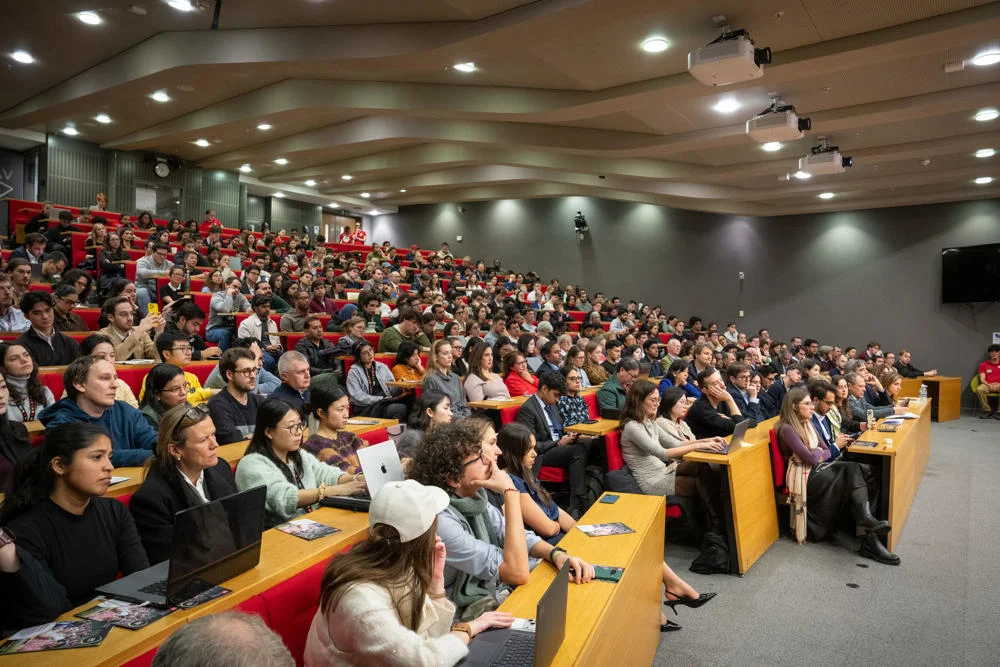

From AlphaGo to AGI: how general artificial intelligence may emerge—and what it could mean
Speaker


Almost ten years ago, millions of people watched an extraordinary event unfold in Seoul. AlphaGo, a program developed by researchers at the AI company DeepMind, defeated Lee Sedol, one of the world’s greatest professional Go players—achieving a milestone that many had believed was still years, perhaps decades, away. Today, we are witnessing equally remarkable advances in artificial intelligence: unmistakable fluency in language, increasingly sophisticated problem-solving, and perhaps even emerging forms of creativity. Some have begun to ask whether machines might eventually possess something resembling consciousness.
In this talk, Thore Graepel will explore how we reached this point, what these advances really mean, and what may come next.
Meet our speaker and chair
Thore Graepel is an internationally recognised leader in artificial intelligence, machine learning and computational science. He holds a part-time position as Professor of Machine Learning at UCL, and his current focus is on building rigorous AI reasoning systems for robotics and other critical applications.
Thore worked at Google DeepMind during two distinct periods. From 2015 to 2021, he contributed to AlphaGo and led research in multi-agent learning and other areas of frontier AI. He returned in 2025 as a Distinguished Research Scientist, leading work on the post-AI future. Between these roles, he served as Senior Vice President and Global Head of Computational Science, Machine Learning and AI at Altos Labs, where he built teams across AI, computational biology and software engineering to advance research into cellular rejuvenation.
Earlier, at Microsoft Research Cambridge, he helped develop TrueSkill and AdPredictor, large-scale machine-learning systems deployed to millions of users. He holds a PhD in computer science, serves as Governor at the London Institute of Mathematical Sciences and on the board of the Cooperative AI Foundation.
Milan Vojnović is Professor and Head of the Department of Statistics at LSE. Milan’s research focuses on machine learning and optimisation, involving the development of novel algorithms and the analysis of their theoretical guarantees to support the design of efficient intelligent systems. He has made significant contributions to scalable optimisation methods for machine learning, multi-armed bandits, multi-agent systems, algorithms under uncertainty, game theory, and network system control and optimisation. His work has been applied across a variety of domains, including online platforms, computer networks, and machine learning systems.
More about this event
Join us on campus or register to watch the event online at LSE Live. LSE Live is the home for our live streams, allowing you to tune in and join the global debate at LSE, wherever you are in the world. If you can't attend live, a video will be made available shortly afterwards on LSE's YouTube channel.
A founder department of LSE, the Department of Statistics is home to internationally respected experts with cutting- edge specialisms in AI, data science, probability in finance and insurance, social statistics, time series and statistical learning, and more. We produce cutting-edge research in developing new statistical and data science methods and their theoretical foundations, and apply these to new forms of social, economic and health data, addressing real-world challenges.
Hashtag for this event: #LSEEvents
Any questions?
If you have a query see our Events FAQ or take a look at the information below.
You can also contact us at events@lse.ac.uk.
Many speakers at LSE events also write for LSE Blogs, which present research and critical commentary accessibly for a public audience. Follow LSE British Politics, LSE Business Review, LSE Impact, LSE European Politics and the LSE Review of Books to learn more about the debates our events series present.
If the event is live streamed, automated live captions will be available. Please note that this feature uses Automatic Speech Recognition (ASR) technology, or machine generated transcription and is not 100% accurate.
Photographs are regularly taken at LSE events both by LSE staff and members of the media and events are routinely filmed. Photographs from events taken by LSE staff are often used on LSE's social media accounts, with videos being made available on the LSE Player. If you have any concerns about this please contact the event organiser in advance of the event.
Please contact the Press Office if you would like to request a press seat or have a media query about this event, email LSE.Press.Events@lse.ac.uk. Please note that press seats are usually allocated at least 24 hours before each event.
We aim to make all LSE events available as a podcast subject to receiving permission from the speaker/s to do this, and subject to no technical problems with the recording of the event. Podcasts are normally available 1 week after the event. Podcasts and videos of past events can be found online.
Event updates and other information about what’s happening at LSE can be found on our Facebook page and for live photos from events and around campus, follow us on Instagram.
Livestreams and archive videos of past lectures are shared on our YouTube channel while event podcasts can be found on the LSE Player.
Attending our events in-person or online? Join the conversation using #LSEEvents.
If you are planning to attend this event and would like details on how to get here and what time to arrive, as well as on accessibility and special requirements, please refer to LSE Events FAQ. LSE aims to ensure that people have equal access to these public events, but please contact the events organiser as far as possible in advance if you have any access requirements so that arrangements, where possible, can be made. If the event is ticketed, please ensure you get in touch in advance of the ticket release date. Access Guides to all our venues can be viewed online.
LSE has now introduced wireless for guests and visitors in association with 'The Cloud', also in use at many other locations across the UK. If you are on campus visiting for the day or attending a conference or event, you can connect your device to wireless. See more information and create an account at Join the Cloud.
Visitors from other participating institutions are encouraged to use eduroam. If you are having trouble connecting to eduroam, please contact your home institution for assistance.
The Cloud is only intended for guest and visitor access to wifi. Existing LSE staff and students are encouraged to use eduroam instead.
From time to time there are changes to event details so we strongly recommend that if you plan to attend this event you check back on this listing on the day of the event.
LSE holds a wide range of events, covering many of the most controversial issues of the day, and speakers at our events may express views that cause offence. The views expressed by speakers at LSE events do not reflect the position or views of the London School of Economics and Political Science.
Subscribe to the LSE Events newsletter