

Fredrick Angwenyi

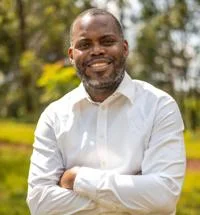
Dr Fredrick Angwenyi is a Medical Doctor and Health Systems Expert at the forefront of Kenya's Universal Health Coverage transformation. He leads bold, innovative health financing initiatives that are reshaping how healthcare is delivered and funded across the nation, focusing on sustainable financing mechanisms that use digital public infrastructure to expand equitable access to care for every Kenyan, and beyond. As a Commonwealth Scholar (2019) and Australian Awards Fellow (2017), he also holds an MSc in Health Policy, Planning and Financing, jointly awarded by the London School of Economics and the London School of Hygiene & Tropical Medicine, equipping him to design and drive health financing solutions that translate policy into measurable impact for millions of lives.
Can you tell us about your career, what brought you to LSE, and what attracted you to PfAL?
My career began nearly a decade ago as a medical doctor. Early in my practice, I frequently encountered the challenges that many individuals and communities face when trying to access healthcare, whether due to cost, distance, or the unavailability of essential services. These experiences prompted me to reflect more deeply on how healthcare systems function and why such barriers persist.
At the time, my perspective on healthcare was largely shaped by the traditional doctor: patient relationship. However, through my work and later a fellowship at the Nossal Institute for Global Health at the University of Melbourne, I was introduced to the broader concepts of health systems and the social determinants of health. This exposure significantly shifted my perspective and inspired me to explore healthcare from a systems level approach.
Thus, I began searching for a programme that aligned with these interests, which eventually led me to the MSc in Health Policy, Planning and Financing. A joint programme between the London School of Economics and Political Science (LSE) and the London School of Hygiene & Tropical Medicine (LSHTM).
Shortly after arriving at the LSE, I learned about the Programme for African Leadership (PfAL) and immediately felt drawn to it. What stood out most was the sense of community, a network of individuals who shared similar cultural experiences and a common aspiration to contribute to the development of their countries. Having studied abroad before, I understood how valuable such a supportive community can be during postgraduate studies, and PfAL offered exactly that.
How did PfAL complement your studies?
PfAL added an important dimension to my academic experiences at LSE. It connected me with postgraduate students from across different departments, creating opportunities to exchange ideas, share perspectives, and support one another as we navigated the demands of our studies.
Beyond academic support, the programme introduced concepts and discussions that complemented what we were learning in our individual classes. It also provided a practical and collaborative space to reflect on leadership, policy, and development in an African context.
What were the biggest things you learned from PfAL?
One of the most important lessons I took away from PfAL was a deeper appreciation of what leadership in Africa truly entails. The programme encouraged us to think critically about the responsibilities that come with leadership and the impact we can have in shaping our communities and institutions.
Equally important was the value of networks. PfAL brought together like-minded individuals with shared ambitions, and it reinforced how powerful collaboration and collective thinking can be when working towards meaningful change.
What did you most enjoy about the programme?
While the formal sessions were incredibly valuable, some of the most memorable moments came from the informal interactions. PfAL created spaces where we could simply connect over lunch or dinner, sharing great food, conversations, and experiences.
Those moments fostered genuine friendships and made the experience of studying in London feel more connected and enriching.
How has being a PfALer influenced you since you left LSE?
The PfAL experience has continued to shape how I engage with others professionally and personally. It has influenced how I communicate ideas, particularly when presenting and pitching concepts to different audiences.
Perhaps most importantly, it strengthened my commitment to mentorship. Through the PfAL mentorship programme, I have come to appreciate the importance of guiding and supporting others as they navigate their own professional and leadership journeys.
What advice would you give to future PfALers?
My advice would be to embrace the opportunity wholeheartedly. Take part in as many activities as possible, both within and beyond the classroom.
Make a deliberate effort to connect with PfALers outside your department and from different countries. Those interactions often provide the richest insights and perspectives. Most importantly, remain open to learning, to sharing your experiences, and to building relationships that will last well beyond your time at LSE.