

Working with international trade data to establish robust evidence in turbulent times
Dr Francesca Torti outlines her work on producing international trade statistics in our increasingly crises-, protectionism- and sanction- defined era.
As global economic and geopolitical tensions increase, the analysis of international trade is becoming more complex, while the need for reliable evidence to support policy decisions becomes higher.
Governments increasingly rely on trade data to monitor risks such as customs duty evasion, sanctions circumvention, the economic effects of tariffs and trade dependencies of critical commodities. Ensuring that these data are analysed accurately and robustly is therefore an important challenge.
As part of the Visiting Researcher Programme of the Joint Research Centre (JRC) of the European Commission, for the past two months I have been based at the LSE Department of Statistics. My stay has focused on participating in discussions and talks round the statistical methods used to analyse international trade data and support evidence-based policymaking.
Among the outputs of the LSE Department of Statistics is research which covers areas such as latent variable models (statistical models that relate observed / manifest variables to unobserved / hidden variables), interrupted time series analysis (an approach involving tracking a long-term period before and after a point of intervention to assess the intervention's effects) and synthetic control methods (an econometric method used to evaluate the effect of large-scale interventions in comparative case studies). These approaches are commonly used to study systems that are only partially observed, as is often the case with trade and economic data. Latent variable models can help estimate hidden processes that cannot be directly measured, interrupted time series methods can detect changes following major policy interventions, and synthetic control methods can create comparison benchmarks to assess the impact of new regulations.
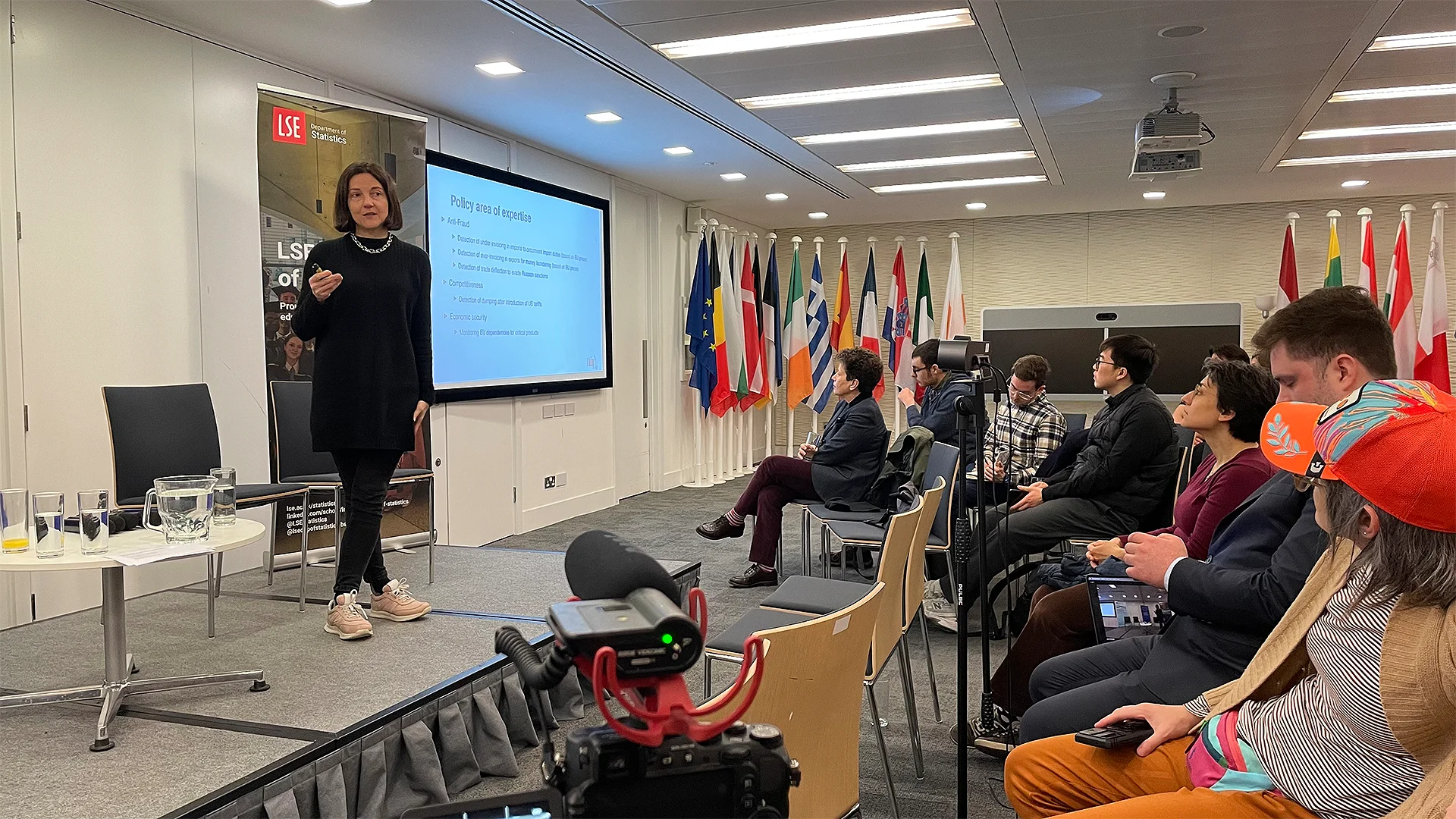
I have been exploring applying these methods to trade-related questions, including how authorities can identify anomalies in customs declarations, monitor compliance with sanctions regimes, assess shifts in trade flows following policy changes and monitor trade dependencies of relevant commodities. In practice, trade data often contain outliers or measurement errors. Standard statistical models can be sensitive to such features, which may affect the reliability of results. I introduced the core concepts associated with this in a public talk at Europe House in March 2026.
The use of mirror statistics, comparing what an exporting country reports having sent with what the importing country reports having received, has already revealed something. Attention should be given to figures that diverge significantly. Discrepancies could then be checked by subject matter experts to verify if they are linked to misclassification of goods under lower-tariff categories, undervaluation of declared prices to reduce import duty liability, or transshipment through third countries to disguise the true origin of a product. A well-known example today are goods being routed through intermediary markets to circumvent sanctions or tariffs, a pattern that shows up in the data as sudden and unexplained export surges from countries that would not ordinarily be significant suppliers. This can be a particularly data-intensive challenge. Monitoring whether restricted goods are reaching sanctioned destinations requires tracking indirect routing through many potential third-country intermediaries and identifying abnormal re-export patterns.
The suspicious activities usually are not invisible: they leave statistical traces in the form of anomalous bilateral trade flows, rapid growth in unusual re-export hubs, or product reclassification patterns that do not correspond to genuine changes in supply chains.
The effects of tariffs present a different but equally important analytical challenge. When tariffs make one market expensive, exporters redirect goods elsewhere, and this trade diversion is measurable. Following the introduction of US tariffs, we observed to a significant reduction in US imports from affected countries such as China alongside a corresponding increase in their exports to other markets. The data signature of this type of “trade diversion” is distinct from that of a genuine production decline, and distinguishing between the two is an example of where rigorous statistical methodology matters.
Central to the research I have been working on is the question of how to ensure that statistical models remain stable and informative even when data quality is imperfect. Building on prior work in robust statistics, I am exploring ways to make latent variable models less sensitive to anomalous observations, such as unusually low declared values that may indicate under-invoicing, or abrupt shifts in trade volumes following the introduction of new trade restrictions. The results are still preliminary, but they point to possible ways of improving the stability and interpretability of model-based indicators used by policymakers.
In parallel, I began a collaboration with LSE Department of Statistics researchers in psychometrics on the design and analysis of survey-based instruments used in EU-wide consultations, focusing on measurement quality and variability in response behaviour, an important complement to administrative trade data.
My visit has led to the preparation of a joint research initiative between LSE and the JRC to support early-career researchers working on methodological questions and their application to policy-relevant problems. Strengthening that capacity matters more than ever, as trade policy increasingly depends on timely, granular, and data-driven analysis. Whether the challenge is detecting a misclassified product code or modelling the downstream effects of a tariff shock, the quality of the underlying statistics is what determines whether policy decisions rest on solid ground.
Continued interaction between academic research and policy institutions in the UK and the EU remains important in this context.
By Dr Francesca Torti, Joint Research Centre of the European Commission