

Dr Mahvish Ahmad
About
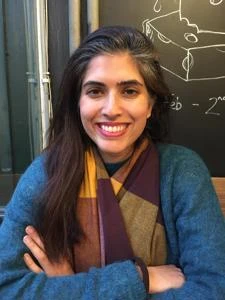
Mahvish Ahmad is an Assistant Professor in Human Rights and Politics and a Co-Director of LSE Human Rights. Her work charts how seemingly disconnected practices of violence and revolt are entangled across history, geography, and social life. Drawing on ethnographic work on violence, anticolonial histories, and South Asian studies, she is especially interested in methods that unearth surprising links between destructive techniques and political struggles that, at first glance, look completely unrelated.
Fifteen years of work with Balochistan and Pakistan fuel many of these inquiries. Here, military violence and movements that counter it are told as a domestic story of postcolonial atrocity or a geopolitical one reflecting the machinations of powerful states. Repression and resistance are analytically disconnected from those elsewhere. She experiments with different theoretical and methodological approaches, foregrounding political thought from those subject to violence and organising politically with and against it. Working across separations, she reconnects seemingly local violence and struggle to global histories – and worldwide movements against – capitalism, colonialism, racism, and empire.
Mahvish holds a PhD from Cambridge, MPA from LSE, and undergraduate degrees from Roskilde University and Copenhagen University. She was also a Crown Prince Frederik Fellow at Harvard, and an AW Mellon Postdoctoral Fellow at the Centre for Humanities Research, University of the Western Cape. She has earlier worked at universities in Pakistan (LUMS and Quaid-e-Azam University) and as a journalist covering political violence in the region.
Key expertise: Violence, State, Militarism, Policing, Empire, War, Decolonial Theory
Research
Mahvish is concluding multiple writing projects to re-narrate the story of repression and revolt in Balochistan. Across this work, seemingly episodic instances of violence and revolt are recast as effects of interconnected techniques of rule that eliminate alternative political and social worlds.
Her first book, Techniques of Disappearance, critically engages a proposition from a woman-led movement – the Baloch Yakjehti Committee – leading the fight against enforced disappearances and military violence in Balochistan. Namely, that state abductions are not a set of isolated events, but part of a broader technique of postcolonial rule that negates Baloch lifeworlds. The book traces how life, politics, knowledge, bodies, relations, and land itself is targeted for erasure, to make Baloch political life structurally impossible in Pakistan as it is imagined and configured today.
The second book, Destruction is Rule, is a historical sociology of three spectacular moments of colonial and postcolonial violence in Balochistan. It re-narrates a 1918 colonial-era punitive expedition and executions of revolt categorised ‘fanatical’, a 1973-’77 counterinsurgency campaign and the Hyderabad Treason Trial against Baloch and other peripheralized nationalists, and contemporary counter-terror operations and enforced disappearances of ‘terrorists.’ The book revisits these key events and figures of violence and racial categorisation as part of worldwide techniques of repression rather than reflections of a domesticated, ethnic conflict.
Her final book is a work of literary non-fiction, entitled Hide the Sun, a title borrowed from Akbar Barakzai’s poem, Who Can Hide The Sun? Inspired by Svetlana Alexievich’s testimonial method, the book compiles transcriptions and translations of interviews, essays, speeches, pamphlets, and other work that she has collected from around Balochistan over a period of 15 years.
She’s also interested in critical documentary and archival methods in sites of war, erasure, and annihilation. She’s launched a series of projects with historians, anthropologists, and literary scholars:
- Revolutionary Papers. A transnational research collaboration exploring 20th century periodicals of Left, anti-imperial, and anti-colonial critical production. With Hana Morgenstern and Koni Benson. Sara Kazmi, Marral Shamshiri-Fard, Mishca Peters, and Maayan have also joined the project. Read our special issue in Radical History Review.
- Archives of the Disappeared. An interdisciplinary research initiative for the study and documentation of communities, social movements, spaces, lifeworlds, literatures and cultures that have been destroyed through acts of political repression and mass violence. With Mezna Qato, Yael Navaro, and Hana Morgenstern.
- Tanqeed. A bilingual Urdu-English magazine out of Pakistan that ran between 2012 and 2017. Published pieces from across Pakistan that challenged international and domestic news coverage, especially of military operations in the former Tribal Areas and Balochistan and the US-led War on Terror. Also included critical coverage of other issues, including climate change and floods, feminism and sexual violence, and the 2013 elections. With Madiha Tahir.
Finally, she works as an advisor on existing critical documentary and archival initiatives:
- Advisory Board, Human Rights Council of Balochistan. HRCB documents ongoing military violence by Pakistani forces in Balochistan as well as other human rights atrocities.
- UK-based Trustee, South Asian Research and Resource Centre. Founded by the poet, writer, folklorist, and archivist Ahmad Salim, this archive and library is based outside of Islamabad in Tehsil Murree and houses up to 40,000 items related to Pakistan’s socialist, cultural, peasant, and worker movements.
Mahvish is part of the Politics and Human Rights research cluster.
Teaching
Mahvish is the convenor of Lawful Violence, a graduate-level, research-led course that investigates a multitude of methods to connect violence and resistance across history, geography, and social life.
She is also the Program Director of the MSc Human Rights and Politics programme (with Sara Salem and Olivia Rutazibwa) and convenes the course Contemporary Politics of Human Rights as part of this role. Finally, she teaches on undergraduate courses, including Introduction to Social Theory and Advanced Social Theory.
Mahvish welcomes applications from PhD students interested in topics that overlap with her areas of expertise, broadly speaking. Her current PhD students include Dan Brown working on internationalist solidarity with the Kurdish Freedom Movement (co-supervisor Ayça Çubukçu) and Sigrid Corry working on Denmark and the Global War on Terror (co-supervisor Suki Ali and Kristin Surak).