

Why does Chile's thriving tech sector underperform in digital service exports?

Chile leads Latin America in digital competitiveness but significantly underperforms regional peers in ICT service exports. New research identifies the binding constraints and what the new Kast administration should do about them.
A reflection by MPA Capstone students at the London School of Economics and Political Science, School of Public Policy, from their project with Globant and ACTI (Chile's ICT industry association).
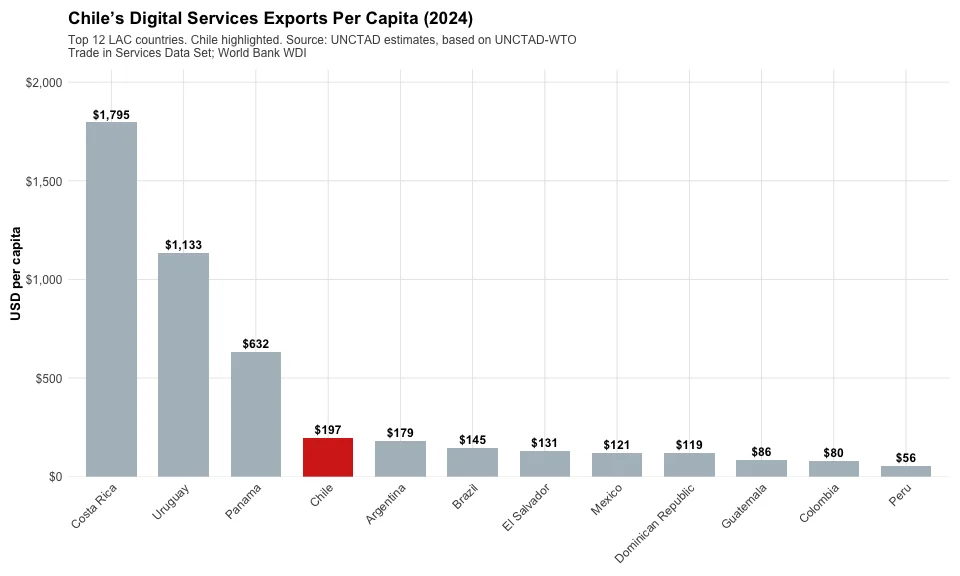
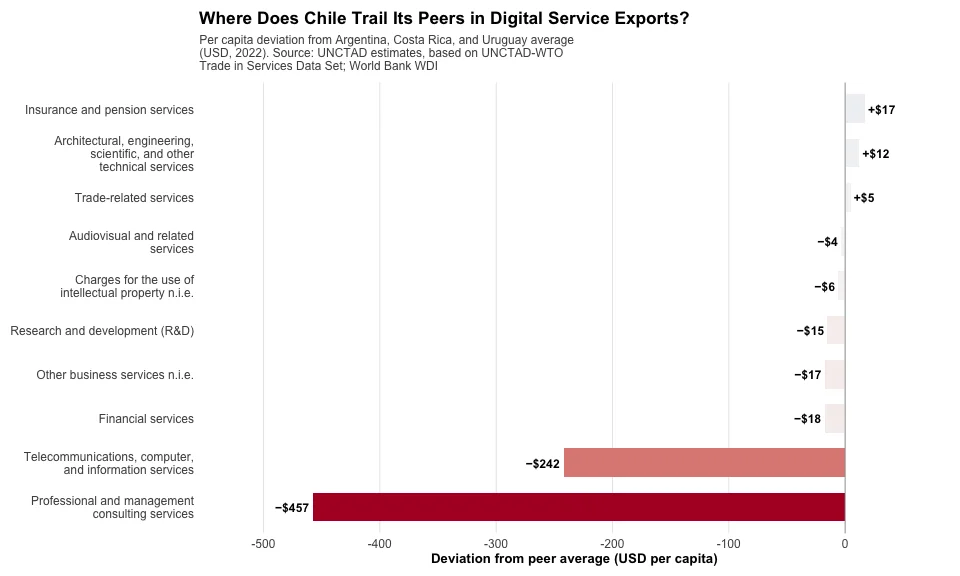
Chile presents a striking paradox. The country ranks first in South America in digital competitiveness, leads the region in AI readiness, and boasts superior broadband infrastructure and a well-regarded startup ecosystem. However, a new analysis by our LSE MPA capstone team determined that it acutely underperforms its peer countries in ICT service exports, and most starkly in computer services — a key focus area for our client, ACTI, Chile's ICT industry association. In 2024, Chile exported just US$640 million in computer services, compared to Costa Rica's US$2.2 billion, Uruguay's US$1.2 billion, and Argentina's US$2.7 billion. Our research team set out to diagnose why this gap exists.
The puzzle is about export orientation, not capacity
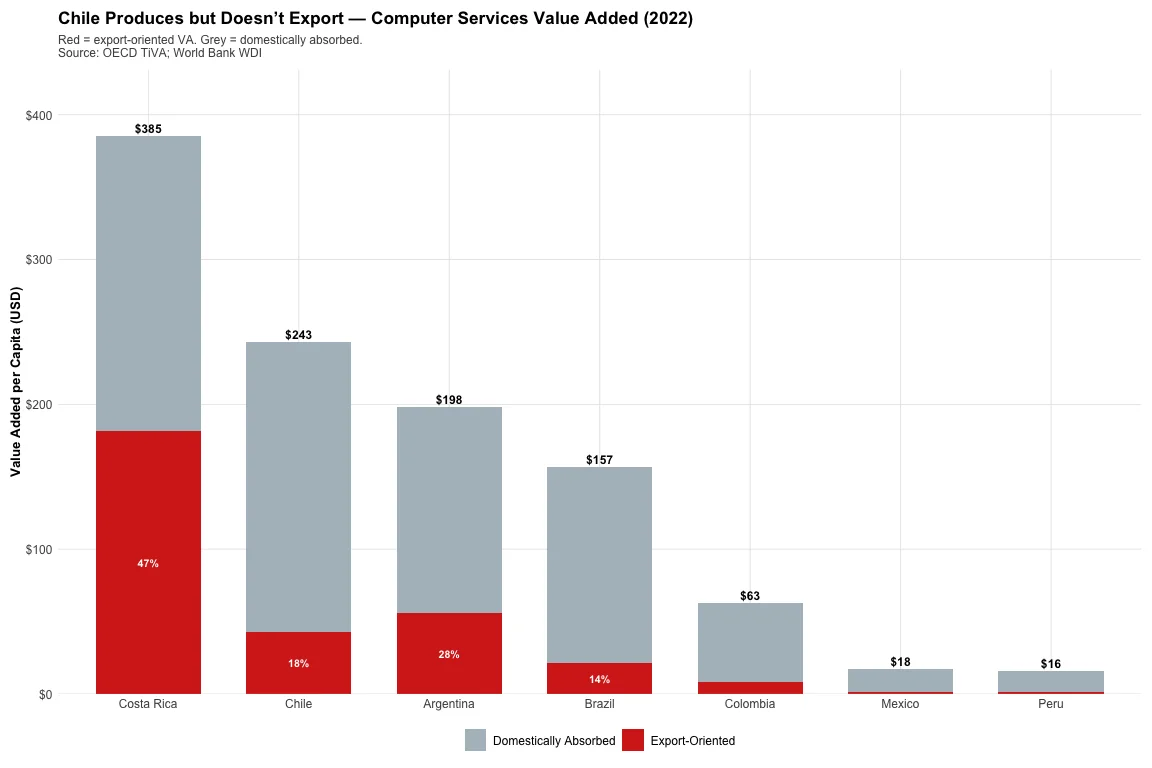
Standard metrics suggest Chile is simply underperforming. But our research, which took a closer look at OECD Trade in Value Added (TiVA) data, revealed something more precise: Chile's domestic value added per capita in computer services (US$201 in 2022) is virtually identical to Costa Rica's (US$203). The gap lies entirely in what happens to that output. Chile directs only 17.5% of its computer services production toward foreign markets while Costa Rica directs 47.2%. Therefore, Chile clearly does not lack a computer services sector, but rather the export orientation of that sector. More information and visualisations of Chile’s export gap and other relevant data can be found on our capstone project’s website, the Digital Services Explorer.
To identify why this gap exists, we applied the Growth Diagnostics framework — a structured method for identifying which constraints are most binding on economic performance — to four candidate explanations identified through our research: coordination failures, taxation, human capital, and trade finance. We combined four waves of Chile's Encuesta Longitudinal de Empresas (ELE) firm survey (2015–2022), OECD and UNCTAD trade data, customs microdata, and interviews with twelve stakeholders across Chile's public and private sectors and academia.
Finding clients abroad is the binding constraint
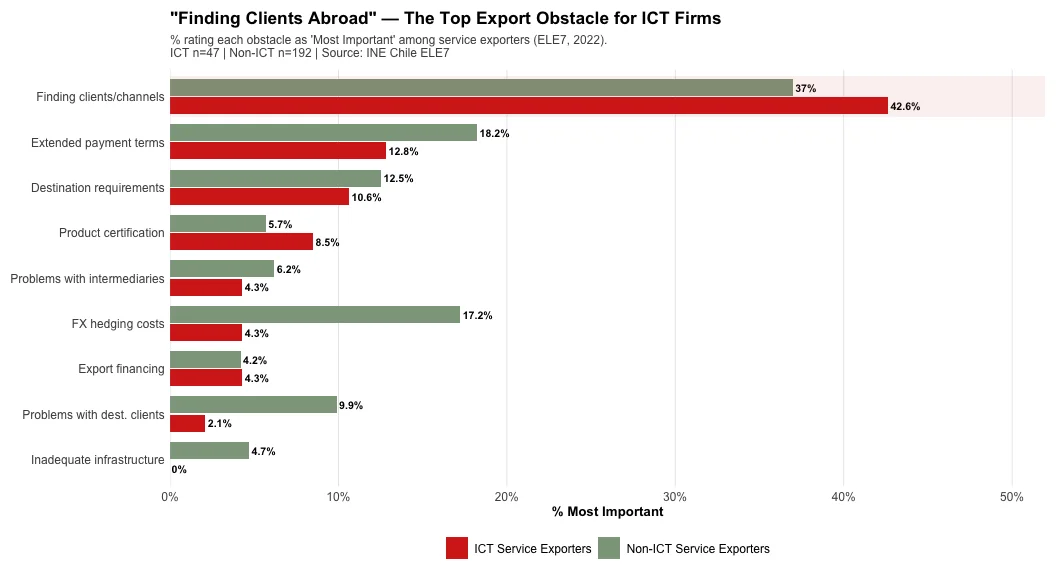
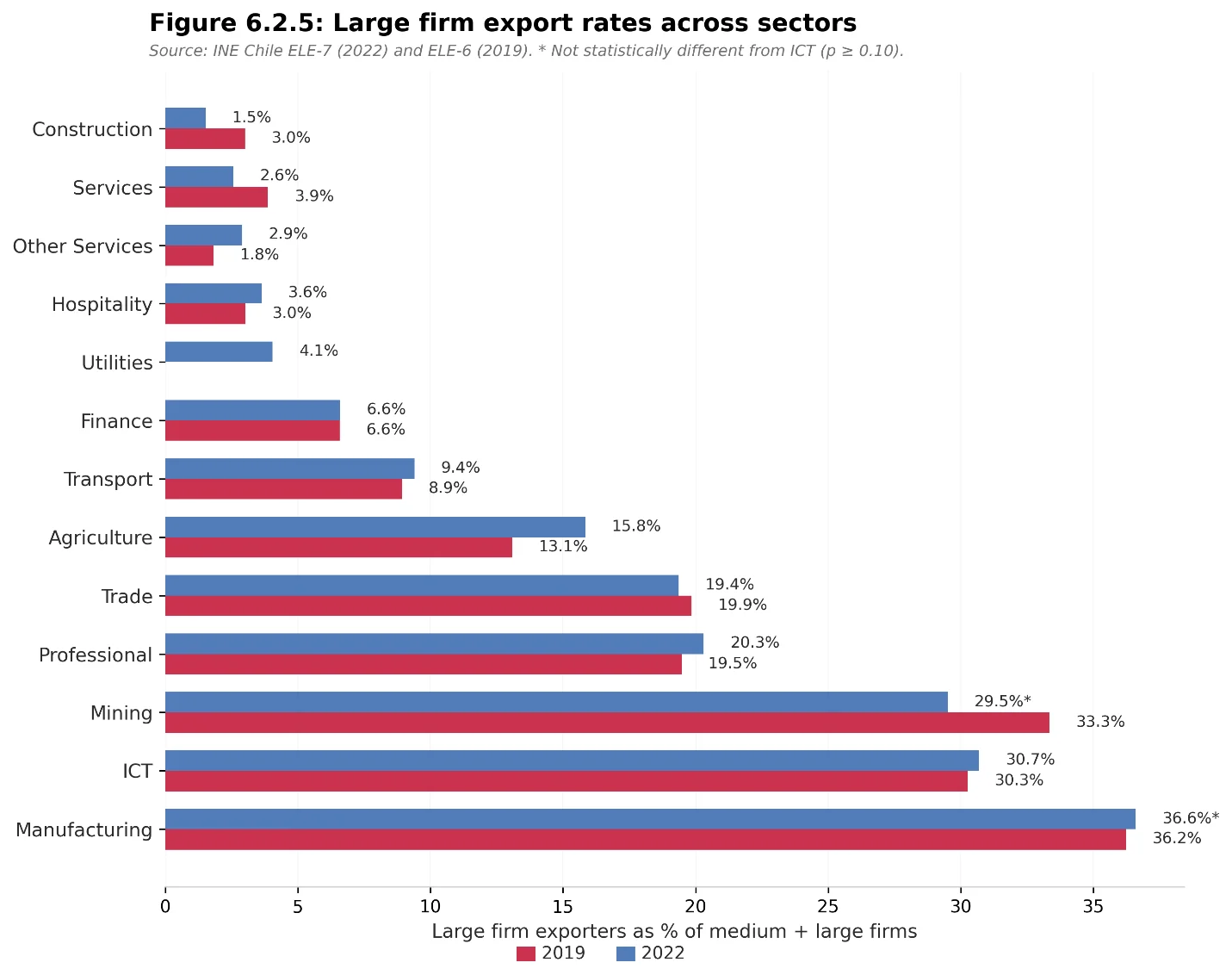
The most striking finding concerns coordination failure. In the 2022 ELE survey, "finding clients or distribution channels abroad" was cited as the single most important export obstacle by 42% of ICT service exporters — nearly double the share who cited it in 2015 (24%). Over the same period, ICT export participation flatlined at around 22%. Evidently, the constraint is worsening while the outcome fails to improve.
The firms that do manage to export are not simply more capable. They are disproportionately those with foreign ownership (38% mean foreign ownership among exporters, versus 6% among non-exporters) or multinational affiliates — firms for which the client discovery problem is solved internally. The few SMEs that export must acquire nearly all foreign clients independently, which is precisely the activity that firms consistently identify as their biggest barrier. There is also enormous unawareness amongst firms of existing public programs aimed at supporting their internationalization: CORFO participation rates were 5.8% for ICT exporters and 5.5% for non-exporters — essentially identical and declining over time.
Our research also revealed that 70% of ICT non-exporters report having “no exportable goods or services.” This is not a capability gap, as Chile's customs microdata shows its ICT sector concentrates in high-skill activities like custom software design, IT advisory services, and simulation modeling. Instead, it reflects the absence of market discovery infrastructure: when not enough institutional mechanisms exist to connect firms with foreign buyers, exporting simply does not register as a viable option.
The tax regime compounds the problem
Chile's statutory corporate income tax rates are competitive by regional standards, but its peer countries have moved further. ICT exporters in Uruguay and Costa Rica operate under effective tax rates close to zero; Argentina's Knowledge Economy Law reduced the rate to 15%. Chile offers no equivalent targeted regime, so while the productive capacity exists, the fiscal incentive to export does not.
Our analysis finds that the few Chilean ICT firms that do export are predominantly large companies capable of absorbing the tax burden — consistent with research showing that a one percentage point increase in effective average tax rates reduces the probability of exporting by 1.4%, with effects concentrated among smaller firms. There is also suggestive evidence that outward ICT FDI moves in sync with Chile's tax burden, implying some firms may find it easier to export from foreign subsidiaries than to bear Chilean taxes directly.
Human capital and trade finance are not the bottleneck
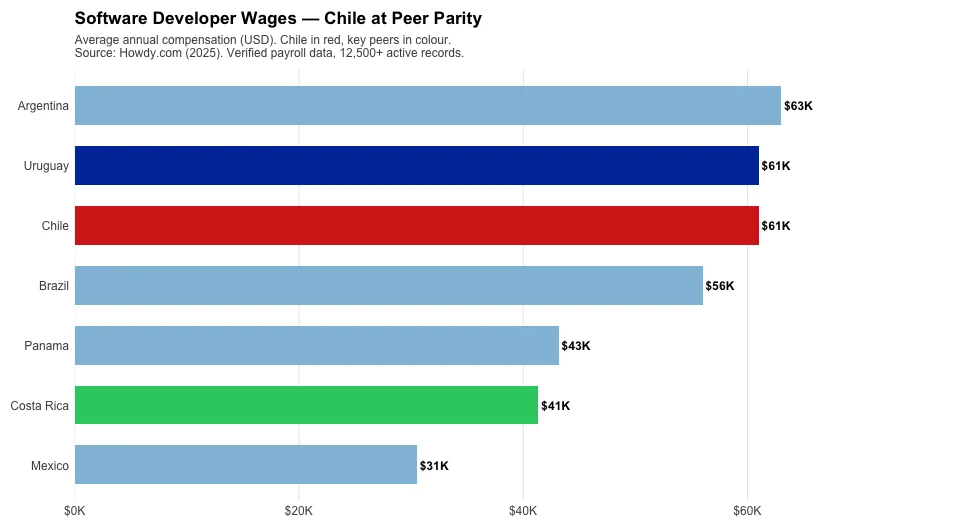
Despite frequent claims to the contrary, human capital does not appear to be a binding constraint on ICT export growth. Chilean software developer wages are at peer parity with Uruguay and Argentina, while Costa Rica — which exports 3.6 times more ICT services — pays developers 32% less. Graduate supply and ICT export growth are essentially uncorrelated within Chile and across peers. ICT firms themselves rank the availability of a skilled workforce sixth among growth obstacles and do not cite it among export barriers at all.
Trade finance appears as more of a second-order constraint driven primarily by information gaps: over 90% of Chilean services firms in one survey were unaware of COBEX, Chile's public trade finance guarantee program. Our research also found a very low reported demand for credit among ICT firms, which is likely a reflection of adaptation to constrained circumstances rather than genuine access to financing barriers.
What the new administration should do
Chile's new Kast administration, which took office in March 2026 with an agenda centered on economic reactivation, opens a genuine policy window. Our recommendations focus on four areas.
First, targeted export promotion: proactive outreach to ICT firms using tax registry data, embedded export advisors within ACTI, subsidized access to global B2B platforms like Clutch and G2, and inbound buyer missions modeled on Israel's IEICI program.
Second, tax reform: a knowledge-economy export regime with a reduced corporate income tax rate (15–20%) for firms deriving the majority of their revenue from exported digital services, along with transferable R&D credits and clearer guidance on existing VAT exemptions.
Third, institutional continuity: a Presidential Digital Economy Envoy with cross-ministerial authority to sustain policy commitment across the four-year electoral cycle — addressing Chile's recurring problem of dismantling nascent industrial strategies before they can mature.
Fourth, better data: oversampling ICT firms in future enterprise surveys and publishing a concordance between Chilean customs codes and international standards, to build a better evidence base for policy evaluation.
Chile has all the ingredients for a highly productive digital services export sector, but it has been missing the coordinated institutional architecture needed to compete with its peers. The Kast government should seize this unique window to make Chile an ICT services leader in Latin America and beyond.
Authors:
Emily Gray, Anushka Jain, Eve Jones, and Noah Daniel are MPA students in the London School of Economics’ School of Public Policy. Their capstone project was conducted in collaboration with ACTI, Chile's ICT industry association.