

Can We Predict Which Countries Are Most at Risk of a Coup?

What Predicts a Coup: Chronic Instability, or Rapid Decline? New quantitative research across 150 countries and four decades finds that rapid shifts in political and economic conditions predict coups more reliably than long-run levels alone.
A reflection by MPA Capstone students at the London School of Economics and Political Science, School of Public Policy.
A coup can unravel a country overnight. Since 1950, roughly half of the world's countries have experienced at least one, often leaving behind economic collapse, political instability, and long-lasting violence. But can these events be predicted? The answer is partially yes: the political and institutional conditions that raise coup risk can be measured and flagged, but the exact timing cannot.
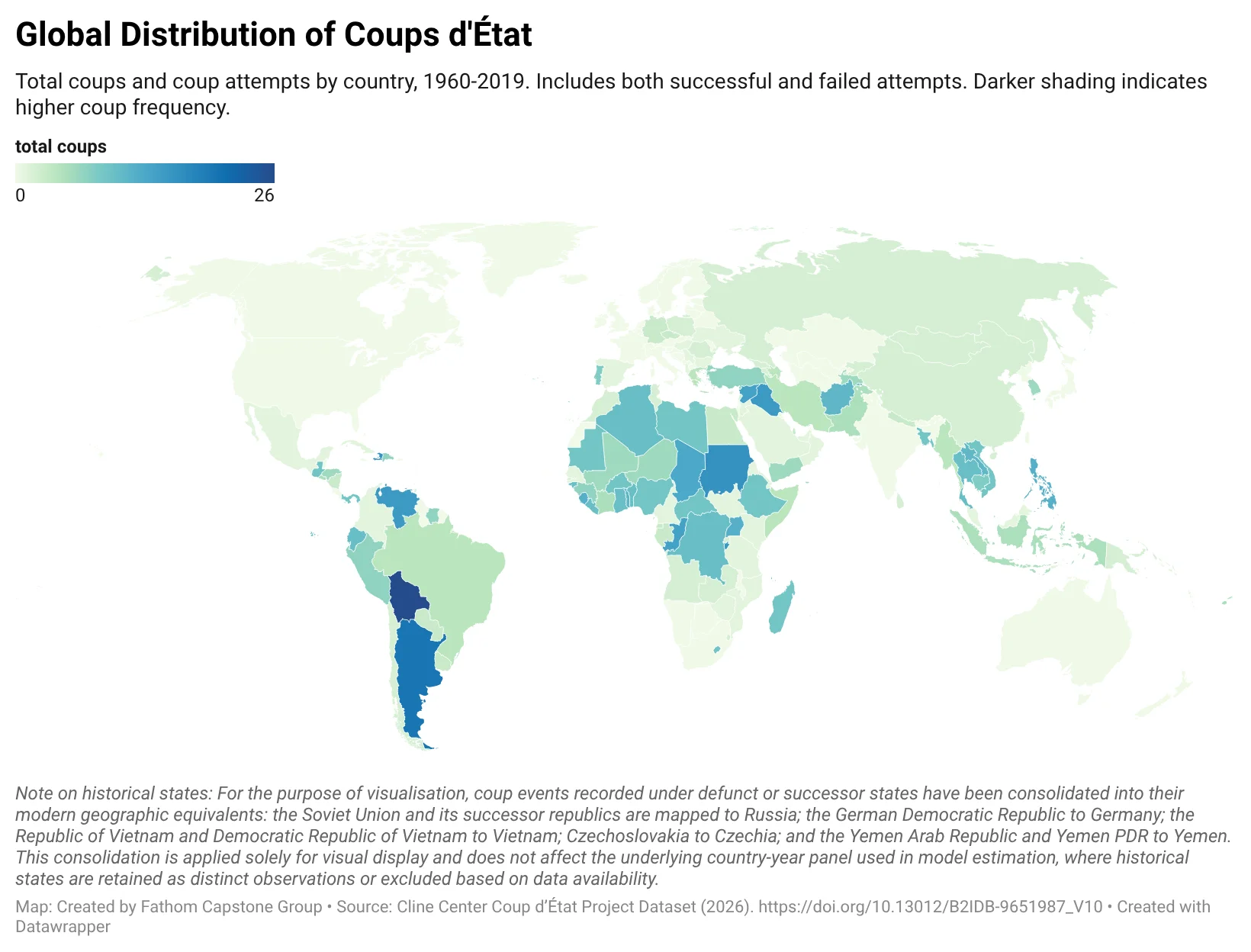
What Drives a Coup?
Coups rarely have a single cause. They emerge from overlapping economic, political, and institutional conditions that together make military intervention both attractive and feasible.
Political scientists have long distinguished between two sides of any coup: disposition and opportunity. Disposition is whether actors want to seize power: do they have grievances, motive, and ambition? Opportunity is whether they can: do they control the institutions and organisational capacity to pull it off? Most analyses treat these separately, but the strongest predictors actually capture both simultaneously.
Across 150 countries and four decades of data, four factors consistently emerge as the strongest predictors of coup risk.
Military influence in government. This is the single strongest predictor, proving more than six times more important than the next variable in the statistical testing. When the armed forces already hold significant sway over civilian governance, the barrier to seizing power outright is much lower. Where the rule of law is weak, "might makes right." This reflects the opportunity side: an autonomous military with organisational capacity.
A recent history of coups. Countries that have experienced a coup in the past five years were associated with approximately a 10 percentage point increase in predicted coup risk.Past coups damage the legitimacy of civilian rule, normalise military intervention as a political strategy, and weaken the capacity of institutions to prevent future attempts. History both creates opportunity and signals disposition: it demonstrates feasibility and lowers the coordination costs for future plotters.
Judicial constraints on the executive. This one is counterintuitive. Stronger judicial constraints are associated with higher, not lower, coup risk. A possible explanation is that in countries where power is heavily concentrated, courts are often weaponised by the ruling group rather than acting as a genuine check on it. The result is that institutions which should prevent a coup end up making one easier.
Electoral democracy. Declines in democratic competition are strongly associated with elevated coup risk, particularly in countries that sit somewhere between full democracy and outright autocracy.
A deeper look at regime type reveals why hybrid regimes - anocracies, often called "electoral autocracies" - may be particularly vulnerable to certain destabilising pressures. These are countries that hold elections but rig them, adopt constitutions but ignore them, or maintain democratic institutions that have lost all teeth. They lack the stability mechanisms of either pure democracies or pure autocracies.
Full democracies are protected by electoral legitimacy: if citizens can remove leaders through the ballot box, the military has less reason to do it extralegally. They also face high international costs; military coups often trigger sanctions, aid suspensions, and diplomatic isolation. Pure autocracies, meanwhile, can rely on repression and patronage networks to suppress threats. They have the surveillance apparatus and loyalty infrastructure to prevent coordination among potential plotters.
Anocracies get attacked from all sides. Opposition movements view elections as illegitimate and mobilise resistance. Military officers see a government lacking democratic legitimacy and calculate that seizing power might be accepted, or at least not strongly opposed. The hybrid nature creates multiple grievances while providing no stabilising mechanism, neither genuine popular legitimacy nor effective repression. This helps explain why over 90% of coups have occurred under non-democracies, but within that category, anocracies are disproportionately vulnerable. More importantly for investors, political and economic pressures do not affect all regimes equally. Rising poverty and increases in military spending appear to have especially destabilising effects within anocracies, raising coup risk more sharply than in either full democracies or autocracies.
Do Economic Conditions Matter?
Economic conditions matter less than one would assume. GDP growth, inflation, and poverty are relatively weak predictors of coup risk on their own. This does not mean economics is irrelevant. The data suggests that economic deterioration raises coup risk mainly by eroding institutions and state capacity, rather than as a direct trigger. A government that can no longer pay its military is vulnerable, but the warning sign is the institutional breakdown, not the GDP figure itself.
Corruption tells a more nuanced story. It is a strong predictor when looking at conditions over several years, but disappears entirely as a signal when looking at short-term changes. This suggests corruption acts as a slow-moving background condition that makes a country structurally fragile, rather than a spark that sets off a coup.
Context also matters. Poverty is not a meaningful standalone predictor, but in hybrid regimes sitting between democracy and outright autocracy, rising poverty and military spending are associated with significantly higher coup risk. In these settings, a government's ability to keep the military and other key power brokers on side depends heavily on its economic resources. This makes economic deterioration far more dangerous.
The relationship between spending and coup prevention is paradoxical. Governments typically try to prevent coups through "coup-proofing" - buying off the military with higher wages, increased defence spending, and distributing rents to key elites. It works, until it doesn't. Economic downturns make exactly this kind of spending unaffordable, but the military's grievances are simultaneously at their highest. A government facing fiscal collapse finds itself unable to pay the very institution most capable of removing it from power, precisely when that threat is most acute.
This timing mismatch is lethal. Government revenue collapses. The fiscal balance swings into deficit. Then the IMF arrives with conditions requiring austerity, further cutting spending. Meanwhile, military officers feel abandoned. They calculate that a new leader might offer a better deal. This is not simply poverty or hardship driving coups; it is the institutional breakdown that accompanies economic stress. The warning sign investors should track is not just GDP, but the government's shrinking capacity to keep its military paid and its elites satisfied. This is why fiscal indicators - government revenue, military spending, IMF programme status - function as leading signals of coup risk, not secondary background controls.
How Accurately Can Coups Be Predicted?
Using these indicators, statistical models were built and tested on data from 150 countries between 1980 and 2024. One model examines which variables contributed most to a country’s estimated level of coup risk, while the other works by comparing countries to past cases with similar political and economic conditions. Burkina Faso is one example where elevated risk was identified in advance. The figures below show all the factors driving the prediction and the historical cases the country most closely resembled. Nine of Burkina Faso’s ten nearest historical comparisons were countries that later experienced coups, leading the model to assign it a high predicted probability.
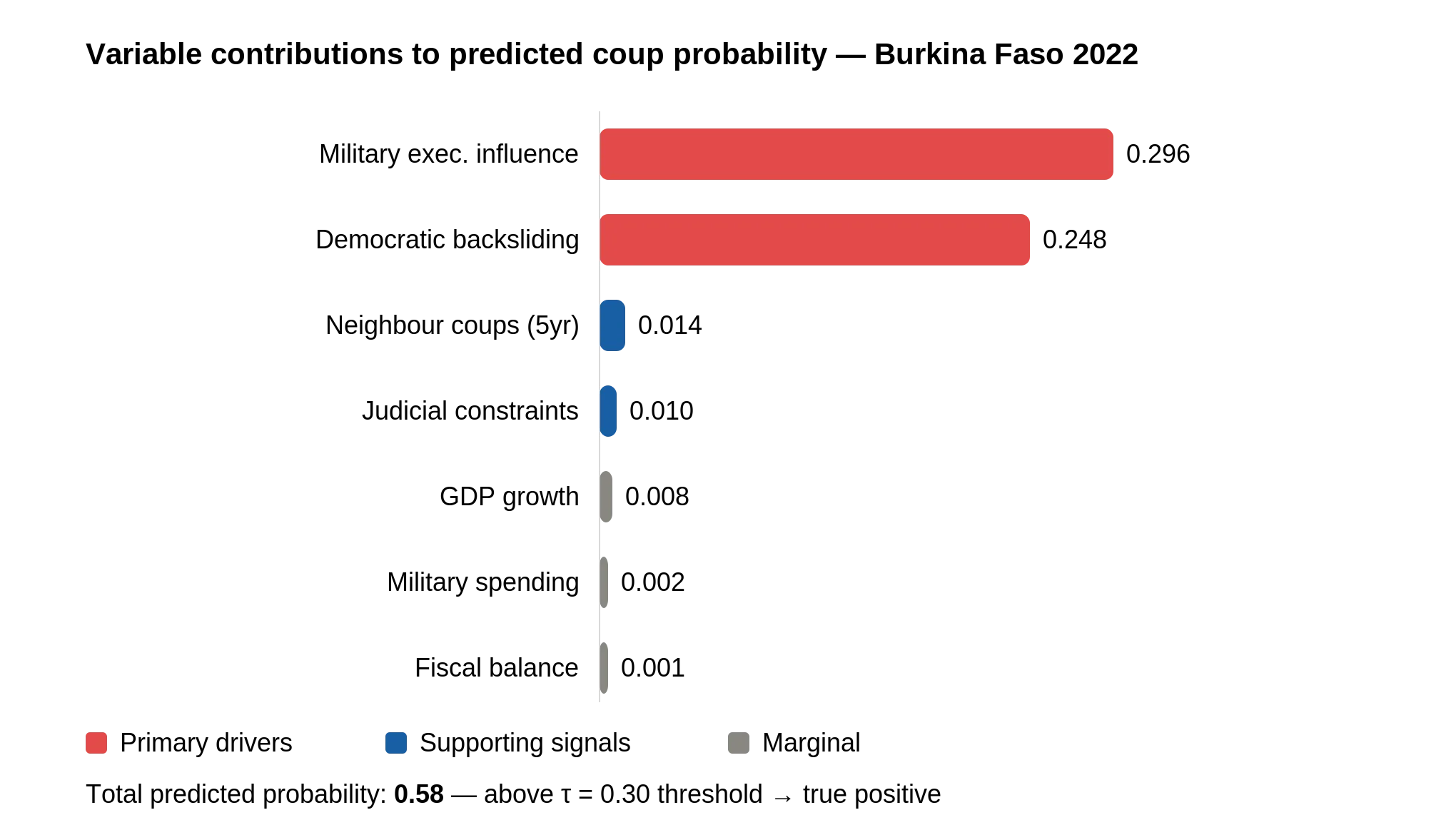
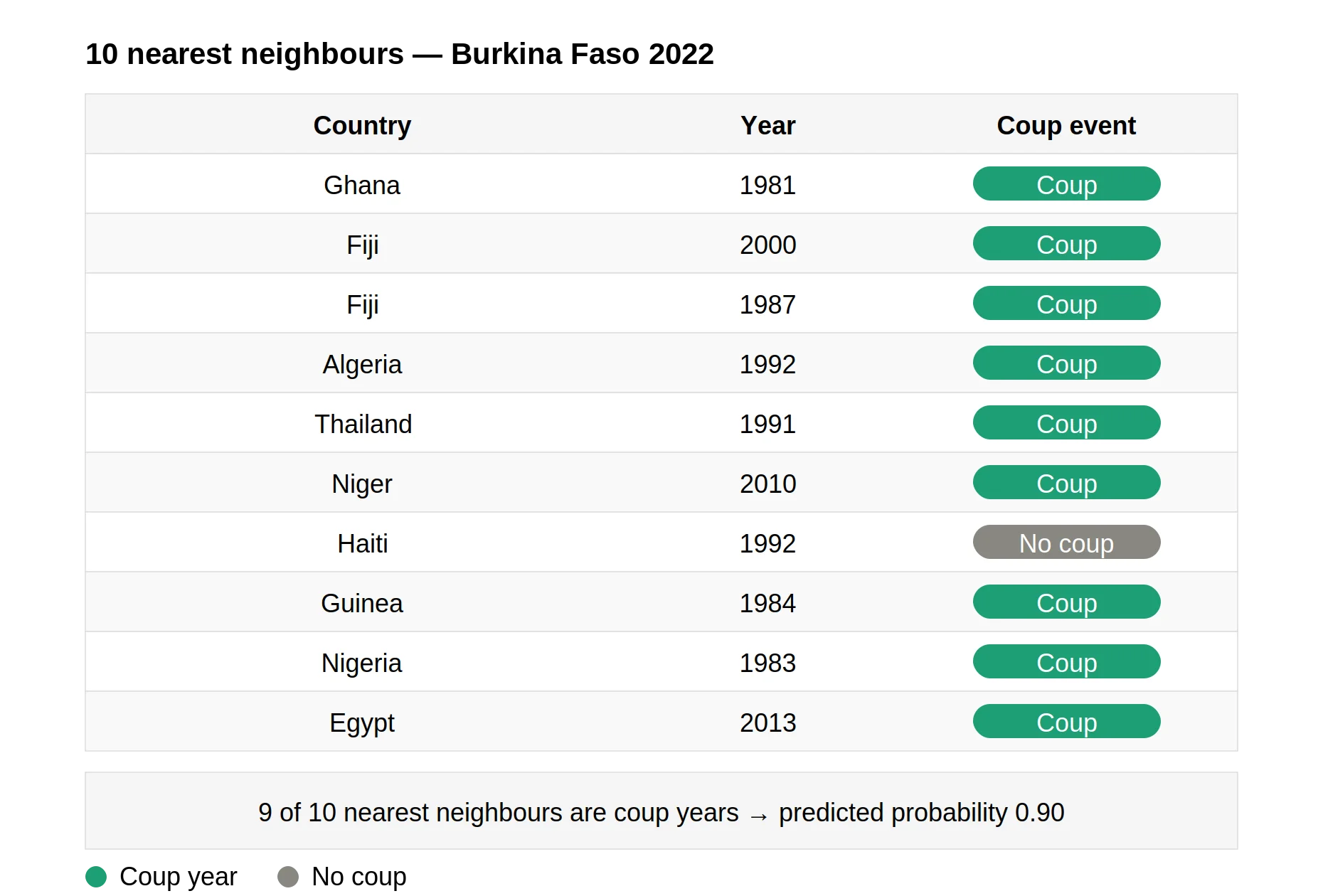
At the same time, the US Capitol assault of January 2021 and the storming of Brazil's government buildings in January 2023 were missed entirely. This is not a flaw in the modelling so much as a boundary on its scope. A framework built on structural conditions, such as military influence, regime type, and institutional degradation, cannot detect crises driven by political rhetoric, the erosion of electoral norms, or the gradual weaponisation of institutions. These dynamics require a different set of tools and indicators.
Raw coup probabilities alone do not always tell the full story. Some countries maintain persistently elevated levels of structural fragility, meaning high predicted risk can become their baseline condition over time. To account for this, risk can also be expressed using z-scores, which measure how unusual a country’s current level of risk is relative to its own historical average.
Haiti offers a powerful example of this. In 2024, the country's predicted probability of a coup was relatively low by raw numbers, around 0.3 on a scale of 0 to 1. Yet its z-score was 1.57, meaning its risk had spiked dramatically above previous norms. Weeks later, a coup occurred. The raw probability missed it; the z-score caught it.
This distinction matters for investors and policymakers. A country scoring high on raw probability is always fragile; it carries perpetual coup risk because of its deep structural conditions. But a country with a rising z-score is experiencing an acute shift: something new is destabilising that previously managed to remain stable. These emerging risks warrant closest attention. A focus on z-scores alongside absolute probabilities gives the framework a dual lens: one for identifying chronically fragile states, one for spotting rapidly deteriorating ones. For investors, deterioration signals are often more actionable than perpetual fragility, because they identify windows of time when preventive action is still possible.
Where Does This Leave Us?
Quantitative models cannot predict the future. What they can do is identify where the conditions for political instability are building, and flag those environments before a crisis occurs. Used in that spirit, this framework is best understood as a screening tool rather than a forecast: it narrows the field of countries that warrant closer attention, without claiming to know exactly when or whether a coup will happen.
There is an unavoidable trade-off in how the tool is used. Setting a lower risk threshold flags more countries, catching more genuine risks, but also generating more false alarms. Setting a higher threshold produces fewer flags but risks missing real events. Where to set that bar depends on the cost of missing a coup versus the cost of acting on a false alarm. This judgment will differ for every investor or policymaker using the framework.
Models excel at identifying where structural conditions are deteriorating: poverty and military autonomy rising together, fiscal capacity collapsing, institutions eroding. What they cannot do is predict the moment when rhetoric tips into violence, or when erosion becomes rupture. For this reason, quantitative risk scores should always be complemented by country-specific qualitative investigation: political insider networks, recent shifts in civil-military relations, and the health of electoral institutions themselves. The model tells you where to look; contextual knowledge tells you what you are looking at.
What Do We Still Need to Know?
Several gaps remain. The model relies on nationally aggregated data, which can obscure subnational dynamics. A region experiencing acute economic stress may be far more volatile than the national average suggests. Incorporating subnational data where available would sharpen the framework considerably.
Food price shocks are another promising avenue. Rapid increases in staple food costs have historically coincided with periods of elevated political instability, but country-level food price data was not available for the full sample and so is not currently captured in the model.
Social media sentiment and protest activity are further signals that quantitative frameworks have only recently begun to incorporate.
Finally, the model is limited to structural preconditions. Understanding what converts those preconditions into an actual coup attempt remains an open question, and one that likely requires qualitative research alongside quantitative screening.
Where Can I Find Out More?
- Powell and Thyne's global dataset of coup events from 1950 to 2010 is the foundational source underpinning most quantitative research in this area.
- The IMF's 2024 analysis of political fragility and coup drivers by Cebotari and colleagues is the most recent cross-country study of what makes countries vulnerable.
- Gassebner and colleagues' examination of when to expect a coup is the most comprehensive test of which variables reliably predict coups across different model types.
- The Cline Center Coup d'État Project at the University of Illinois maintains the primary global registry of coup events used in this study.
Authors:
Jules Burgo-Küntzmann is an MPA candidate at the London School of Economics and Political Science and a visiting fellow at the Atlantic Council’s Freedom and Prosperity Centre. He holds an LLB in public law from the Université Paris-Panthéon-Assas. His research interests lie in geopolitical risk, international political economy, and more broadly international relations.
Raul Misirkhanov is an MPA candidate at the London School of Economics and Political Science with experience across multinational business and public policy. His background includes work at Coca-Cola CCI and the Azerbaijan Entrepreneurs Confederation, where he focused on stakeholder engagement between government institutions and the business community. His interests include governance, economic policy, and the intersection of politics, finance, and technology.
Maria Graham is a dual-degree MPP/MPA candidate at Sciences Po and the London School of Economics and Political Science. She holds a BSc Honours in Anatomy and Cell Biology from McGill University and has professional experience as a paediatric clinical research coordinator and research assistant within the biotechnology sector. Her interests include maternal and child health, global health governance, access to medicines, and the use of data visualisation for policy communication.
Sagarika Bopanna is an MPA candidate at the London School of Economics and Political Science. She holds a BA in Honours Economics from CHRIST University, Bangalore and has professional experience evaluating research methodologies and project designs at the International Growth Centre. Her research interests lie in geopolitical risk, development economics, and social impact. She focuses particularly on how political instability undermines institutional capacity in developing countries