

SPP Womxn's Network

Promoting and facilitating gender equality in public policy
Established in 2018, the School of Public Policy’s (SPP) Womxn’s Network is a student-run organisation focused on the advancement and empowerment of students within the SPP and broader LSE community who are marginalised by the intersectionalities of gender and/or sexuality.
The Network aims to further encourage the inclusion of marginalised voices within policymaking through various events and forums designed to promote learning and open discussion. Therefore, the Network’s primary goal remains understanding reasons for such policy gaps, promoting further representation within policymaking, and creating a safe space for such discussions to occur.
The Network strives to create an environment in which all students feel welcomed to join the conversation around improving policymaking for communities who are marginalised by the intersectionalities of gender and/or sexuality. The Network functions through three main pillars: Advocacy, Events, and Professional Development.
Through these pillars the Network encourages students and alumni to collaborate in discussing ways in which intersectional and inclusive policy can be further implemented and barriers within policy careers can be eradicated. Through events and engagement with practitioners, academics, and advocates, the Network amplifies innovators in gender-based policymaking and exposes students to the importance of this underrepresented area of public policy, as well as potential career opportunities.
Advocacy
Drives the network’s advocacy agenda by pressing for change on gender issues within the School of Public Policy, LSE community, and beyond. The objective of the Advocacy Committee is to challenge and change the political, economic, and social systems, institutions, and practices that create inequitable conditions for womxn and other marginalised populations.
Previous initiatives include:
- 2021-2022 Curriculum Inclusivity Report
- Reporting Resources Awareness
- Recommendations for Faculty Workshops & Student Training
- 2020-2021 Curriculum Inclusivity Report
- 2019 Gender Balance Report
Events
Organises and hosts events led by policy professionals, academics, practitioners, and students. The objective of the Events Committee is to enable learning, discussion, and action to address the challenges facing womxn personally and professionally both within the School of Public Policy and in the broader intersection between gender and policy.
Previous initiatives include:
- Hosting speaker discussions with Q&As Breakfast and Bias with Professor Rubio MarquezGender, Inclusivity and Policy panel with Dr. Hochstetler and Professor Rubio MarquezAllyship and Inclusivity workshop with Beyond Equality
- Hosting career panels and personal development events and trainings Women in Consulting Time Management workshop with the head of HKS Women's Network
- Providing tickets and access to global (virtual) conferences Women’s Economic Forum Global Conference
Professional Development
Provides opportunities for students from the School of Public Policy to build connections with and learn from SPP alumni, policy practitioners, academics, speakers, and fellow students. The objective of the Professional Development pillar is to advance gender balanced leadership both within the SPP as well as in professional settings by providing resources like mentoring and professional and interpersonal skills workshops. Our aim is to help womxn find solutions to barriers they may face professionally and ultimately support them in achieving their career goals.
Previous initiatives include:
- Annual mentorship program with SPP alumni and students
Terms of Reference
1. Purpose
1.1. To give space for the voices, concerns, and experiences of womxn at the School of Public Policy and beyond.
1.2. To ensure the previous, current, and future experiences of all womxn are integrated into policy design and practice in the School of Public Policy and beyond.
1.3. To ensure that policy debate and legislation within the School of Public Policy are not gender neutral and instead take a necessary intersectional and gendered perspective.
2. Membership
2.1. The Womxn’s Network holds open membership for students in the School of Public Policy and encourages all individuals to join and play an active role in the organisation.
2.2. It is expected that all members of The Womxn’s Network support the principles of inclusion, diversity, democracy, women’s rights, human rights, equality, and social and economic justice for all.
3. Function
3.1. To act as an independent forum for LSE students and staff to raise gender- and/or sexuality-specific matters for consideration.
3.2. To share information that represents womxn’s intersectional perspectives on political, social, economic, and cultural matters.
3.3. To influence School of Public Policy staff in building a more inclusive environment and curriculum that represents all womxn and their experiences.
3.4. To serve as a liaison between School of Public Policy staff and students on gender- and/or sexuality-specific initiatives, including complaints and situations of bias as they occur.
3.5. Committees
3.5.1. Advocacy: Drives the network’s advocacy agenda by pressing for change on gender issues within the School of Public Policy, LSE community, and beyond. The objective of the Advocacy Committee is to challenge and change the political, economic, and social systems, institutions, and practices that create inequitable conditions for womxn and other marginalised populations.
3.5.2. Professional Development: Provides opportunities for students from the School of Public Policy (SPP) to build connections with and learn from SPP alumni, policy practitioners, academics, speakers, and fellow students. The objective of the Professional Development pillar is to advance gender balanced leadership both within the SPP as well as in professional settings by providing resources like mentoring and professional and interpersonal skills workshops. Our aim is to help womxn find solutions to barriers they may face professionally and ultimately support them in achieving their career goals.
3.5.3. Events: Organises and hosts events led by policy professionals, academics, practitioners, and students. The objective of the Events Committee is to enable learning, discussion, and action to address the challenges facing womxn personally and professionally both within the School of Public Policy and in the broader intersection between gender, sexuality, and policy.
4. Organisational Structure
4.1 Commits to being non-hierarchical in structure and function, encouraging the free expression of thought and ideas.
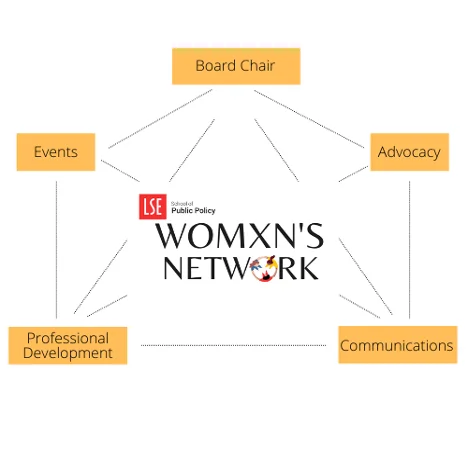
The 2024–25 academic year was one of growth, visibility, and impact for the SPP Women’s Network Board. Among its most significant achievements was the release of the SPP Curriculum Report, the first since 2021. The report provided an in-depth review of the School of Public Policy’s courses and put forward clear recommendations on how diversity and inclusion could be further embedded within teaching and learning. By placing a spotlight on the curriculum, the board helped to spark conversations about representation and ensured that diversity remains at the heart of SPP’s academic agenda.
Another key success was the board’s proposal for SPP to provide free sanitary products for staff and students. With the support of the SPP EDI Committee, this recommendation was implemented and led to the installation of a dedicated kiosk on the 5th floor. This initiative addressed a practical need while also signalling SPP’s commitment to fostering a supportive and inclusive environment for all.
The board also prioritised strengthening community and visibility. Highlights included the Women of Westminster walking tour, which celebrated women’s contributions to public life, and a lively panel event that created space for open discussion and knowledge sharing.
Together, these achievements demonstrate the Women’s Network Board’s ongoing commitment to driving meaningful cultural change within SPP and ensuring that its work brings tangible benefits to students, staff, and the wider LSE community.
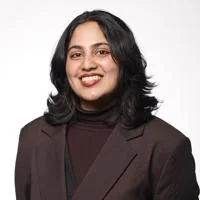
Chair: Khushi Shetty
Pronouns: she/her
Khushi is currently pursuing a Master of Public Administration at LSE, where she explores the intersections of governance, equity, and social impact. She holds a BSc (Hons) in Economics and Finance from Ashoka University, alongside a Postgraduate Diploma in Sociology and Anthropology.
Before joining LSE, Khushi worked as a Research Analyst at CSRBOX, leading and supporting need, baseline, and impact assessments across education, healthcare, and infrastructure sectors. Her work combined data analysis, field coordination, and stakeholder engagement to inform more accountable CSR strategies. She is currently interning with UN-Habitat's Planning and Finance Section in Nairobi, where she works on Rapid Own-Source Revenue Analysis, supporting municipal finance diagnostics and strengthening local governments' revenue systems. Her academic research reflects a deep commitment to inclusive, evidence-based policy, from an empirical study on the impact of heat stress on labourers in Delhi, to a qualitative study, Garbage (and) Governance, examining lived inequalities near Delhi's Bhalswa landfill.
As Chair of the Network, Khushi aims to build stronger interaction between the School of Public Policy and the critical issues that shape it. She is particularly committed to bringing gender and marginalised community perspectives into mainstream policy dialogue, ensuring they are seen not as niche concerns but as integral to effective policymaking. She believes that inclusive spaces emerge through open dialogue, thoughtful understanding, and collective effort.

Head of Community Engagement: Rocio Maldonado
Pronouns: she/her
Rocío Maldonado is a political scientist from Chile and second year Master's student at the London School of Economics and Political Science (LSE), specializing in international public policy, human rights, and global governance. She graduated first in her class from the Pontificia Universidad Católica de Chile, receiving the Academic Excellence Award, and is a recipient of the Luksic Scholarship, awarded to outstanding Chilean students pursuing postgraduate studies abroad.
Rocío has over four years of professional experience across government, international organizations, and the nonprofit sector. She served as an Advisor at Chile's Ministry of Women and Gender Equity, where she led international cooperation initiatives, coordinated Chile's reporting to United Nations and regional human rights mechanisms, and managed projects on gender equality, economic empowerment, digital inclusion, and climate policy. She has also worked as a consultant at Fundación ChileMujeres, focusing on research and data systems related to women's economic participation.
She has also been selected as an Elizabeth Abi-Mershed Fellow at the Inter-American Commission on Human Rights (IACHR), where she contributes to the Follow-up of Recommendations of Cases Unit, supporting the promotion and implementation of international human rights standards across the Americas.
At the Womxn's Network, her goal is to foster meaningful dialogue on gender and intersectionality, creating spaces for inclusive discussion and bringing these issues to the forefront of academic and student life at LSE.
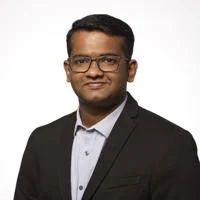
Head of Advocacy: Shreyas Ashok Kumar
Pronouns: he/him
Shreyas is a second-year Master of Public Administration student at LSE, with previous experience working at the intersection of politics, social justice, and inequality. He came to public policy from a unique starting point, graduating at the top of his class with a degree in Computer Science, and now brings that quantitative background to questions of poverty, feminism, representation, and political economy.
Shreyas has spent much of his career designing and evaluating policy for India's most marginalised communities. At the Abdul Latif Jameel Poverty Action Lab (J-PAL) South Asia, he worked on the Graduation Approach to tackling multidimensional poverty, supporting government partners with evidence and implementation. Earlier, working with the Ministry of Social Justice and Empowerment in India, he designed a livelihoods programme for ultra-poor scheduled caste households. With the Indian National Congress, the principal opposition party in India, he carried out policy research and writing on unemployment, inequality, caste, and discrimination, and contributed to the 2024 national election manifesto. As a LAMP Fellow, he supported a Member of Parliament and drafted a bill on proportional affirmative action for tribal communities, which was introduced in the Parliament of India. He is also a co-founder of the Eva Climate Foundation, which advises local governments on climate action.
As Head of Advocacy for the Womxn's Network, Shreyas brings an intersectional and materially grounded lens to conversations about gender in policy, drawing on his interests in feminist theory and queer rights. His goal is to expand what the Network does and to push for real, lasting change in how the SPP functions and beyond, treating gender and marginalisation as central to good policymaking.

Head of Social Media: Yuxuan Li
Pronouns: she/her
Yuxuan is a second year MPA student. Prior to joining LSE, she studied Politics at King's College London, engaging with topics in climate change policy and gender studies. In particular, she has focused on the disproportional impacts of climate change and policy means to uplift disadvantaged communities in developing countries.
During a semester abroad in the US, Yuxuan attended the 68th UN Commission on the Status of Women in New York as an NGO delegate and organised a parallel event to raise awareness on the mental health and education access for minority left-behind girls in rural China. As the Chair for Charity and Philanthropy Affairs at KCLCSSA, she has organised charity runs and other events to raise donations for public welfare programs and schools in impoverished villages in China. At LSE, she plans to use her quantitative skills to further her study in development economics and impact investment, exploring how to channel and motivate private funds toward meaningful social outcomes.
As Head of Social Media for the SPP Womxn's Network, Yuxuan is focused on growing the Network's digital presence, raising awareness of its initiatives, and connecting its conversations to the broader policy community.
The Womxn’s Network welcomes the opportunity to work with partners on new projects, including advocacy, events, or professional development initiatives, as well as opportunities outside of these pillars (e.g., research, consultancy work).
To get in touch about partnering with the Womxn’s Network, please reach out to spp.womxns.network@lse.ac.uk.
Current partners include:
- Women's Forum for the Economy & Society
Contact us
If you have any queries, please contact us via email: spp.womxns.network@lse.ac.uk