


The world is your office: how ‘‘work from anywhere’’ is transforming work

For many people around the world, it was only when the pandemic hit that working from home became not just a possibility but a forced reality. Since then, the options available to both employees and employers have continued to evolve. With technological advances and the rapid growth of AI, work can now, for many, be done from just about anywhere. But how has this shift affected us, and what does the ability to work outside the office mean for the future of work?
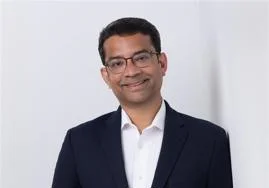
Prithwiraj Choudhury, Professor of Organisational Behaviour in the Department of Management at LSE, is a globally recognised expert on the future of work. His pioneering research on the ‘‘work from anywhere’’ (WFA) model explores the effects on employees, organisations and communities across the globe. Professor Choudhury’s book, The World is Your Office: how work from anywhere boosts talent, productivity and innovation, became a national bestseller in the United States, translating academic insights for a general audience.
Redefining the geography of work
For more than a decade Professor Choudhury has focused on how technology is reshaping the spatial organisation of work. A key aspect of this research is a challenge to the longstanding assumption that workers must move to where jobs are located. Instead, his work examines what happens when organisations redesign roles so that work itself becomes mobile.
“Work from anywhere is a work arrangement which allows workers to choose where to live. Instead of having workers relocate or migrate to where the company is, an alternative is to allow the work to be moved to where the worker wants to live,” he explains.
“Remote and distributed work has been around for decades. There's work by Jack Nilles, dating back to the late 1970s when there was an OPEC oil crisis, which triggered the first idea of ‘why do we have to commute for working?’ If you count the number of days that people were working remotely in the United States, the number was hovering around 5 per cent of all working days. Since the pandemic, that number has shot up to about 30 per cent of all workdays, which is a very, very large increase in a short period of time. The interesting thing is that despite all the debates that have been happening in the real world and in the media around the benefits and the pitfalls of remote and distributed working, that number has been surprisingly stable in almost all major Western economies.”
The spread of work from anywhere has been particularly pronounced among start-ups. “Today, if an entrepreneur is starting a company, it is almost always that work from anywhere becomes the default operating model,” Professor Choudhury says. “And the biggest advantage of working from anywhere is that it allows companies to hire from anywhere. So instead of hiring talent from London or New York or Silicon Valley, now you can expand hiring to multiple countries which gives entrepreneurs access to global talent.”
Hybrid work and flexible models
As remote work became mainstream during the COVID-19 pandemic, many organisations settled into hybrid arrangements. But Professor Choudhury argues that hybrid work is not a single model and that its long-term success depends on how intentionally it is designed. His research distinguishes between different forms of hybrid working, each with distinct implications for productivity, collaboration and organisational culture.
Professor Choudhury identifies three “flavours” of hybrid work: “Weekly hybrid is when you show up at an office for two or three or four days a week. Monthly hybrid is when you are in person with your team for a week every month. The third form of hybrid is quarterly hybrid, and this is very popular amongst start-ups and companies like Airbnb and Spotify where teams meet once or twice a quarter in a designated location. So they could go to a conference in Madeira, for instance, and spend a week together every quarter.”
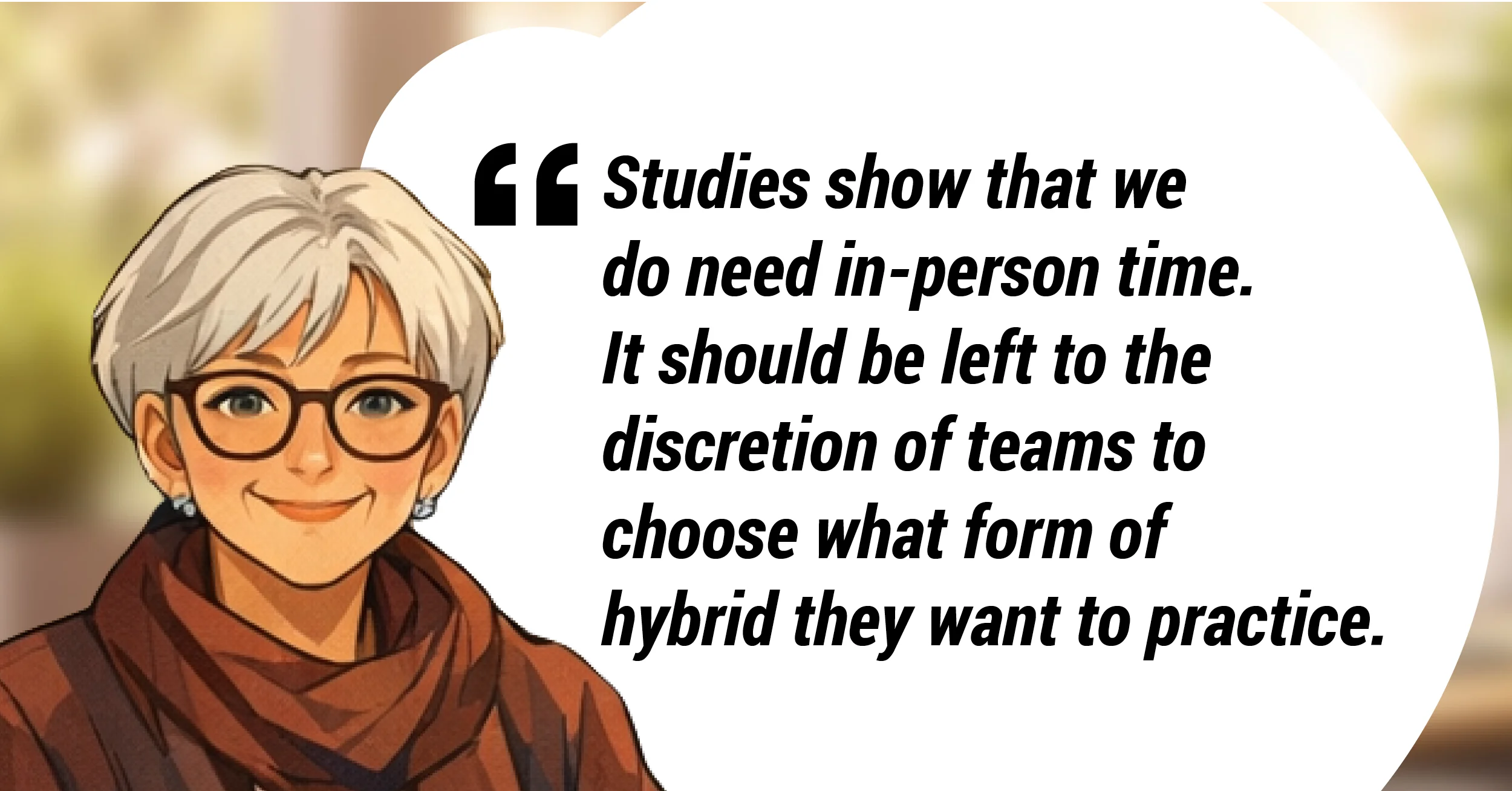
Though in-person interaction remains important, Professor Choudhury emphasises the need for flexibility. “Though I am a researcher of work from anywhere, studies show that we do need in-person time. It should be left to the discretion of teams to choose what form of hybrid they want to practice, and this is one thing I'm hoping will evolve over time, where traditional teams will take that step from weekly to monthly and then to quarterly hybrid. That entails a lot of investment in best practices.”

Reshaping talent and communities
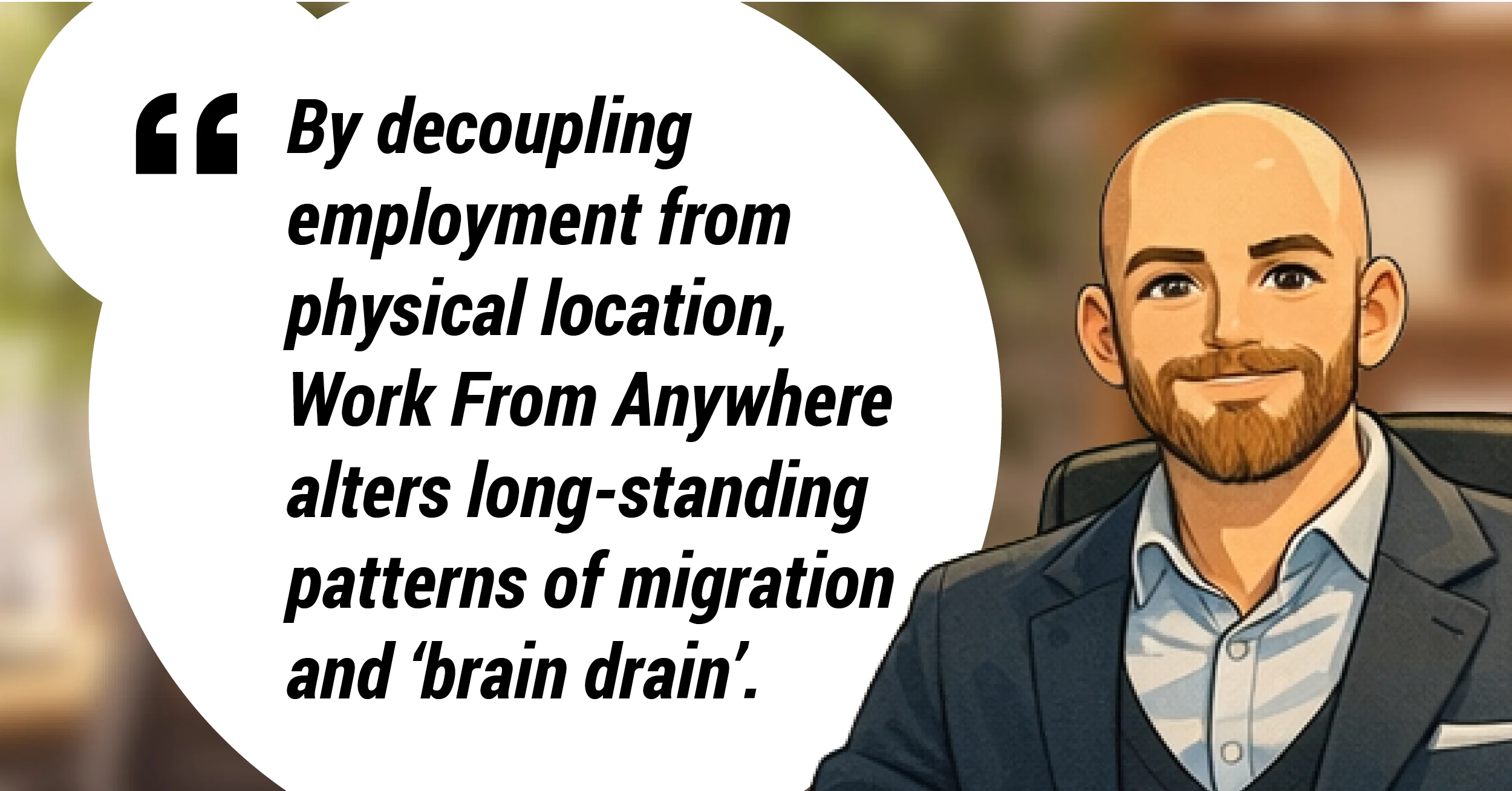
Beyond individual firms, Professor Choudhury’s work explores how work from anywhere is reshaping labour markets and communities themselves. By decoupling employment from physical location, WFA alters longstanding patterns of migration and ‘‘brain drain’’, showing consequences not only for workers and employers, but also for smaller towns that have historically lost people and opportunity.
“It's a win for the individuals because they can choose to live in cheaper towns with more affordable housing or closer to family, and it's a benefit to the organisation because the company now can hire more widely which means you're not stuck to one labour market. You can go around the world and hire the best talent so your workforce is more diverse,” he says.
“But the thing that's most exciting to me is the fact that smaller towns around the world are starting to see an influx of new talent. For decades, smaller towns in Britain and the United States – and frankly every country in the world – lost their young people to large cities and smaller towns have been devastated. Because of that [WFA], it creates a more fair, spatial distribution of talent. And over time, it leads to the revitalisation of small towns.”
Digital twins and AI: the next frontier
While much discussion of work from anywhere focuses on knowledge workers, Professor Choudhury’s more recent research pushes the concept further. Advances in AI, automation and digital twins are beginning to extend flexibility into sectors once considered incompatible with remote work, from manufacturing and energy to healthcare.
Digital twins are a combination of sensors, AI, the cloud and automation, where you create a virtual copy of, for example, a factory, hospital or airport. They allow workers to undertake tasks such as remotely operating equipment or optimising processes. They could even allow medical staff to remotely monitor patients from their homes, relieving pressure on hospital ward space.
“My expectation is in the next five to 20 years work from anywhere is likely to become widespread in settings that otherwise wouldn't have allowed workers to work from anywhere,” Professor Choudhury explains.
His latest research explores the rise of personal AI bots and agentic AI architectures.
“AI bots are AI agents which impersonate a particular individual,” he explains. “In one field experiment we created a bot for a real CEO called Wade Foster from a company called Zapier. The experiment centred around Zapier employees asking Wade questions, with the answer coming from either the human CEO or the bot CEO,” he says.
“The employees had to do two things: they had to identify whether it was the human or the bot and then they had to rate how helpful the answer was. What we found in that study is that the employees of Zapier could not identify whether the answer came from the human Wade or the bot.
‘‘But the other finding of the study showed that if the employee thought it was a bot, which might be an incorrect guess, they found the answer to be less helpful. So this was classic evidence of algorithm aversion: that humans, under some conditions, tend to be averse to algorithmic output.
“However, these bots are able to imitate personalities and provide a line of reasoning to imitate personalities. And I find this fascinating because for the first time in human history, human capital is getting encoded outside of the human. And this has profound implications for work from anywhere, because CEOs are already starting to use this technology. Otter CEO Sam Liang has created a SAMBot, which he plans to send to some less important meetings. Using SAMBot hypothetically, Sam could hold a conversation with every single Otter employee at the same time. These bots have no work-life balance issues and they have no timezone constraints. They can keep communicating and reasoning even when the human is sleeping or on a flight.”
Beyond personal bots, agentic AI promises to change team structures and productivity.
“AI agents are going to be co-workers. So you can imagine one architecture where you ask an AI agent to take the pros of a certain decision, and the other AI agent to take the cons. What I find intriguing is how these agentic architectures will incorporate both humans and AI agents and what kinds of work and team configurations will emerge, which will both expand work from anywhere, but make us more productive.”
How will the world of work continue to develop?
Taken together, Professor Choudhury’s research offers a picture of work that is increasingly removed from place, time and even individual human presence. As digital twins, AI agents and personal bots mature, he argues that organisations face fundamental choices about how work is structured, how teams are assembled and how technology is used to augment rather than diminish human capability.
Professor Choudhury presented his research into digital twins, AI agents and how bots and agentic architectures may shape jobs and workplaces over the next 10 years at a public lecture at LSE in March 2026.
Professor Prithwiraj Choudhury was speaking to Helen Flood, Media Relations Officer at LSE.
Subscribe to LSE Research for the World
Research for the World is the online magazine by LSE - The London School of Economics and Political Science.
Related content
Is AI really taking our jobs? The future of work explained

Beyond the office walls: how to escape the tyranny of out-of-hour emails and thrive in a digital workplace

Is the UK undergoing a “quiet quitting” revolution?