

John Norton wins the 2026 Lakatos Award!
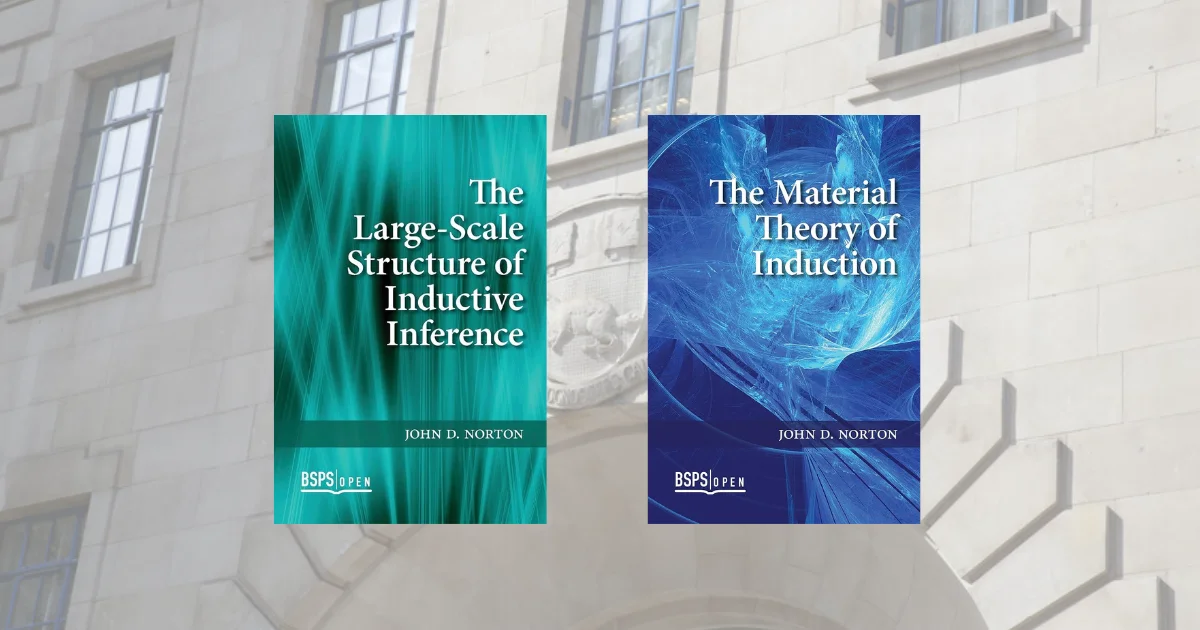
The London School of Economics and Political Science (LSE) is pleased to announce the 2026 Lakatos Award winner John Norton, who receives the award for his books The Material Theory of Induction (University of Calgary Press) and The Large-Scale Structure of Inductive Inference (University of Calgary Press). Congratulations!
The Lakatos Award was made possible by a generous endowment from the Latsis Foundation, in memory of the former LSE professor Imre Lakatos. It is administered by an international Management Committee, which is organised from the LSE but independent of LSE’s Department of Philosophy, Logic and Scientific Method. The Committee decides the outcome of the Award competition on the basis of advice from an anonymous panel of selectors who produce detailed reports on the shortlisted books.
The prize winner will receive their Award and deliver their prize lecture at the LSE at a time to be confirmed later. The lecture will be open to the public.
About the award winner
The Material Theory of Induction and The Large-Scale Structure of Inductive Inference are praised by the selectors of the Lakatos Award as together making “a very strong case for the material account of inference” and as being “a work of exceptional scholarly rigour”. The books offer “sweeping but compelling arguments for two theses: (i) there can be no content-neutral, formal, universally applicable rules or procedures for justifiable inductive inference and (ii) real inductive inferences in science are nevertheless often justified, with the key work in the justification being performed by local ‘material’ facts.” Despite the topic being complex and demanding the “writing is unusually clear and readable, indeed almost uniquely so”.
John D. Norton is a Distinguished Professor at the University of Pittsburgh. He studies the history and philosophy of physics and also the general philosophy of science. He gave the first interpretation of Einstein's "Zurich Notebook," which cataloged the steps of Einstein's discovery of general relativity. He has worked on foundational problems in the theory of relativity and statistical physics, including a long-standing critique of the claimed connection between information and thermodynamic entropy. In general philosophy of science, he has defended an argument view of thought experiments and criticized metaphysical conceptions of causation and possibility.