

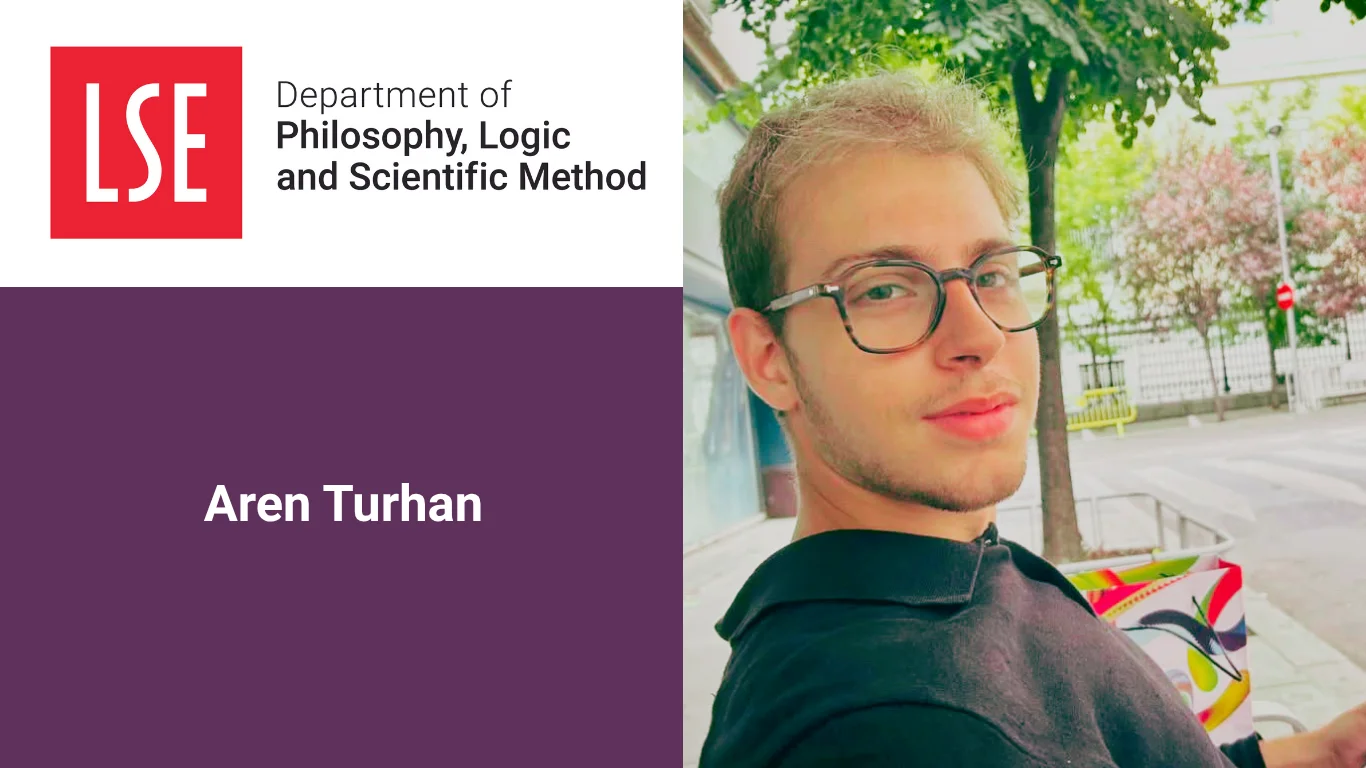
Aren Turhan (MSc Philosophy of Economics and the Social Sciences)

Why did you choose LSE and the programme?
For better or for worse, I find that the English education system pushes for very early specialization for those who want to pursue graduate study. Coming from a sociology and anthropology background transitioning into formal education in philosophy, I wanted my taught master’s experience to be more exploratory in nature—gathering knowledge and weeding out areas of interest from non-interest. I found the programme to offer precisely this exploratory structure. Students are welcomed to combine courses in philosophy of science, philosophy of economics, philosophy of social sciences, ethics, and even continental philosophy and social sciences courses from other departments. With careful selection, one can attain any experience one wishes from the programme, in a structured and disciplined manner. This was one of the primary attractions of LSE and the programme for me.
Which aspects of your studies were the most beneficial for your professional as well as personal development?
I am a firm believer that one of the most useful professional and interpersonal skills one can obtain, is being able to form, spot and respond to cogent arguments. At the risk of turning this testimony into an argument, every profession (and indeed every personal interaction) depends on communicating ideas and evaluating them carefully. This is especially important for anyone hoping to pursue research or academia.
LSE taught me the above skills in great rigour, and also taught me something equally important: to approach other people’s arguments charitably before jumping to criticism.
What is your fondest memory of your time here?
Rather than a singular moment, my fondest memory will be an abstracted “ideal day on campus”; a couple stimulating classes during the day; some vaguely productive time spent doing coursework in the library or Marshall building; regular study breaks for a small bite, some coffee, or a walk around campus with a friend; a 5-6 p.m. pub session in agreeable weather, chatting away, people-watching, greeting familiar faces and finally returning home for dinner, having been intellectually and socially satiated!
Why would you recommend studying at LSE and the Philosophy department in particular?
I could come up with a long list of reasons, but most of them would likely fall under my particular satisfaction with LSE and the Philosophy department’s pedagogy. Despite being (unimaginably busy) leading scholars in their respective fields, professors, visiting research fellows and even phd students never fail to treat you with warmth as an emerging intellectual peer, willing to offer guidance and support. The content for any given course is clearly updated regularly to keep up with student feedback, and disciplinary developments, the latter which is exceptionally important, again for those who wish to pursue further research. Finally, people at LSE treat philosophy as a genuinely productive and powerful tool for real-world application and enacting visible change.
Your LSE experience in your own words.
It has been a joy and a privilege to surround myself with people equally curious and passionate about what philosophy has to offer, as I am. While the academic experience has been appropriately challenging, often pushing me well beyond my comfort zone, there is a certain sense of ease and familiarity in being surrounded with motivated people who clearly like what they do, who come from varied intellectual and professional backgrounds. This will certainly sound cheesy, but my time at LSE has often felt like a year-long—yet not nearly long enough!—family gathering of distant relatives. There is a great feeling of solidarity in being a LSE Philosophy student.