
Antonina Scheer

About
Antonina is a Senior Policy Fellow and Deputy Director for Policy at the TPI Global Climate Transition Centre (TPI Centre).
The TPI Centre provides asset owners and managers with publicly available data on the climate performance of companies, banks and countries. She led the methodological development of the Assessing Sovereign Climate-Related Opportunities and Risks (ASCOR) tool and currently leads research at the intersection of national and corporate transition planning.
She has authored a range of policy-oriented publications including on corporate climate action, national climate policy, labelled bonds and the just transition challenges in extractive sectors. She is an active collaborator with the International Transition Plan Network, the Just Transition Finance Lab and the Centre for Economic Transition Expertise (CETEx).
Background
Prior to joining the TPI Centre, Antonina worked at the Climate Bonds Initiative, the International Renewable Energy Agency, an aquatic ecology research lab at McGill University, a Panamanian environmental non-profit organisation, and the housing facilities department of McGill University. Antonina holds an Honours BSc in Environmental Sciences from McGill University and graduated with Distinction from the MSc in Environmental Change and Management at the University of Oxford.
Research
Research interests
- Climate finance
- Sustainable development
- Just transition
Engagement and impact
Policy
By Ben Gilbey (ITPN), Antonina Scheer and Adrien Rose in November 2025
A discussion paper by the International Transition Plan Network (ITPN) and the TPI Global Climate Transition Centre (TPI Centre) at LSE
By Antonina Scheer, Johannes Honneth, Setenay Hizliok, Simon Dietz and Carmen Nuzzo on 14 November, 2023
Assessing Sovereign Climate-related Opportunities and Risks (ASCOR) is an investor-led project to develop a free, publicly available, independent tool that assesses countries on climate change. The ASCOR framework is composed of indicators for the transparent assessment of the progress made by countries in managing the low-carbon transition and the impacts of climate change.
Podcasts and videos
On 16 December 2025
In this episode of the Net Zero Investor Podcast, the reporter Atharva Deshmukh is joined by Sung-Ah Kyun, Associate Director and Head of Policy, Research and Partnership at the European Bank for Reconstruction and Development (EBRD) and Antonina Scheer, Deputy Director, Policy at the TPI Global Climate Transition Centre at LSE.
Sun-ah and Antonina attended COP30 in November 2025 and reflect on the highlights of Brazil's moment in the climate spotlight.
On 14 November 2025
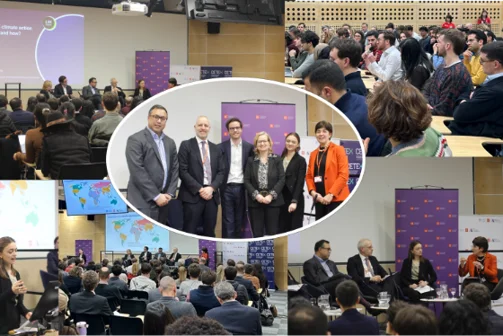
This COP30 side event highlighted key findings from the “State of the Sovereign Transition 2025” report alongside the release of our latest sovereign assessment data for 85 countries on the Assessing Sovereign Climate-related Opportunities and Risks (ASCOR) tool.
Following a presentation with a focus on Korea and its regional peers, panellists discussed the policies and governance structures needed to make Nationally Determined Contributions (NDCs) investable and accelerate transition finance flows. To this end, they stressed the importance of constructive engagementbetween investors and policymakers. They also reflected on the ongoing COP30 negotiations and how they may shape the next decade of investment opportunities.
On 28 August 2025
Why are the new generation of Nationally Determined Contributions (NDCs) among the most important policy documents of this decade? How concerning is it that so few countries have published an NDC target for 2035? How does tracking progress help finance the implementation of the NDCs?
In this episode, Antonina Scheer, Deputy Director for Policy at the TPI Global Climate Transition Centre (TPI Centre), provides insights to answer some of these questions in the EY Sustainability Matters podcast. She also explains how the ASCOR (Assessing Sovereign Climate-related Opportunities and Risks) tool evaluates the credibility and ambition of NDCs and how our research can help make them investable for investors.