

Enock Wanderema
MSc Behavioural Science
2025/26
Learn more about Enock's background and experience as an AKO scholarship holder in the Department of Psychological and Behavioural Science (PBS).
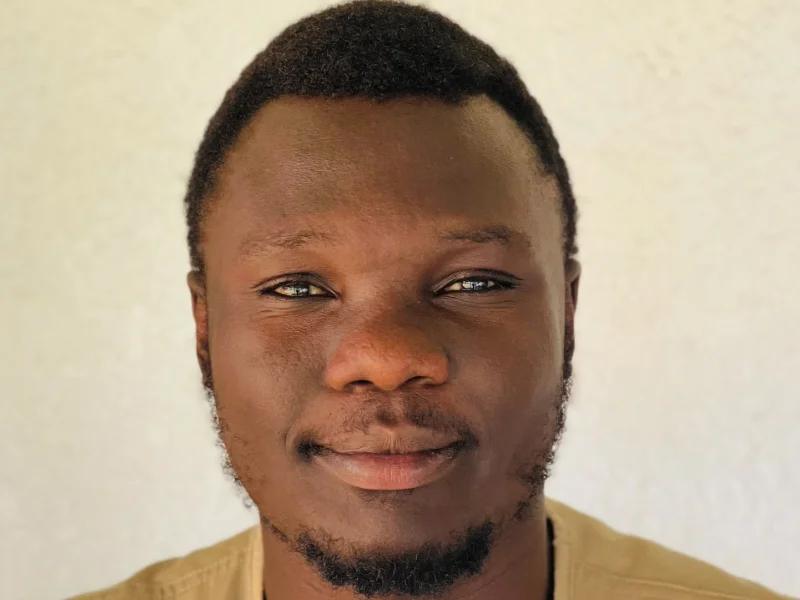
We arrived from different parts of the Global South carrying the same mix of gratitude and nerves, and that became its own kind of belonging.
Hi Enock! Thank you for taking the time to answer some questions. Please can you tell us a bit about yourself and the journey that led you to LSE?
I am a journalist by training. I started writing for newsrooms after my undergraduate studies in 2022, then shifted to communications in 2023. My work has always been about getting people's attention, and I am good at it. But sometimes a message works and sometimes it bounces off, and the same message can pull different reactions from different people. Those are questions about behaviour. That meant a programme built on behavioural science.
What made you want to study your MSc programme in the Department of Psychological and Behavioural Science?
Behavioural Science is still rare as a standalone department in most universities, so LSE came up first and fast every time I searched. PBS also has the widest choice of modules I found, and all of them looked worth taking. Before applying I watched clips of Professor Liam Delaney and Dr Ganga Shreedhar, and they made it obvious this was where I wanted to be. Most of all, the AKO Master's Scholarship, aimed at students from South Asia, Africa and Latin America — a dream department running a scholarship for my region?
How has the AKO Master’s Scholarship influenced your experience, both academically and personally?
First, because of AKO, I am at LSE. Everything else cascades from that. I came in as a writer, and almost everything the degree asked of me had to be built from scratch, the passion aside. I had dropped maths at O-Level and arrived certain I would never be a numbers person. Then LSE asked me to design experiments, collect the data and run the analysis myself. I loved it. My dissertation turns on the same instinct. Europe's new AI Act says you must be told you are talking to a machine, and I am asking whether that honesty backfires and makes people trust the service less. Long before LSE, my writing skills were largely advanced by a global communications advisor to the organisation I was working for in Uganda. She took it on herself to mentor me in writing and storytelling. Our interactions were entirely virtual. Meeting in person was not a thought either of us allowed ourselves. AKO changed that, she’s British, and I am in the UK.
What has helped you feel connected to the Department of Psychological and Behavioural Science and the wider LSE community?
The other AKO scholars were the first thread. We arrived from different parts of the Global South carrying the same mix of gratitude and nerves, and that became its own kind of belonging. The Behavioural Science cohort itself has been warm and open. I have never seen a more help-hungry class; make your issue known, and someone turns up. The professors have been approachable. I am a proud student of the department. Beyond PBS, I have found my footing with the other African students on the Programme for African Leadership, which I recently completed. About eighty of us — a great way to keep home away from home.
How do you see your LSE experience shaping your next steps?
The methods I leave with are the greatest asset of this degree. They cut across the social sciences, useful for almost any question you can put to research or experiment. I am already using them at home, working out why a Ugandan hotel owner hands guest data to the government or holds it back, when that same data could shape how the country plans. A project around AFCON 2027 may be next. Further out, I am pointed at a PhD in cooperative AI and AI safety, the question of how people and the machines we are building learn to get along. Underneath all of it, advancing the behavioural science practice anchored in sub-Saharan Africa.
Finally, what three words would you choose to describe your PBS experience?
Adventurous. Galvanising. Momentous.