

Techno-optimistic scientists take fewer climate actions, new LSE study finds

Scientists who believe technology will largely solve the problems caused by climate change are 23% less likely to engage in civic climate action and 18% less likely to make high impact lifestyle changes, compared to scientists who disagree with this belief.
This is the key finding from a new study from the London School of Economics and Political Science (LSE) published today (7 October) in Environmental Research Letters.
Drawing on a survey of over 9,000 scientists across 115 countries, 27% said they agreed with the statement that ‘technology will largely solve the problems caused by climate change’. In comparison, 44% disagreed with the statement (29% neither agreed nor disagreed).
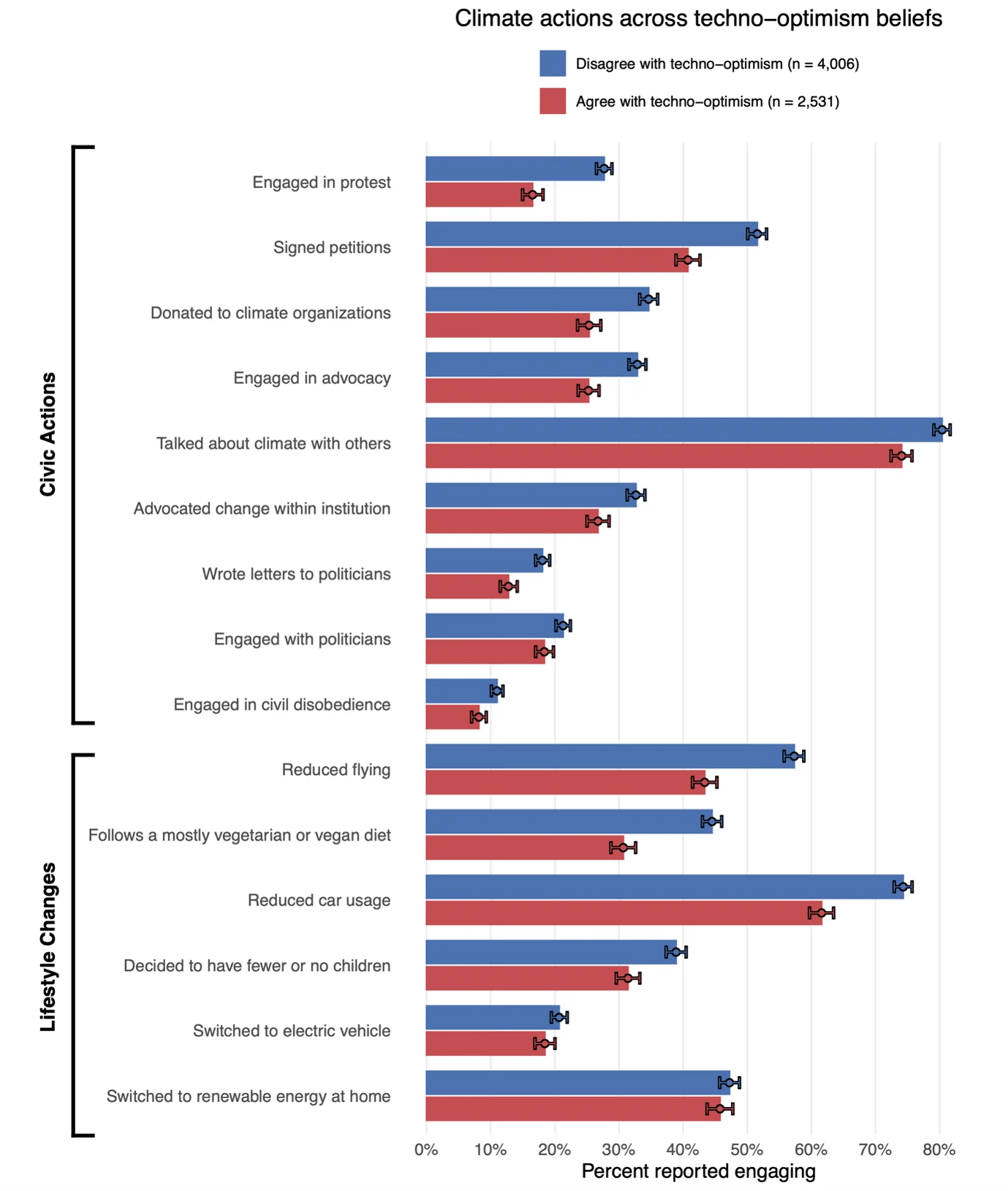
Scientists who agreed that technology will largely solve the problems caused by climate change (techno-optimists) reported engaging in less civic actions than those who disagreed. They reported signing less petitions (41% versus 52%), engaging in less protest (17% versus 28%) and engaging in less advocacy (25% versus 33%).
Likewise, this group also reported engaging in fewer high-impact lifestyle changes. For example, techno-optimistic scientists were less likely to report reducing their flying (43% versus 57%), reducing their car usage (62% versus 74%) or following a mostly vegan or vegetarian diet (31% versus 45%). The differences in technology-oriented climate actions such as switching to an electric vehicle (18% versus 21%) and switching to renewable energy at home (46% versus 47%) were negligible.
The researchers also found that techno-optimism is most prevalent among scientists with right leaning political views. The scientists were asked to rate their political leanings on a scale from one (most left leaning) to seven (most right leaning). Only 16% of left-leaning scientists (who identified with one and two on the scale) were techno-optimists compared to 48% of right leaning scientists (who identified with six and seven on the scale).*
There was also variation across scientific fields with the percentage of techno-optimists highest in applied (31%) and natural sciences (29%) and lowest in those in the social and behavioural sciences (23%) and humanities (23%).
The authors raise concerns about reliance on technological solutions in the report, where they state: “The belief that technology will largely solve climate change and its consequences, what we refer to as techno-optimism, can lead to an over reliance on technological solutions at the expense of far-reaching socio-economic transformations needed to address climate change.
“For example, current climate change mitigation scenarios rely heavily on the roll out of speculative negative emissions technologies in the future. This reliance has wide-ranging societal implications: it hampers the development of alternative decarbonisation pathways that focus on the behavioural, political, and structural changes needed to advance sustainability transformation and deflects attention from the urgent need for immediate emission reductions.”
Commenting on the findings, lead author Dr Fabian Dablander from the Department of Psychological and Behavioural Science and the Global School of Sustainability at LSE said: “Technological solutions are often politically attractive because they promise to address climate change without requiring changes to how people live and consume. Strikingly, we see the same tendency at the individual level, with greater faith in technological solutions going hand in hand with less engagement in climate action. Yet technology cannot substitute for the broader societal changes and large-scale shifts in consumption that are also needed.”
“Scientists may be experts, but expertise alone does not determine how they think about or engage in climate action. Techno-optimism varied strongly with scientists’ political orientation, while it hardly varied with how closely their own research was related to climate change. This suggests that broader worldviews matter even among experts in shaping which kinds of climate solutions they see as necessary.”
*The 16% and 48% figures given here are average percentages of scientists who identified as one and two on the political scale and six and seven on the political scale, respectively.
For a copy of the study, please visit Environmental Research Letters.