

LSE academics awarded Philip Leverhulme Prize 2026 to fund future research
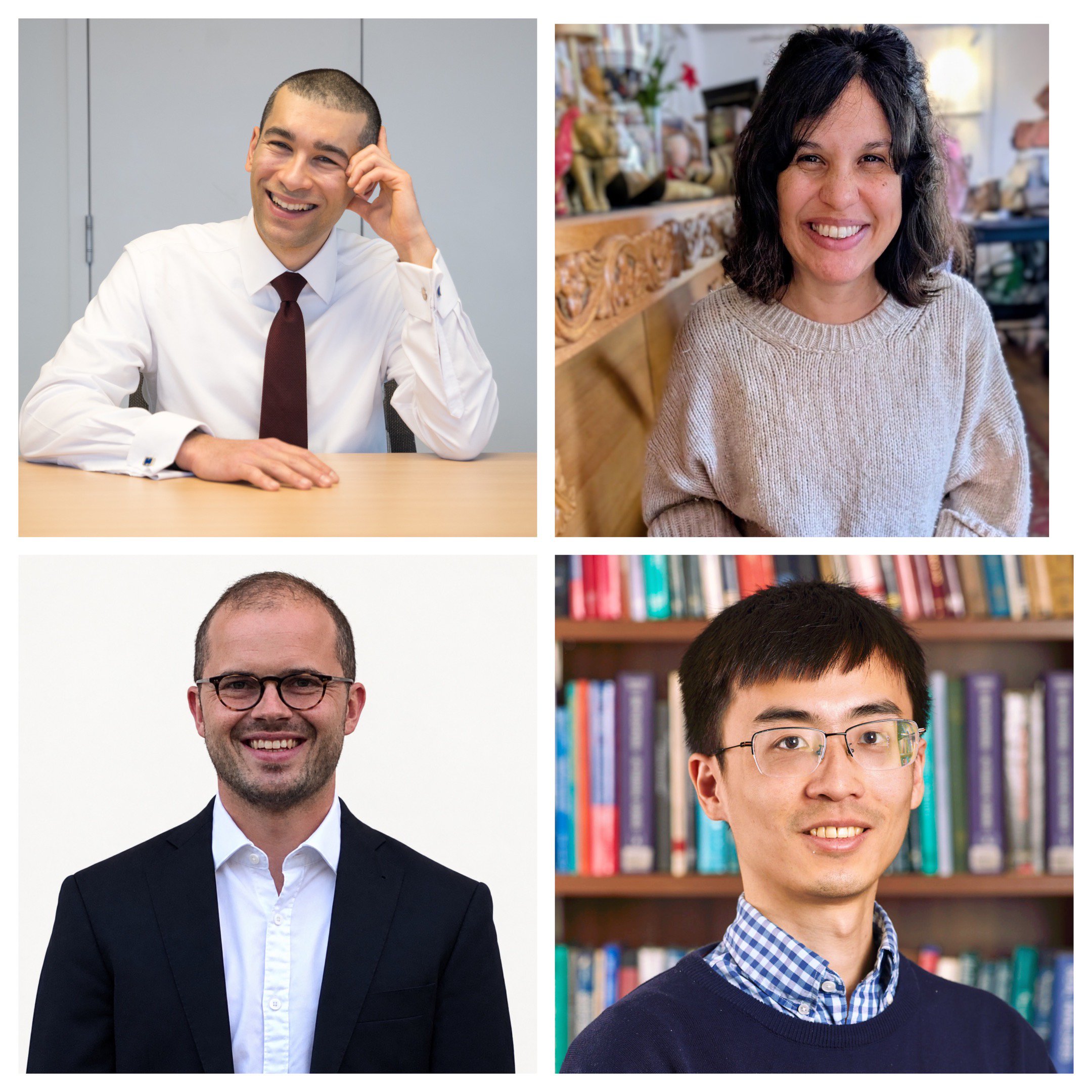
Dr Jake Subryan Richards, Dr Richard Martin, Dr Roxana Willis and Professor Tengyao Wang have been awarded prestigious 2026 prizes by the Leverhulme Trust.
The prizes recognise and celebrate the achievements of outstanding researchers whose work has already attracted international recognition and whose future careers are exceptionally promising.
Each of the prize winners receives £100,000 which can be used to advance their research.
Chosen from over 400 nominations, the Trust offered five prizes in each of the following subject areas: Biological Sciences, History, Law, Mathematics and Statistics, Philosophy and Theology, and Sociology and Social Policy.
Dr Jake Subryan Richards from the Department of International History at LSE and a current Fellow of the Wissenschaftskolleg zu Berlin has been recognised for his work on the history of the African diaspora, legal history, slavery and emancipation, Atlantic history and empires in global history.
Commenting on his award, Dr Richards said: “I am thrilled and honoured to be awarded a Philip Leverhulme Prize. This funding enables me to develop new research on how enslaved and freed people shaped and protected their environments. Their actions offer hope for us all during the ongoing climate crisis. I look forward to continuing my collaboration with LSE colleagues Kasia Paprocki, Austin Zeiderman, Rebecca Elliott, and Tanya Matthan in the Social Life of Climate Change hub, where my ideas have begun to take shape. I am grateful to the village of scholars who have guided me, and to the Leverhulme Trust for the faith that they have placed in me and my research."
Dr Roxana Willis from the LSE Law School was recognised for her work on legal anthropology – bringing ‘outsider’ perspectives to debates in law, including criminal law, environmental law, and human rights.
Commenting on her award, Dr Willis said: “I am enormously grateful to the Leverhulme Trust for its support of working-class education and scholarship, to the colleagues who supported my nomination, and to everyone whose direct and indirect contributions make my research possible. I hope that the work facilitated by this award will deepen our understanding of environmental injustice by placing the perspectives and knowledge of those most affected at the centre of legal debate.”
Dr Richard Martin also from the LSE Law School was recognised for his work on the intersection of criminal justice, human rights, and public law, using doctrinal legal analysis and empirical, interdisciplinary methods.
Commenting, Dr Martin said: “I'm hugely grateful to the Leverhulme Trust. Like many colleagues, I find the most rewarding parts of academic life (teaching, supervision, research and the life of the School) compete for the same hours, and getting the balance right is one of the hardest parts of the job. The Prize gives me the privilege of shifting it towards research for a few years. That research sits where law meets the realities of state power: how rights, rules and institutions shape what police and other criminal justice officials do, and what it takes for legal reform to make a difference in practice.”
Professor Tengyao Wang from the Department of Statistics was recognised for his work on high-dimensional statistics and machine learning: structured signal estimation, robust inference, and change detection amid complex nuisance variation.
Commenting, Professor Wang said: “I’m delighted to receive a Philip Leverhulme Prize and very grateful to the Leverhulme Trust for its support. This award will support my research into developing new statistical methods that can reliably extract signals of interest from complex data, even in the presence of high-dimensional or complex nuisance influences that cannot themselves be consistently estimated. My aim is to develop robust statistical machine learning methods that deliver trustworthy results, even when the underlying modelling assumptions are weak or inaccurate.”
To find out more about the Philip Leverhulme Prize please visit their website.