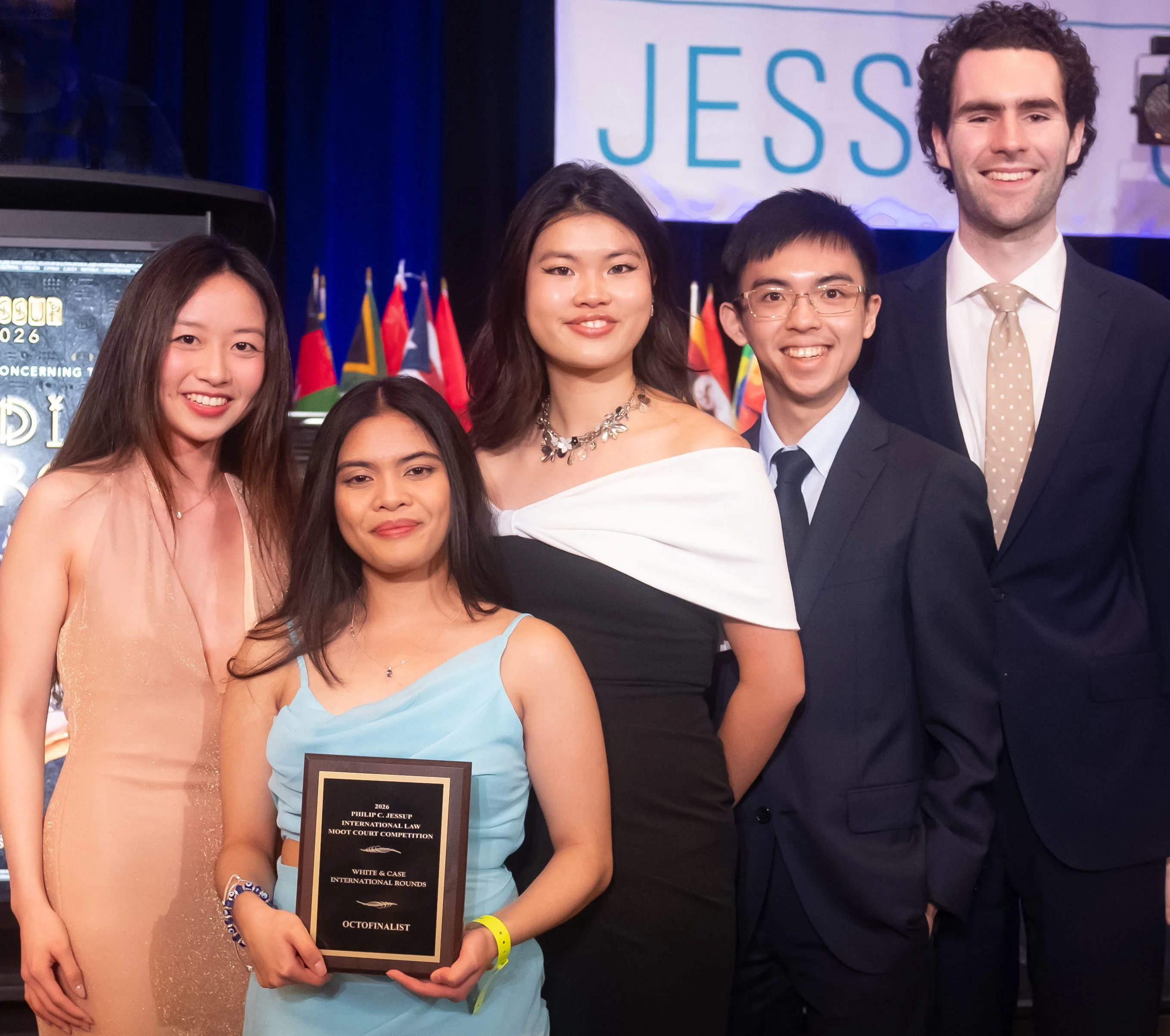

LSE historic success in Jessup international round
Last week, LSE represented the UK at the International Round of the Philip C. Jessup International Law Moot Court Competition, progressing to the octofinals (top 16).
Founded in 1960, the Jessup is the world’s largest mooting competition, simulating a fictional dispute before the International Court of Justice. In its 67th year, 806 teams from 99 countries participated in the competition, with 164 teams qualifying for the International Round in Washington DC.
Having won the UK National Round on 1 March, LSE represented the UK in four Preliminary Rounds against University of Warsaw, Universiti Malaya, Loyola University Chicago, and Bangladesh University of Professionals, advancing to the Run-Off Round against Rajiv Gandhi National University of Law. LSE then progressed to the Round of 32, defeating Max Planck Institute for Comparative Public Law and International Law/Heidelberg University. Ultimately LSE was knocked out in the Octofinal Rounds by University of Sydney. The World Championship Round between National University of Singapore and Ateneo de Manila University was judged by professors James Anaya, Dapo Akande, and Soledad García Muñoz.
LSE’s outstanding 2026 team comprised LLM students Man Rou (Meryl) Lim and Tin Ming (Sky) Ng, LLB students Kelly Hangchi and Leanne Lirio, and BA Anthropology and Law student William Harrison-Cushing. The team was coached by barrister and LSE alumnus Sajid Suleman, LLM student Lucija Ovsenik, and Dr Oliver Hailes. Practice rounds were generously judged by several LSE alumni and invited practitioners.
The team worked together over six months in researching and writing two 10,000-word submissions on four complex issues of public international law, including third-party intervention before the ICJ, the rights of Indigenous peoples, double jeopardy in extradition proceedings, and the jurisdictional immunities of state-owned enterprises. The team then prepared 45-minute oral submissions for each side of the dispute, which were delivered in 14 national and international matches before benches of three judges and challenged by arguments from opposing counsel.
‘Throwing ourselves into the Jessup demanded an incredible amount of time, intellectual and emotional investment,’ the team said, ‘but it was worth more many times over. The relationships built within and beyond our team, and the practical advocacy and research skills developed with the invaluable mentorship of our dedicated coaches, made the whole experience so rewarding, and unlike anything else aspiring lawyers can experience at this stage.
‘Anyone with burgeoning interests in international law, advocacy and most importantly with a genuine curiosity about the way the world works would absolutely benefit from the experience. Of course, the adrenaline from mooting against people from all around the UK and the globe can't be replicated!’
Overall, LSE ranked in the top 16 out of 806 registered teams and won the Rebecca Wallace Trophy as UK national champion for the first time since 2015.
Sky Ng also won a Ved P. Nanda Award for ranking in the top 20 oralists out of 547 speakers in the International Round and was named Best Oralist in the UK Championship Round.
If you are a current or incoming student who is keen to compete or to coach next year, please email o.hailes@lse.ac.uk. The 2027 Jessup problem (to be released in September 2026) will address issues of gender apartheid, mass influx of asylum seekers, sanctions designated by artificial intelligence, and contested government status following a coup d'état.