

Saving the Planet in an Age of Geopolitical Rivalry
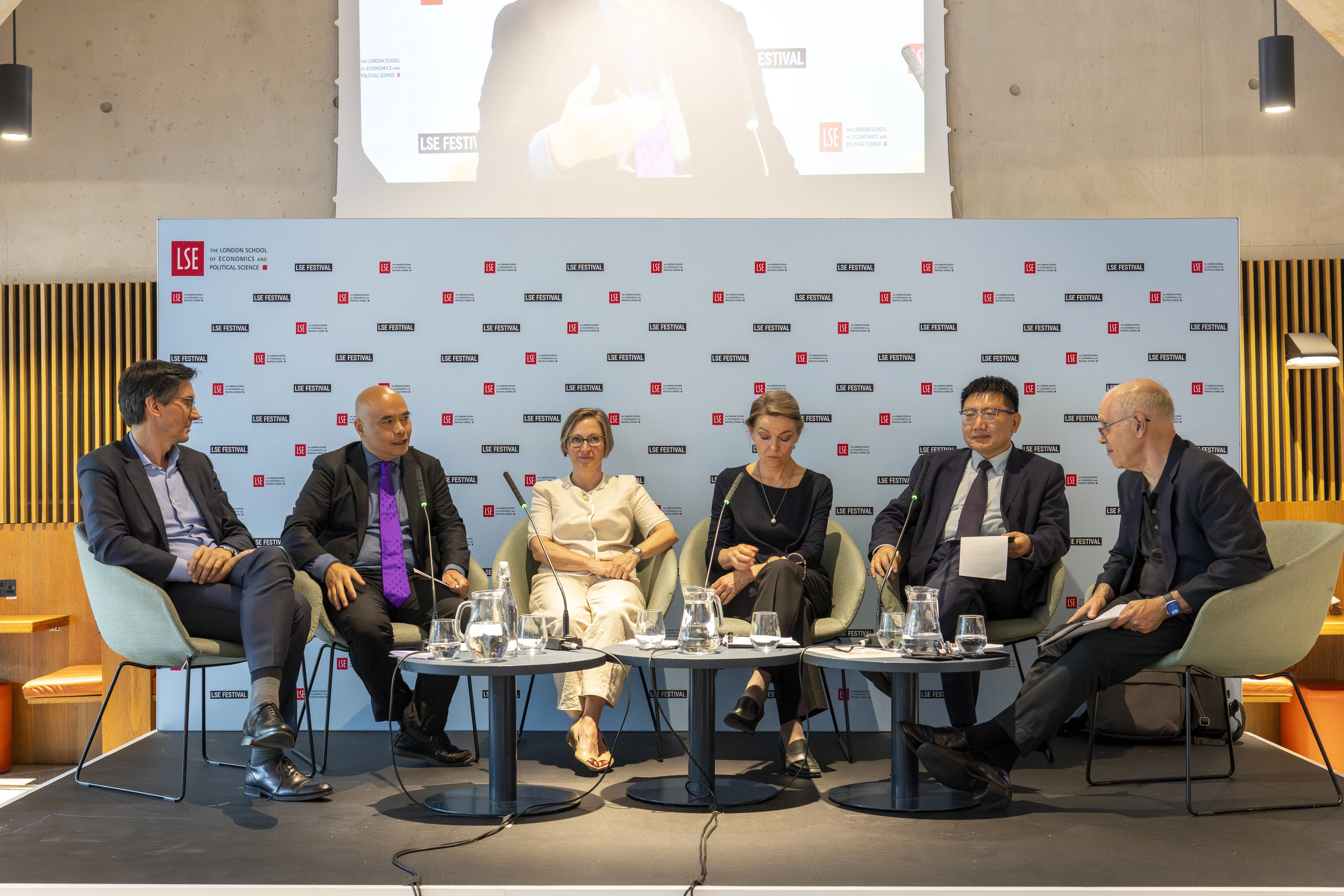
Leading experts from LSE and Tsinghua University are exploring whether the global resurgence of geopolitical competition is eroding the collective capacity of the international community to address environmental, financial and public health crises globally.
One of the 12 awarded projects from the LSE-Tsinghua University inaugural Sustainability Research Fund, Global Sustainability Governance in the Age of International Fracture, responds to the urgent need to better understand how the resurgence of great power politics is affecting sustainability governance.
Led by four experienced scholars, Professor Robert Falkner (LSE), Professor Peter Trubowitz (LSE), Professor Li Bin (Tsinghua) and Professor Sun Xuefeng (Tsinghua), this fourteen-member team is mapping geopolitical challenges and possible policy solutions in three crucial research areas: managing great power rivalry's impact on sustainability; sustaining institutional cooperation in a post-multilateral world; and mitigating potential adverse effects of resource competition on the world’s resource-rich regions.
The project team is truly interdisciplinary, spanning across LSE’s Department of International Relations, Department of International Development, Department of Government, Department of Health Policy, Phelan US Centre; as well as Tsinghua’s Institute for International Relations and Department of International Relations. Consequently, the project also serves as an international research consortium that brings together American, Chinese and European scholars with the goal of catalysing further collaboration and offering effective global sustainability governance practices.
Conversations at the LSE Festival 2026: “How to save the planet”
In June, members of the project team had the opportunity to convene at the LSE Festival 2026. Appropriately themed “How to save the planet,” the festival aimed at interrogating the impact of global challenges affecting the Earth, and how those with political power can tackle them. Their event featured Professor Robert Falkner (LSE Department of International Relations), Professor Tang Xiaoyang (Tsinghua University), Professor Stephanie Rickard (LSE Department of Government), Professor Catherine Boone (LSE Department Government and Department of International Development), Professor Zhao Kejin (Tsinghua University), and Professor Peter Trubowitz (Phelan US Centre Director), who chaired the event.
The panel discussed the global resurgence of geopolitical competition and its implications on the strategies that sustainability leaders can adopt to sustain international cooperation over climate and trade. Each panel member contributed distinct points reflecting the intricacies of their expertise:
- Professor Zhao (Tsinghua) spoke on how the fragmentation of the world order means a shift towards multipolarity as countries focus on strategic competition, such as China’s focus on the resource-rich Global South, and the EU’s pursuit of strategic autonomy.
- Professor Boone (LSE) commented that these changes mean that smaller countries, such as many of those in Africa, are at risk of greater exploitation, and so need to focus on their own development through regional collective action.
- Professor Rickard (LSE) looked at how international trade has also become fragmented, with more countries pursuing bilateral or regional, rather than multilateral agreements. New agreements on trade and climate issues have been hindered by a low trust environment that sees the normalisation of violating existing trade agreements and regulations.
- Professor Tang (Tsinghua) discussed how China has seen its energy transition as a developmental necessity, focusing on action rather than talk.
- In contrast, Professor Falkner (LSE) commented that higher energy prices following Russia’s invasion of Ukraine and the US-Iran war have shown the importance of decarbonisation to address Europe’s dependency on Russian energy.
The panel discussion concluded with comments about how while great powers continue to maintain spheres of influence, the multilateral trading framework cannot be left behind. There should be a shift from a focus on using regional and institutional power to a more pragmatic, multi-stakeholder model of regionalisation, which focuses on collaboration.
Professor Trubowitz (LSE) said that the “LSE Festival provided a unique opportunity for the LSE-Tsinghua project team to share its preliminary findings about how the return of geopolitics is impacting the political possibilities for international cooperation over climate, trade and other pressing global matters.”
Future trajectories of the research
Currently, the project team is in the second phase of research, involving two conference meetings with the full cohort of team members at LSE and Tsinghua. Phase three, the final phase, will commence in May 2027 and culminate in a jointly written LSE-Tsinghua ‘white paper,’ drawing out the policy implications of their research.
The project team also plans to disseminate research findings in a Special Forum of the Chinese Journal of International Politics, which is published by Oxford University Press, as well as other scholarly journalists and magazines.
As the inaugural projects continue their research, Global Sustainability Governance in the Age of International Fracture represents the momentum found in working collaboratively with Tsinghua University to deliver tangible impact on the world’s most pressing sustainability challenges.
Want to stay up to date with LSE’s International Strategy and Academic Partnerships team? Be the first to know about international projects by subscribing to our newsletter.
Photo Credit: Noah Da Costa/LSE