

Gender Justice and the Wellbeing Economy
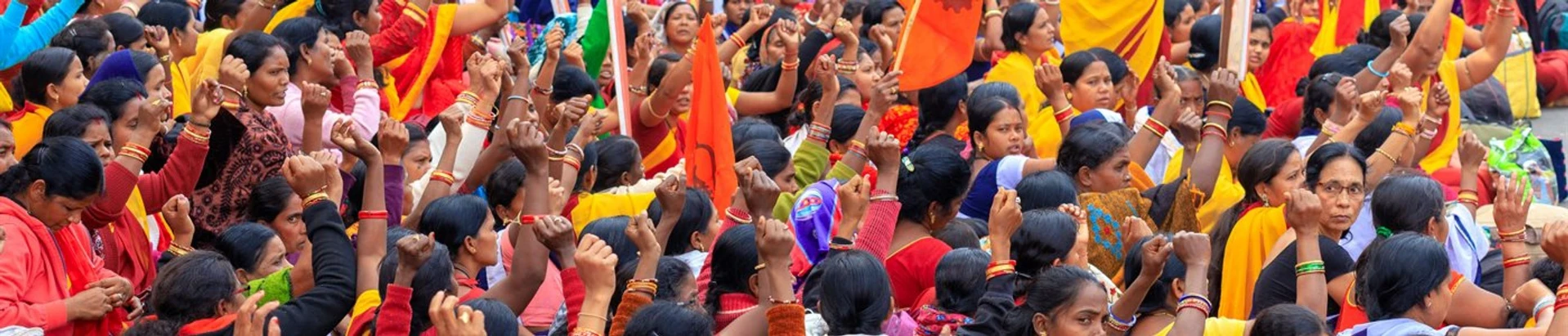
Situating Gender Justice and the Wellbeing Economy within movements for a paradigm shift from a growth-driven economic system to an economy of wellbeing prioritizing care of the people and care of the planet.
The Programme is led by Professor Naila Kabeer (Director) and Dr Ania Plomien (Deputy Director).
The Gender Justice and the Wellbeing Economy programme positions itself among the growing voices and movements across the world calling for a paradigm shift from the current growth-driven economic system to an economy of wellbeing, one that prioritizes care of the people and care of the planet. What distinguishes our work is the emphasis on gender justice as central to the processes by which this must be achieved. We share the concerns with the ever-rising levels of inequality and the looming climate catastrophe that underpin these movements, but we draw and expand on research that demonstrates how the underlying causes of ‘ill-being’ are bound up with processes that have bolstered and exacerbated long-standing gender injustices. Our main contribution to the wider voices and movements consists of evidence-based analysis advocacy and activism that makes the case for gender justice as foundational to creating a new wellbeing economy.
Highlights
- Two new working papers in the Gender Justice & Wellbeing Economy sub-series
Available to read now: 'The political ethics of care and social reproduction feminism' by Sara R. Farris and 'Beyond scarcity? why abundance matters in a turbulent & unequal world' by Lyla Mehta and Thomas Røkås
The inter-related nature of the injustices associated with rising economic inequality and looming climate catastrophe has come to the forefront of public consciousness: those at the bottom of the distribution of income and wealth have contributed least to climate change but are likely to suffer most. The relationship between the causes and consequences of these phenomena underpins arguments for a transition from a growth-driven economic paradigm to one that prioritizes wellbeing. Far less attention, however, is paid to gender injustice, to the persistent devaluation of activities associated with the care economy, and the implications of this and other gendered harms for the transition to a wellbeing economy. Our research programme aims to correct this blind spot by generating evidence-based arguments and advocacy within policy and activist pathways so as to ensure that gender justice is given prominence in the deliberations about the transition to a wellbeing economy.
The programme brings together an interdisciplinary core team and a wider network of scholars and activists in order to articulate the role of gender justice in the wellbeing economy through a focus on three thematic areas: an analysis of the problem, the conceptualization of alternatives, and the construction of an agenda for change.
The drivers of ill-being in the world today. This theme takes the work of Karl Polanyi on the destructive impact of deregulated markets and fictitious commodities as its starting point. It examines how this work has been built on and reformulated to make it fit-for-purpose in analysing the ill-effects of the current neo-liberal agenda of privatization, liberalization and financialization. It deals with the negative effects of this agenda on distributional issues, on natural resources and ecological services and on the key dimensions that are at the heart of human wellbeing across the world: food, water, shelter, health, education and the care provided and received within the home and outside it. The theme explores, in particular, the nature of the inter-relationships between gender injustice and these various impacts: how gender injustices can magnify these impacts but can also be exacerbated by them - bearing in mind all the time that gender itself is differentiated by class, location and social identity.
Conceptualizing the wellbeing economy. Along with concerns about growing manifestations of ill-being, there is now widespread recognition by both the policy establishment as well researchers and activists that GDP is not only an inadequate measure of national progress but its limitations have contributed to the problems we seek to address. Differing ways of conceptualizing alternatives have been suggested in its place, many discussed under the rubric of the wellbeing economy. This second theme assesses them for the notions of wellbeing they incorporate and the attention they pay to notions of gender justice. It also explores the extent to which they capture findings on wellbeing reported by smaller scale, empirical studies in different parts of the world. While the physical dimensions of basic necessities that are crucial for wellbeing may be reasonably similar across the world, what do these studies tell us about values and meanings attached in different societies to intangible dimensions such as justice, fairness and an ethic of care in different societies? Are these values and meanings similar within these societies or are there differences by class, gender and other axes of inequality? We need to understand potential differences more clearly if movements for change are to cross cultural boundaries and build alliances across the world.
Pathways to the wellbeing economy. The third theme focuses on the work of scholars, policy makers and activists who have been arguing for the transition from a growth-driven economic system to an economy that prioritizes human and environmental wellbeing. Certain policy debates recur in this literature, but they do not necessarily engage with the goal of gender justice. Drawing on the work of Karl Polanyi and Nancy Fraser, we see the regulation of market forces to serve the needs of the planet and people, the de-commodification of goods and services that are necessary for human wellbeing and the eradication of gender and other forms of social injustice as constituting the core of a just transition. The policy literature includes promising approaches for such an agenda:
- The case for the public provision of public goods, particularly those essential to human wellbeing
- Securing dignified livelihoods: rights, resources and social protection
- Financing the wellbeing economy: contributions and claims
- Democratizing the transition: accountable states and active citizens
The biggest challenge to achieving the kind of transition that can encompass wellbeing, justice and sustainability can be summarized in what has become a widely cited aphorism ‘It is easier to imagine the end of the world than to imagine the end of capitalism’. The crucial insight it offers is that the challenge we face can be traced to a failure of imagination on the part of the people who matter – not only those in power who have started to question the market-driven growth paradigm, but the wider society whose willingness and capacity can power the transition to a cleaner and fairer economy. Under this theme, we will draw on a broad range of efforts to bring about a transformation in the capacity to imagine that a different future is possible, to go beyond academic and policy discourse to the visions and imperatives outlined by those with the greatest stake in an alternative future and to the various ways in which they urge us to imagine this future. As Arundhati Roy wrote in relation to the last pandemic, crises have often represented moments in history when human beings are faced with the possibility of breaking with the past and imagining their world anew. We are now in an era of multiple and overlapping crises that threaten human existence as we have known it. We can choose a future that reproduces the injustices of the past but with far more destructive consequences or we can discard that historical baggage and, as she puts it, walk through lightly, ‘ready to imagine another world. And ready to fight for it’.
- Co-creating games for wellbeing and justice in two Colombian cities
This project engages with community organisations, social leaders and schoolteachers through close co-creation workshops, and with families and urban policymakers through city and neighbourhood events to foreground bottom-up conceptions of wellbeing grounded in visions of justice.
This project addresses a critical constraint on women's economic participation in low-income urban Bangladesh: the near absence of affordable, trustworthy childcare outside the family.
LSE team
- Professor Naila Kabeer, Department of International Development and LSE III
- Dr Ania Plomien, Department of Gender Studies and LSE III
- Dr Kate Steward, LSE III
- Professor Radhika Balakrishnan, Rutgers University and LSE III
- Professor Tim Forsythe, Department of International Development, LSE
- Dr Sophie Legros, Department of Methodology, LSE
- Dr Kasia Paprocki, Department of Geography and Environment, LSE.
- Professor Diane Perrons, Department of Gender Studies, LSE
- Zainab Salbi, LSE III
External members
- Dr Sajeda Amin, Poverty, Gender, and Youth Program at the Population Council, Bangladesh
- Dr Magdalena Sepúlveda Carmona, Global Initiative for Economic, Social and Cultural Rights, Geneva
- Dr Sarah Cook, Department of Economics, University of Nottingham, Ningbo, China
- Professor Deepta Chopra, Institute of Development Studies, Sussex
- Professor Diane Elson, University of Essex
- Dr Sara Farris, Goldsmiths University, UK
- Haris Gazdar, Social Science Research Collective, Pakistan
- Professor Jasmine Gideon, School of Social Sciences, Birkbeck University of London
- Professor Jayati Ghosh, University of Mass, Amherst
- Professor James Heintz, University of Mass, Amherst
- Dr Ayesha Khan, Overseas Development Institute London
- Rachel Noble, OXFAM GB
- Dr Luiza Nassif Pires, State University of Campinas and Research Centre on Macroeconomics of Inequalities, Sao Paolo
- Dr Shahra Razavi, Social Protection Department, ILO
- Dr Munshi Sulaiman, BRAC Institute of Governance and Development, Bangladesh
- Professor Dzodzi Tsikata, SOAS University of London
- Professor Imraan Valodia, University of Witwatersrand, South Africa
Past events
Reimagining Development: Power, Agency, and Futures in an Uncertain World
8 - 10 July 2026
The programme’s work was represented at the Development Studies Association conference in Ireland, where Naila Kabeer presented the JID-sponsored keynote 'Reimagining pathways to gender justice in an era of uncertainty'. The conference convenors published a blog on the plenaries.
Tools that Trap Us: How our theories and methods limit our political imagination
5 June 2026
This event, co-organised with Future Narratives Lab, convened 45 experts and leaders from across civil society, academic and philanthropy for a one-day workshop. The workshop explored how some of the most common methodologies and conceptual tools used in efforts at social and political change can have serious limitations that risk reinforcing rather than challenging power, and explored responses and alternatives.
Methodologies and Epistemologies of Social Reproduction workshop
May 2026
Dr Ania Plomien, together with co-convenors of the BSA Care and Social Reproduction Group, organised a workshop bringing together established and early career scholars to discuss twelve papers spanning diverse contexts, including Armenia, Colombia, Germany, Greece, India, Lebanon, Pakistan, Spain, South Africa and the UK. Following the workshop, the team submitted a Special Issue proposal to an academic journal. The workshop was funded by The Sociological Review Foundation.
SuPWR dissemination event
March 2026
Professor Deepta Chopra organised the closing workshop of Sustaining Power: Women’s struggles against contemporary backlash in South Asia (SuPWR), a six-year ESRC-funded project involving collaboration with BIGD, one of the programme’s network partners. The project brought together activists from 16 women’s movements in Bangladesh, India, Nepal and Pakistan working against backlash and towards women’s rights and wellbeing.
Women, nature, and 2030: a transformational global climate solution
20 January 2026
Speaker: Zainab Salbi
Climate change is not gender-neutral — not in its impact on women and girls, nor in the solutions women are leading. This lecture shares new research revealing how women’s leadership is providing new pathways to address the climate crisis through new behaviours, economic models and long-term community transformations.
Drivers of ill being: crafting feminist pathways to the well-being economy
Workshop organised by the Gender Justice and the Wellbeing Economy Research Programme
1 - 2 May 2025
This two-day event for the Gender Justice & Wellbeing Economy project brought together network members, academics and researchers to foster collaboration, develop project themes, agree next steps and raise awareness of the project and its research agenda.
Gender, wealth, and wellbeing: promising pathways to a just transition
24 January 2025
Speakers: Professor Naila Kabeer, Dr Grace Mbungu
This workshop brought together academics, policymakers and civil society practitioners to explore the gender dimensions of rising inequality and accelerating climate change within a unified framework. The workshop report outlines the key findings from these discussions.
Investing in women to advance gender equality in an era of polycrises
Webinar for International Women’s Day with UNU-International Institute for Global Health
6 March 2024
Speakers: Dr Stellah Bosire, Rajat Khosla, Professor Adeeba Kamarulzaman, Professor Naila Kabeer
Gender, Policy and Human Rights: Rethinking ‘Progress'
Public event co-hosted with Department of International Development and Department of Gender Studies
5 March 2024
Speakers: Professor Radhika Balakrishnan
This public event explored the relationship between gender, policy and human rights, examining how conventional ideas of progress can be rethought through a feminist lens.
Working papers
- Mehta, L. & Røkås, T. (2026). Beyond scarcity? why abundance matters in a turbulent & unequal world. (III Working Papers 177). International Inequalities Institute, London School of Economics and Political Science.
- Farris, S. R. (2026). The political ethics of care and social reproduction feminism. (III Working Papers 176). International Inequalities Institute, London School of Economics and Political Science.
- Kabeer, N. & Plomien, A. (2026). Gender justice and the wellbeing economy: the feminist case for an alternative economic paradigm. (III Working Paper Series 169). International Inequalities Institute, London School of Economics and Political Science.
Recent publications
- Drivers of ill-being: crafting feminist pathways to the well-being economy. Gender Justice & Well-being Economy: Workshop Report. London School of Economics and Political Science, London 1-2 May 2025
Journal articles
- Chopra, Deepta and Sekhar, Resham (2025) ‘Invisible Work, Visible Malnutrition: A Feminist interpretation of ‘care’ to tackle nutritional inequalities through social protection’. Economic and Political Weekly
- Kabeer, Naila (2025) ‘A foundational asymmetry: gender, unpaid care and the labour market’ Oxford Review of Economic Policy Special Issue on The economics of care
- Elson, Diane and Jeff Powell (2025) ‘Engendering monetary policy’ Feminist Economics
Book chapters
- Cook, Sarah, Shahra Razavi, Silke Staab and Naila Kabeer (2026) ‘Gender and social policy in the Global South’ in A.Barrientos, M. Carnes, H. Kwon, H. Obinger, L. Patel and C. Schmidt (eds) Oxford Handbook of Social Policies in the Global South Oxford (OUP)
- Plomien, Ania and Schwartz, Gregory (2025) ‘The crisis of social reproduction provisioning: gender, class and migration in Poland and Ukraine’ in Jill Rubery, Valeria Insarauto, and Núria Sánchez-Mira (eds) Women in turbulent times. Crises, transitions, and challenges for gender equality. Routledge.
Blogs
- Kabeer, N. & Plomien, A. (2024) Placing gender justice at the heart of the wellbeing economy. LSE Inequalities Blog.
- Kabeer, N. (2025) Women are seen as ‘saviours’ or ‘victims’ in climate change debates: why this is a problem. The Conversation.
Media articles
- Kabeer, N. (2026). Gender, agency and the quality of growth: Lessons from the Bangladesh paradox.The Daily Star.
Videos
- Focus on the Global South (2024) Geopolitics and Globalization: A Feminist Reading and Critique from Southeast Asia. YouTube.
Professor Radhika Balakrishnan of Rutgers University speaks about the limitations and problems of a growth-oriented way of organizing the economy and society.
Beyond GDP
Professor Kabeer has contributed to several high-level policy discussions on measuring progress beyond GDP. She was a member of the UN High Level Expert Group on Beyond GDP, which submitted its report, Counting What Counts: A Compass for Progress for People and Planet, to the Secretary-General in May 2026. She participated in the launch of the report at a meeting of UN member states and has since discussed its findings in wider international forums, including a panel at the April 2026 conference Eradicating Poverty Beyond Growth: A Global Roadmap for a New Economy. In June 2026, she also gave the opening address at an expert group discussion organised by the Friedrich-Ebert-Stiftung in Berlin on alternative prosperity indicators for sustainability policy beyond GDP and beyond 2030.
Professor Kabeer also presented a policy brief commissioned by UN Women, titled Feminist pathways to the wellbeing economy: reflections on SDG8, at the CSW71 Expert Group Meeting from 30 June to 2 July 2026. The meeting focused on the priority theme of accelerating the 2030 Agenda ahead of the next session of the Commission on the Status of Women.
Public roles and forums
- The programme’s network has also been represented in emerging global initiatives on inequality. Professors Imraan Valodia and Jayati Ghosh are members of the Founding Committee for the International Panel on Inequalities. Professor Kabeer attended the meeting at the University of the Witwatersrand in Johannesburg convened to draft the Panel’s mandate, alongside other III members including Francisco Ferreira, Mike Savage and Max Lawson.
- Professor Dzodzi Tsikata continued to contribute to international debates on social development and sustainable finance. She attended the Second World Summit for Social Development in Doha in November 2025 and later published reflections on the summit’s approach to social development. She also served on the UN-DESA Commission of Experts that produced the report Financing a Sustainable Future: Proposals for a Renewed Global Development Finance Agenda.
- Professor Sarah Cook is a member of the Independent Group of Scientists working on the Global Sustainable Development Report 2027 to be published by the United Nations Department of Social and Economic Affairs. She is also co-chair of the working group on integrating social and economic dimensions within the green transition as part of the High-Level Task Force on China’s Environment and Development Outlook.