

Book Launch - Reimagining Development: Bold Directions Towards a Thriving World




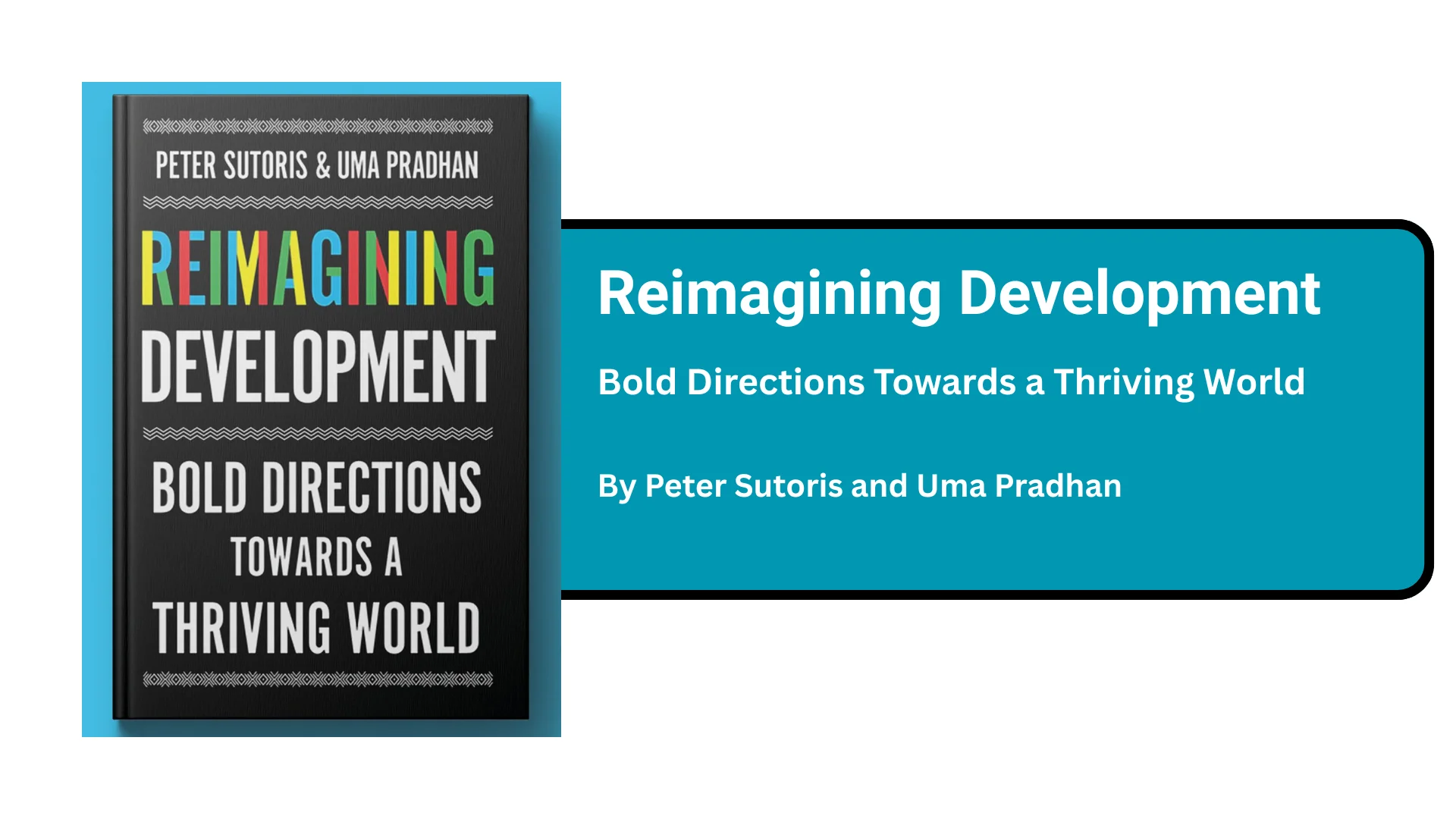
Join the Department of International Development for the launch of Peter Sutoris & Uma Pradhan's book Reimagining Development: Bold Directions Towards a Thriving World.
About the Book
Imagining a better future is at the heart of development. But mainstream development models are driven by a very narrow, Western-centric set of ideas about what it means to be human. What could be possible if we let ourselves imagine differently? As our world continues to evolve at breakneck speed and faces unprecedented crises—from the decaying environment to cascading inequality—the need for bold new directions for development has never been greater. Peter Sutoris and Uma Pradhan put a spotlight on the thought-provoking visions of leading theorists, activists and practitioners for rethinking development as a political project towards more equitable futures. Questioning top-down economic frameworks, they explore transformative ideas—from degrowth to indigenous knowledge—that may enable us to address the complexities of our rapidly changing global landscape. They consider how the world can chart a path towards reconciling the moral case for eradicating poverty with these critical perspectives to advance a more ethical approach, one that is sensitive to history, diversity, and the challenges and opportunities of this moment. If development is to remain relevant today, it must reinvent itself—and finally listen to voices on the ground.
Reviews
‘A refreshing new take on development that moves beyond conventional debates to instead build intellectual bridges that conjure up a new imaginary of a thriving world.’ — Nayanika Mathur, Professor of Anthropology and South Asian Studies, University of Oxford, and author of Paper Tiger: Law, Bureaucracy and the Developmental State in Himalayan India
‘A timely contribution to the ongoing debates over redefining “development”. In an intriguing way, it bridges the gap between longstanding critiques and more recent ideas such as degrowth. An excellent book.’ — Tiina Kontinen, Professor in International Development Studies, University of Jyväskylä
‘This well-argued and very readable book critiques the worst of Development practices with a quiet fury. But it also explores possibilities for fruitful development, combining case studies of yesterday and today with imagined futures, all within a deep moral framework.’ — Michael J. Reiss, Professor of Science Education, University College London
‘In an era when the future looms as a spectre of suffering, Reimagining Development offers a powerful theoretical and practical case for the centrality of imagination—collective, individual and relational—for redefining development itself as a bridge toward thriving.’ — Anne Rademacher, Professor of Environmental Studies, New York University, and co-editor of Death and Life of Nature in Asian Cities
‘This foundational book tackles the enduring question of what to do with development as an extraverted technology of stagnation—especially for communities outside of the dominant orthodoxies of advancement often trapped in its logic, offering readers other imaginaries of thriving.’ — Divine Fuh, Director of the Institute for Humanities Africa, University of Cape Town
About the speaker
Peter Sutoris is an environmental anthropologist and Associate Professor in Climate and Development at the Sustainability Research Institute, University of Leeds. His research focuses on imagination of the future, environmental social movements and activist pedagogies for change. He is author of Visions of Development (OUP, 2016), Educating for the Anthropocene (MIT Press, 2022) and Reimagining Development (2025; with Uma Pradhan) as well as Coordinating Editor of Degrowth Journal and Editor of Compare.
Uma Pradhan is an Associate Professor in Education and International Development at University College London. Her research focuses on the intersections of education, indigenous language, and development. She is the author of Sf Simultaneous Identities: Language, Education, and the Nepali Nation (2020, Cambridge University Press) and co-editor of Anthropological Perspectives on Education in Nepal (2023, Oxford University Press) and Language Education, Politics, and Technology in South Asia (2025, Routledge).
About the chair
David Lewis is Professor of Anthropology and Development in the Department of International Development. David's research interests lie at the interface between development studies and anthropology, and most of his work has been concerned with understanding people's encounters with development actors and development processes.
About the Discussant
Dr Tine Hanrieder is an Associate Professor in the LSE Department of International Development. Tine is a political scientist doing research on global health, labour, and migration. She is the author of a monograph on the history of the WHO International Organization in Time and of articles spanning the areas of global governance, the sociology of knowledge, and political economy. She currently conducts research on the intersection of health and labour struggles and on post-neoliberal health reform attempts.
Any questions?
You can contact us at intdev.comms@lse.ac.uk
From time to time there are changes to event details so we strongly recommend that if you plan to attend this event you check back on this listing on the day of the event.
Whilst we are hosting this listing, LSE Events does not take responsibility for the running and administration of this event. While we take responsible measures to ensure that accurate information is given here this event is ultimately the responsibility of the organisation presenting the event.
LSE holds a wide range of events, covering many of the most controversial issues of the day, and speakers at our events may express views that cause offence. The views expressed by speakers at LSE events do not reflect the position or views of the London School of Economics and Political Science.