

Alumni Spotlight: Claire Chaumont
Claire Chaumont, DrPH, is a global public health leader, strategist and educator who bridges the critical gap between vision and real-world impact.
A political scientist and Fulbright Scholar trained at Harvard, Sciences Po and the London School of Economics, she has brought deep expertise in health systems and global governance together to advise governments, NGOs and multilateral organizations across more than 20 countries. Today, as special advisor to the UCLA Chancellor and a faculty member in Health Policy and Management, she draws on her tenure at the World Health Organization to drive the university’s strategic plan from conception to implementation and teach the next generation of public health leaders. She is the co-author of Understanding Public Health alongside Dr Julio Frenk and Dr Suerie Moon.
Claire talks to us about her time at LSE studying on the HPPF programme, her career journey since graduating, career advice for current students and what led her to co-write the latest textbook
Public Health: Clear Thinking for Effective Action
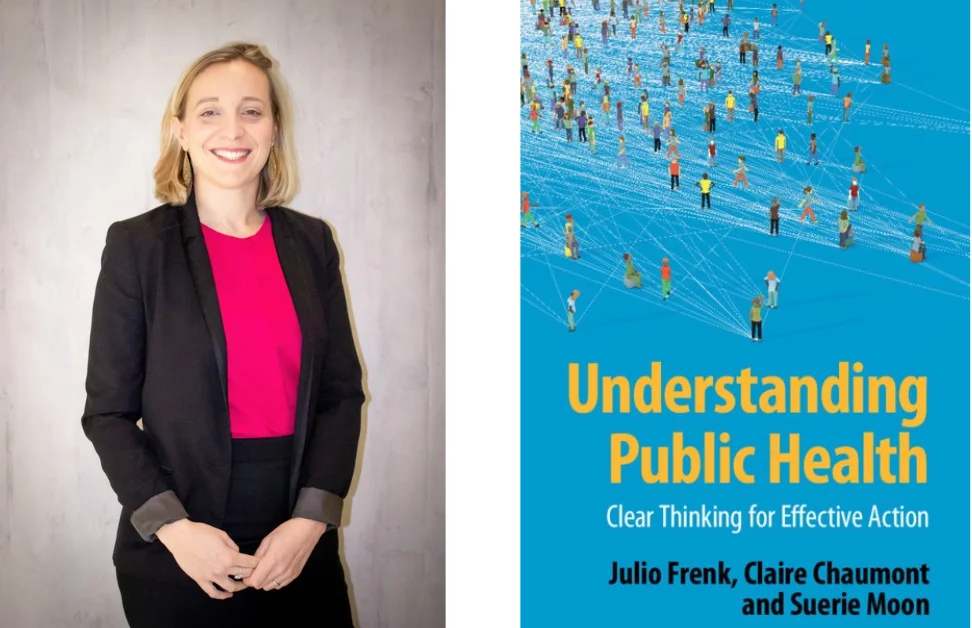
Claire Chaumont, MSc in Health Policy, Planning and Financing, 2011
We need people who remain invested, curious, and passionate about improving health systems and protecting the progress that has been made over the past century
Looking back to your time on the MSc in Health Policy, Planning and Financing, what originally drew you to the programme, and what impact did it have on your career?
I was initially drawn to the HPPF programme for two main reasons.
First, it offered the opportunity to build a strong technical foundation in health policy and health financing while also gaining exposure to a broader range of public health topics. I really appreciated this combination of deep technical expertise and a broader understanding of the many factors that shape public health.
Second, I was excited by the opportunity to study across two very different institutions: LSE and LSHTM. Each institution has its own culture, legacy, and approach to public health, and being part of both communities was a unique and enriching experience.
The programme had a profound impact on my career. Fundamentally, it gave me a strong understanding of the key principles of public health that I continue to draw on today. One of my favourite courses was an introduction to health financing taught by Sarah Thomson and Elias Mossialos, and many of the concepts I learned there still shape the way I think about health systems and policy.
Since graduating in 2011, you've worked across global health organisations, including WHO. What have been some of the most defining moments in your career journey?
There have been several defining moments in my career.
One was joining the Harvard DrPH programme in 2015, which had a strong focus on leadership. That experience helped me realize that while I deeply enjoyed health financing, my path was not necessarily to become a technical expert in one specific area. Instead, I discovered that my strengths and interests were in developing strategic direction, building coalitions, and thinking about how to translate ideas into action. Working with people and helping organisations move forward gives me a great deal of energy.
Another defining moment was helping establish the Delivery for Impact Department at WHO, a new team focused on achieving greater health impact at the country level. It was exhilarating to contribute to such an important institution, and because of the transversal nature of our work, I gained a 360-degree view of the organisation and how different parts of global health come together.
And now, joining UCLA represents another exciting chapter. I have the opportunity to support the execution of the strategy of a leading public university at a moment when universities have never been more essential to advancing science, knowledge, and society.
Drawing on your experience across global health, what prompted you to write Understanding Public Health, and what were you hoping students and educators would gain from it?
Understanding Public Health was co-written with two distinguished co-authors: Dr. Julio Frenk, now Chancellor at UCLA, and Dr. Suerie Moon, Professor of Global Health Practice and Co-Director of the Global Health Centre at the Geneva Graduate Institute.
The book grew out of a course at Harvard for DrPH students. I was initially a student in that course and later became the lead instructor. Over more than a decade, we had the opportunity to test this material with hundreds of students and saw how valuable it was to provide them with a coherent framework for understanding and connecting the many different ideas, disciplines, and perspectives that shape public health.
Our hope was to create a resource that would help students and educators develop a shared foundation for thinking about public health challenges and the systems needed to address them.
What career advice would you give to current and recent graduates of the Health Policy, Planning and Financing programme?
Public health and global health can feel challenging at the moment, but I believe this is precisely the time to lean in.
We need people who remain invested, curious, and passionate about improving health systems and protecting the progress that has been made over the past century. At the same time, we face major emerging challenges—from climate change to growing health inequalities—and the next generation of public health leaders will play a critical role in addressing them.
My advice would be to stay engaged, remain open to different opportunities, and recognise that public health needs many different kinds of expertise, perspectives, and leadership.
You have described HPPF as an important part of your development. What does it mean to reconnect with the LSE Health Policy community at this stage in your career?
When I joined LSE, I often wondered how I could build a career in international health policy. My professors, as well as my friends and peers in the programme, showed me that it was possible.
Coming back to reconnect with the LSE Health Policy community at this stage of my career feels very meaningful. I am now at a point where I want to play that same role for younger generations: to help students and early-career professionals see the possibilities ahead, build confidence in their own paths, and recognise the impact they can have in public health.
Interested in finding out more?
Public health has never been more critical. Understanding Public Health: Clear Thinking for Effective Action cuts through the noise to deliver a concise yet comprehensive guide to the foundational concepts and frameworks shaping the field today. This essential textbook equips future leaders with the tools to tackle complex crises. Abstract theories are transformed into actionable insights by examining real-world challenges, including COVID-19, climate change, obesity, and HIV/AIDS.
Take a look at Understanding Public Health: Clear Thinking for Effective Action