

GSoS Student Blog: Reflections on the GSoS Forum 2026
GSoS Student Blog: Reflections on the GSoS Forum 2026
By Jiangyi Guo, GSoS Scholarship Student
Attending the Global School of Sustainability (GSoS) Forum as a GSoS Scholarship Student was an inspiring opportunity to engage with leading academics, policymakers, industry experts, and fellow researchers working across climate change, sustainable development, finance, and governance. Throughout the event, one message resonated across every session: sustainability is no longer simply an environmental concern—it has become a central challenge for economic growth, financial systems, public policy, and society itself.
The GSoS Forum 2026 brought together discussions spanning sustainable growth, climate finance, biodiversity, behavioural science, governance, and interdisciplinary research. While each panel approached sustainability from a different perspective, they collectively asked one overarching question: how can we accelerate the transition towards a sustainable future while ensuring economic prosperity, social inclusion, and environmental resilience?

Sustainable Growth: moving beyond technological innovation
The opening panel focused on sustainable growth and challenged the common perception that technological innovation alone will solve the climate crisis. Instead, speakers argued that the real challenge lies in technology diffusion—understanding why proven clean technologies fail to spread rapidly despite becoming increasingly affordable.
Professor Robin Burgess introduced this perspective by highlighting China's role in dramatically reducing global solar panel costs through industrial policy. While these policies benefited countries worldwide, many regions with abundant solar resources still lag behind in renewable energy deployment. This demonstrates that today's barriers are increasingly institutional rather than technological, including financing constraints, regulatory systems, infrastructure, and political economy.
Professor Anna Valero expanded this discussion by examining how green industrial policy can simultaneously promote economic growth and climate objectives in the UK. Rather than viewing sustainability as separate from growth, she argued that long-term prosperity depends on successfully integrating climate action into industrial strategy. Beyond supporting strategic sectors such as offshore wind, carbon capture, and sustainable finance, she emphasised that green policies must deliver visible benefits—including employment opportunities, cleaner air, and regional development—to maintain long-term public support for the net-zero transition.
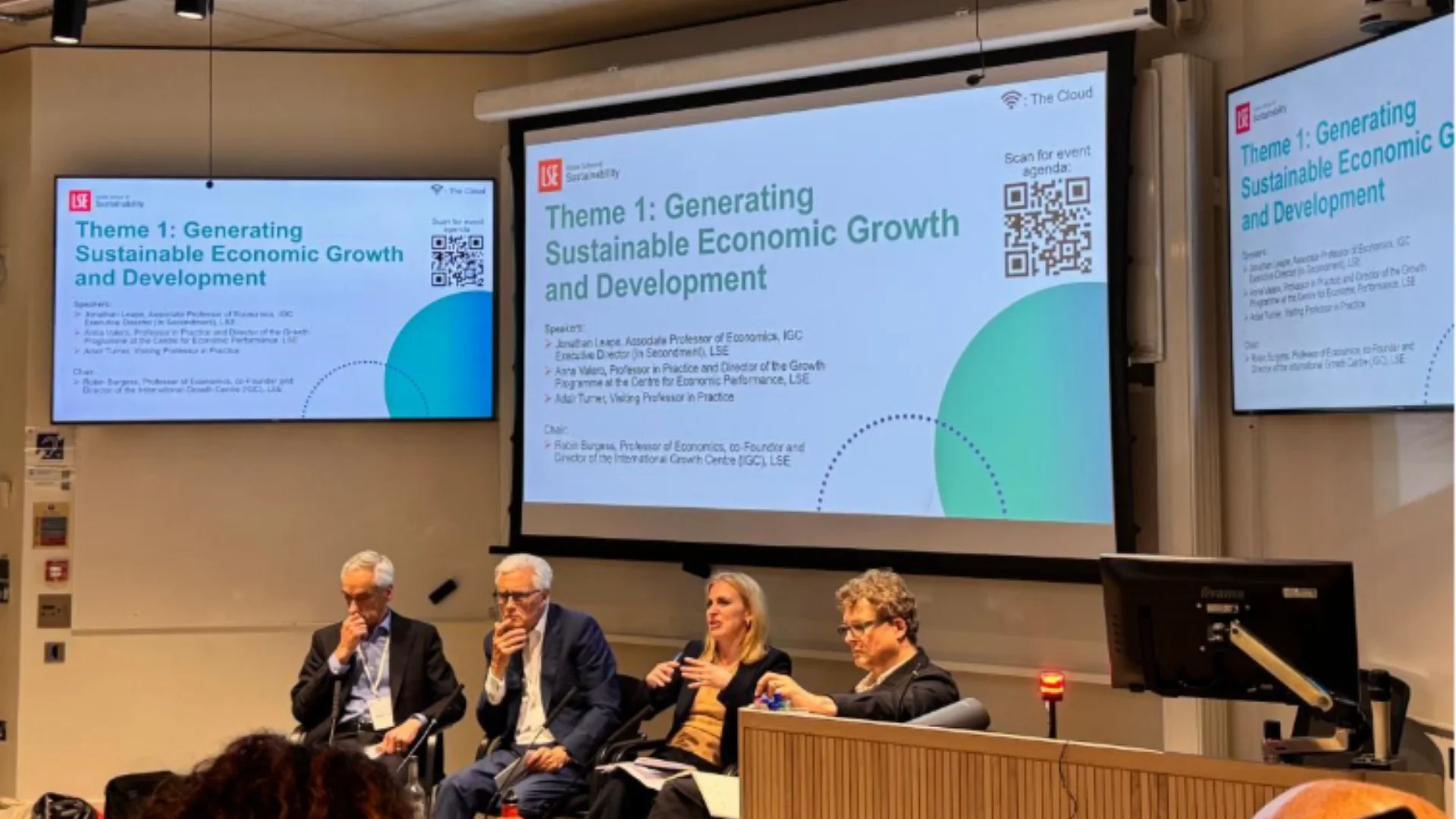
The discussion then shifted towards developing economies, where Jonathan Pershing, Professor in Practice and Dean of the Global School of Sustainability, explored the unique challenges facing Sub-Saharan Africa and South Asia. Falling solar costs alone have not translated into widespread adoption because weak electricity distribution systems, financially constrained utilities, and governance challenges continue to hinder investment. His examples from Pakistan and South Africa illustrated that successful energy transitions require not only affordable technologies but also resilient institutions and functioning electricity markets.
Lord Adair Turner concluded the session with a broader historical perspective, arguing that humanity now possesses the technological foundations for a new era of clean electrification. Dramatic cost reductions in solar power, batteries, and electric technologies have fundamentally changed what is economically feasible. Yet the pace of deployment remains constrained by high financing costs, outdated regulatory assumptions, and institutional inertia rather than technological limitations.
The panel discussion reinforced that achieving sustainable growth requires more than technological breakthroughs. Effective industrial policy, international cooperation, financial reform, and institutional innovation are equally essential for accelerating the transition.
Finance: turning viable technologies into investable projects
If the first panel addressed how sustainable technologies emerge, the second focused on how financial systems can help deploy them at scale.
A recurring message was that many climate projects are already economically viable but remain not yet bankable, particularly in emerging markets. High perceived risks, limited project data, inconsistent investment standards, and fragmented financial structures continue to discourage institutional investment.
Speakers introduced new initiatives aimed at improving blended finance by bringing together researchers, investors, policymakers, development banks, and credit rating agencies. Better transparency, stronger evidence on project performance, and more standardised investment structures could reduce financing costs and unlock substantially larger private capital flows.
One particularly interesting discussion centred on the distinction between values and value. While institutional investors increasingly recognise the importance of climate resilience, biodiversity, and inclusive growth, investment decisions ultimately depend on financial performance. Several speakers therefore argued that future research must provide stronger empirical evidence demonstrating how sustainability contributes to long-term corporate value, lower financing costs, and improved investment returns.
Artificial intelligence also emerged as an important opportunity. Rather than focusing exclusively on AI's environmental footprint, speakers highlighted its potential to optimise electricity grids, improve energy storage systems, analyse investment risks, and support renewable energy deployment, particularly in developing economies.
The discussion ultimately highlighted that finance should not be viewed as a passive funding mechanism but as an active driver of sustainable transformation.
Personal Reflections
What impressed me most throughout the GSoS Forum 2026 was not only the diversity of expertise represented but also the consistent effort to connect different disciplines around shared challenges. Although the discussions ranged from industrial policy and climate finance to biodiversity, behavioural science, international law, and AI, they repeatedly converged on the same central question: how can sustainable transitions happen faster, at greater scale, and in ways that are both economically effective and socially inclusive?
Several overarching themes emerged from the Forum. First, nature should no longer be treated as a peripheral environmental issue but recognised as the foundation of economic resilience and long-term prosperity. Second, while financial innovation is essential for scaling climate and biodiversity solutions, markets alone cannot capture the full value of nature or ensure equitable outcomes. Third, technological progress is no longer the primary constraint; institutions, governance, behavioural incentives, and political narratives increasingly determine whether sustainable solutions are successfully implemented. Finally, the discussions reinforced that interdisciplinary collaboration is not simply desirable—it is essential. Finance, economics, law, behavioural science, AI, and community engagement must work together if sustainable development is to move from promising ideas to meaningful action.
As a GSoS Scholarship Student, I found the forum both intellectually stimulating and personally inspiring. The opportunity to engage with world-leading scholars, policymakers, and practitioners broadened my understanding of sustainability while demonstrating how rigorous academic research can contribute to practical policymaking. More importantly, the forum highlighted the unique role universities can play—not only by generating knowledge, but also by connecting disciplines, informing public debate, and developing solutions to complex global challenges.
I am grateful to GSoS for the opportunity to participate in this event and look forward to applying these insights in my own research while continuing to contribute to conversations on sustainable growth and development.