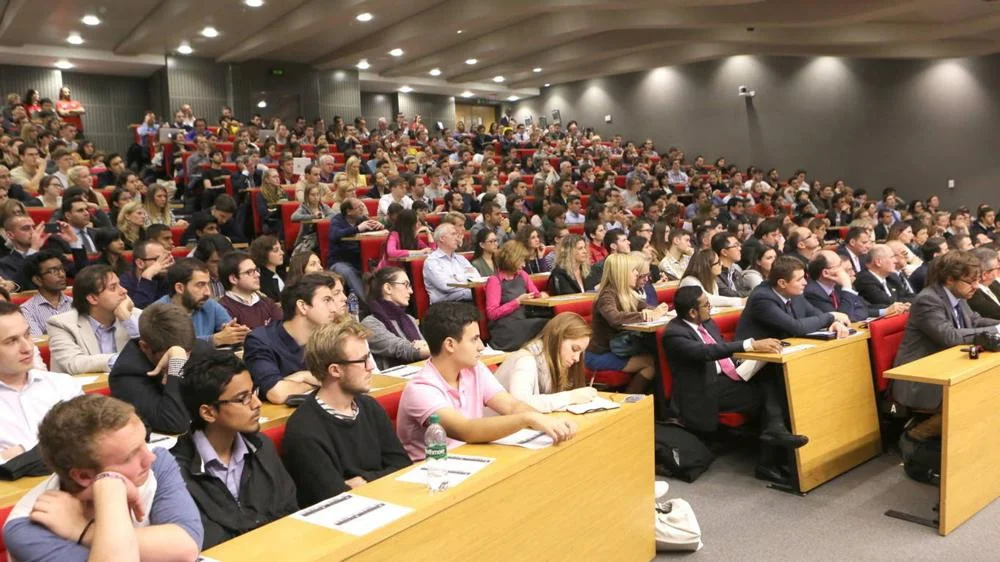

The data centre question: how does AI impact climate goals? I LSE Festival Skills

Speakers


Chair

As AI and cloud computing scale at pace, the data centres powering them are expanding just as rapidly, reshaping electricity markets, infrastructure investment and sustainability priorities.
For leaders, these shifts are no longer technical questions but strategic ones.
Recent headlines have highlighted rising electricity costs, delayed projects and increasing scrutiny of the environmental footprint of digital infrastructure. At the same time, technology companies argue that data centres drive innovation, jobs and long-term economic growth, creating complex trade-offs for organisations navigating digital transformation.
This Executive Education panel brings together expertise in AI, energy economics and sustainability policy to examine the leadership implications of this transition.
- How significant is the impact of data centres on energy systems and emissions?
- What trade-offs and synergies are emerging between digital expansion and climate goals?
- What governance, market and technological actions are needed?
Join us for a thought-provoking one-hour live panel exploring the intersection of AI, the economy and the future of sustainable growth.
Meet your speakers and chair
Jonathan Cardoso-Silva is an assistant professor in the LSE Data Science Institute where he teaches modern best practices for the collection, storage and manipulation of data for analytics and AI. Jon co-leads the GENIAL project, a study that looks into how the use of AI by undergraduate students impact, or interfere, with their learning experience at university.
Marion Dumas is Assistant Professorial Research Fellow at the Grantham Research Institute. Her research interests encompass green innovation, the institutional processes underpinning decarbonisation, and the interaction between reducing inequality and fighting climate change. Marion is an environmental economist and political economist, also trained as an environmental scientist, broadly interested in how to reform both economic policies and institutions to contend with planetary boundaries.
Sini Matikainen is Director of Economic and Fiscal Policy at the LSE Centre for Economic Transition Expertise (CETEx). Sini joined the Grantham Research Institute on Climate Change and the Environment as a Distinguished Policy Fellow in June 2024. She also previously worked at the Grantham Research Institute from June 2016 until September 2018 as a Policy Analyst.
More about this event
This event is part of the LSE Festival: How to save the planet running from Monday 15 to Saturday 20 June 2026. This year's Festival explores how existential threats including the climate crisis, conflict and AI are affecting all parts of the world, transforming the way and where we live, and how our societies function. With a series of events asking what can we be doing to save the Earth, its people and environment? Booking for all Festival events will open on Monday 18 May.
LSE Executive Education provides high quality courses in business and management, economics, finance and public policy designed to accelerate your career. As part of the London School of Economics, a world-class university and renowned for its excellence in leading research in the social sciences, our courses expertly connect the theory to the real-world global business context. Learn with world-class academics and practitioners, extend your professional network and gain a truly international perspective, right in the heart of London.
For any queries relating to this event please email events@lse.ac.uk.
Hashtag for this event: #LSEFestival
Many speakers at LSE events also write for LSE Blogs, which present research and critical commentary accessibly for a public audience. Follow LSE British Politics, the Business Review, LSE Impact, LSE European Politics and the LSE Review of Books to learn more about the debates our events series present.
If the event is live streamed, automated live captions will be available. Please note that this feature uses Automatic Speech Recognition (ASR) technology, or machine generated transcription and is not 100% accurate.
Photographs are regularly taken at LSE events both by LSE staff and members of the media and events are routinely filmed. Photographs from events taken by LSE staff are often used on LSE's social media accounts, with videos being made available on the LSE Player. If you have any concerns about this please contact the event organiser in advance of the event.
Please contact the Press Office if you would like to request a press seat or have a media query about this event, email LSE.Press.Events@lse.ac.uk. Please note that press seats are usually allocated at least 24 hours before each event.
We aim to make all LSE events available as a podcast subject to receiving permission from the speaker/s to do this, and subject to no technical problems with the recording of the event. Podcasts are normally available 1 week after the event. Podcasts and videos of past events can be found online.
Event updates and other information about what’s happening at LSE can be found on our Facebook page and for live photos from events and around campus, follow us on Instagram.
Livestreams and archive videos of past lectures are shared on our YouTube channel while event podcasts can be found on the LSE Player.
Attending our events in-person or online? Join the conversation using #LSEEvents.
If you are planning to attend this event and would like details on how to get here and what time to arrive, as well as on accessibility and special requirements, please refer to LSE Events FAQ. LSE aims to ensure that people have equal access to these public events, but please contact the events organiser as far as possible in advance if you have any access requirements so that arrangements, where possible, can be made. If the event is ticketed, please ensure you get in touch in advance of the ticket release date. Access Guides to all our venues can be viewed online.
LSE has now introduced wireless for guests and visitors in association with 'The Cloud', also in use at many other locations across the UK. If you are on campus visiting for the day or attending a conference or event, you can connect your device to wireless. See more information and create an account at Join the Cloud.
Visitors from other participating institutions are encouraged to use eduroam. If you are having trouble connecting to eduroam, please contact your home institution for assistance.
The Cloud is only intended for guest and visitor access to wifi. Existing LSE staff and students are encouraged to use eduroam instead.
From time to time there are changes to event details so we strongly recommend that if you plan to attend this event you check back on this listing on the day of the event.
LSE holds a wide range of events, covering many of the most controversial issues of the day, and speakers at our events may express views that cause offence. The views expressed by speakers at LSE events do not reflect the position or views of the London School of Economics and Political Science.
Join the LSE Events mailing list